Big, bright and beady eyes looking right through you, resting her gaze on meeting the soul, Durga, the beautiful supreme goddess, asks you to dare. The three-eyed deity, in a blast of red and yellow, and a thunderous jubilant tune, asks you to be brave.
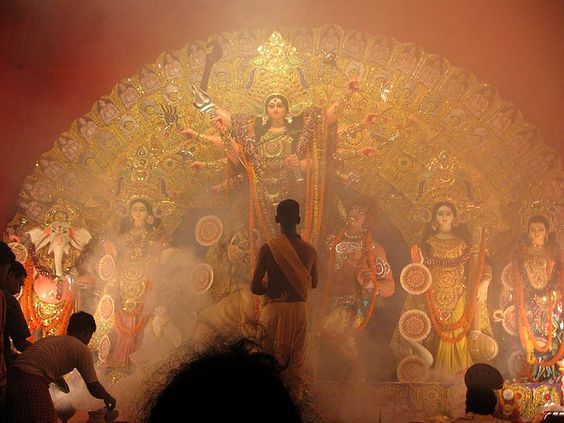
Every mortal being bows and offers herself and dances madly, in a daze, circling in the incense fog, urging goddess Durga to bless and enlighten her devotees.
Durga Puja, a Hindu festival, celebrates every shade and story of life, fostering passion, guiding the troubled, reminding the beaten soul to rise once again.
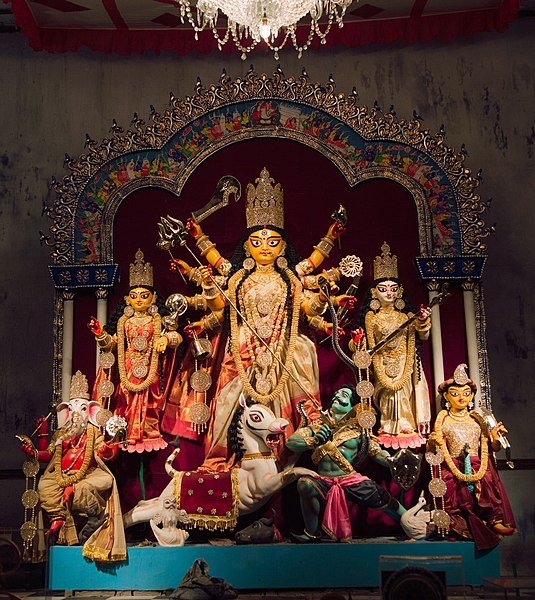
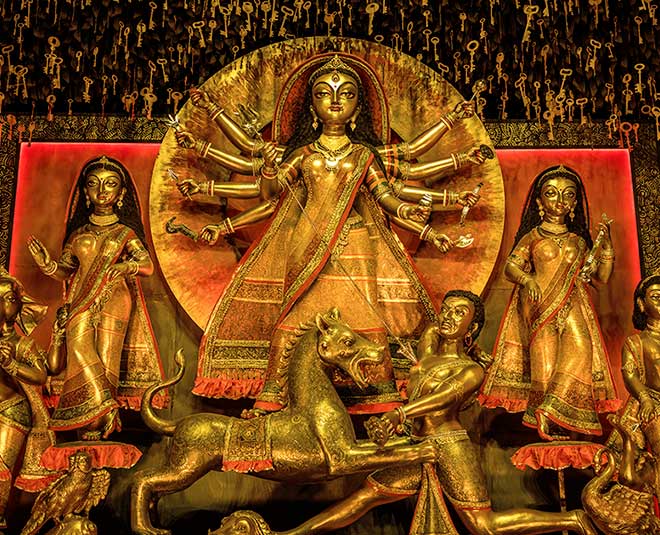
Many old Hindu scriptures have passed the story of the fierce warrior goddess Durga, with a royal lion as her vahana (vehicle) by her side, killing Mahishasura, a shape-shifting deceitful demon who had caused havoc on the earth.
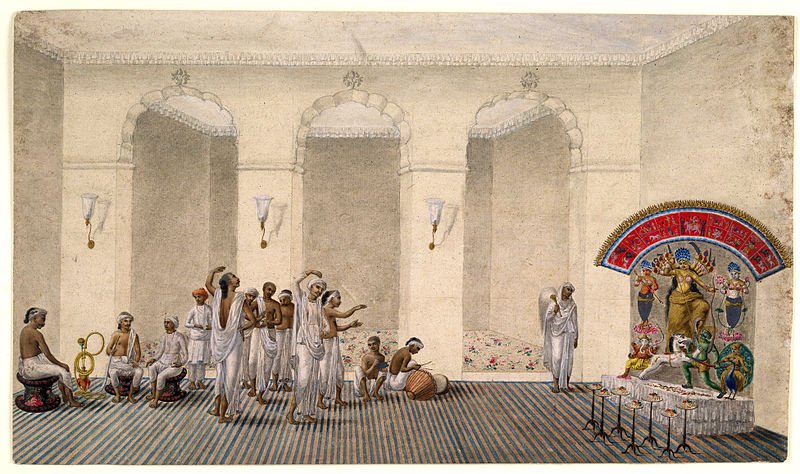
Grand clay idols of Durga – her ten hands carrying various weapons, slaying the terrible Mahishasura with a trishul (trident) who lies on her feet – are built and placed under beautifully decorated marquees.
Different avatars of goddess Durga are worshipped for ten days – for she is the personification of power, wealth, emotions, intellect, nourishment, beauty, desires, faith, righteousness, forgiveness and peace – and on the last day, the idol is taken to a local river body for visarjan (immersion of the idol). She then returns to her husband, Lord Shiva, who resides in the Kailash Peak in the Himalayas.
Slayer, nurturer, the feminine soul of the Universe, Durga is the life force, the will to survive, the spirit to fight back, the joy of being alive and the celebratory dance of the Creation.
Exceptionally popular in the eastern parts of India – mainly in West Bengal, Odisha, Assam, Tripura, Bihar – these states lit up magnificently, colouring every nook and corner alive. In our corona-hit world, with provisions in place, India welcomed goddess Durga once again.
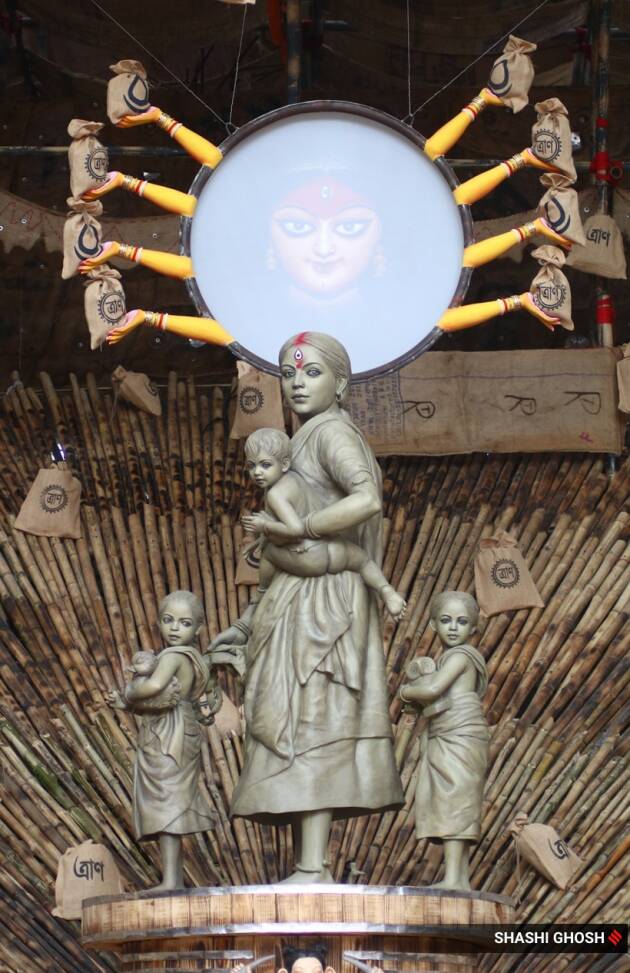
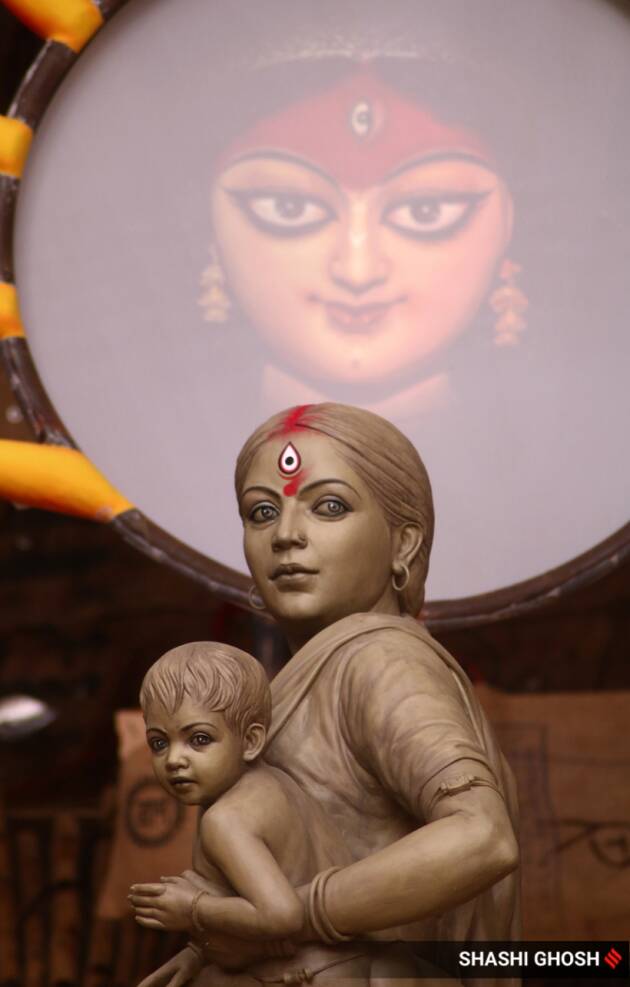
More of a socio-cultural festival than just a religious one, the artists always come up with unique themes and styles when creating the idol. This year it was the idol depicting goddess Durga as a migrant mother carrying a young one in her arms, with two little girls walking by her side that won everyone’s heart.
The idol, created by Kolkata based artist Pallab Bhaumik, highlighted the plight of the migrant workers who were forced to walk thousands of kilometres to reach home from cities during the lockdown.
Devoid of vibrant colours, the ‘migrant’ Durga represents the hardships of a section of society who are usually forgotten after they make headlines, but such brilliant is this work that it appears to be more alive and grand than anything real.
Yet again it is the victorious, omniscient eyes of the goddess that say the most. She smiles for she is the witness of the on-going life drama.
The depiction of goddess Durga as a ‘migrant mother’ then could not be more apt because a labourer is also closest to the raw life drama which we all on the contrary love to refine before consuming.
And it must be a fierce conviction to win that fuelled the hearts of the migrant mothers and their faith in life that encouraged them to complete the tiring journeys. Because if not honest hope, what could be behind their unswerving patience and perseverance?
They will win in their journeys, everyone who creates something will win, for every action is an oblation, it is life and the wondrous Durga, its symbol.
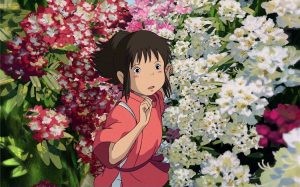
The crayon doodles, chalk scrabbled floor and walls, silly games of following the clouds, the butterflies and the wind, toying with fairy tale thoughts, dancing in the rain, eating snowflakes, and living in the inverted fable world… all this and every other childhood memory comes alive in Miyazaki’s masterpiece anime, My Neighbour Totoro.
Those whispers, secrets, and myths that we all have heard, in which the happy spirits rise to guide the one who dares and bridges her to the magic around, which world-wide have different versions, which are absurd yet possible, forms the core of this motley work.
Two little girls, Satsuki and Mei, move to the countryside in Japan along with their father, Tatsuo Kusakabe. Mama Yasuko Kusakabe is not well and so she is admitted to the hospital which is closer to this countryside house.
“But she will recover and come back home soon”, says Dady Tatsuo, “when, will she be back by tomorrow?” asks four years old Mei, “there she goes again with tomorrow”, says Satsuki and they all laugh.
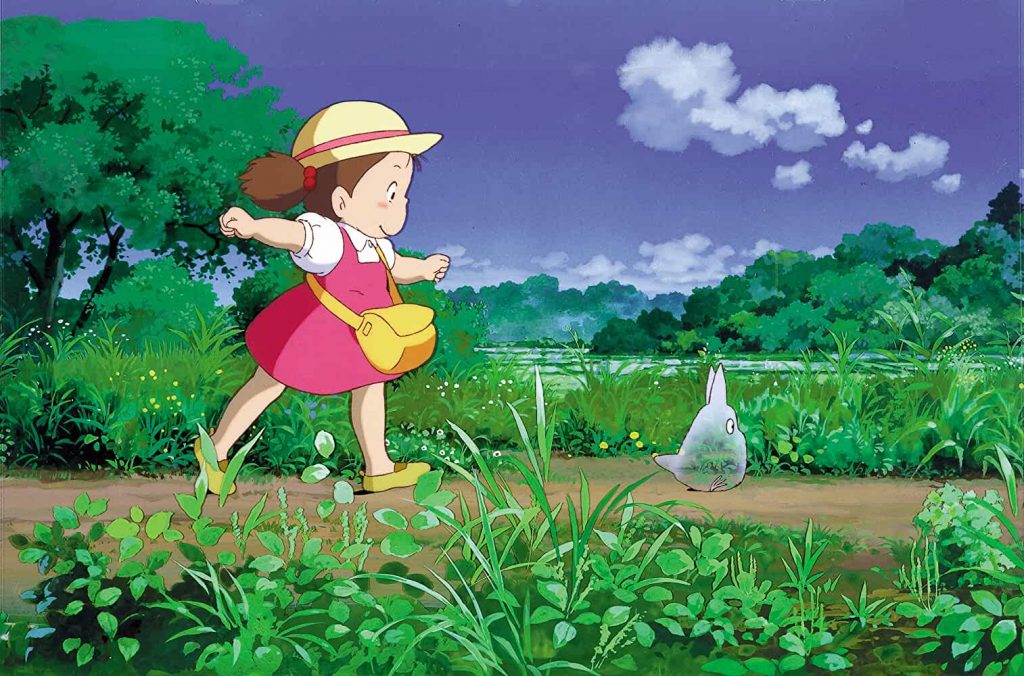
Mei is courageous, she even catches a soot gremlin to show it to Satsuki but it ends up only in making her hands black.
As Satsuki goes to school, little Mei plays around the house alone; carrying her packed lunchbox, she explores the place with a clear and light mind, giggling, following two small bunny-like Totoros to the colossal camphor tree and ultimately meeting the big Totoro there.
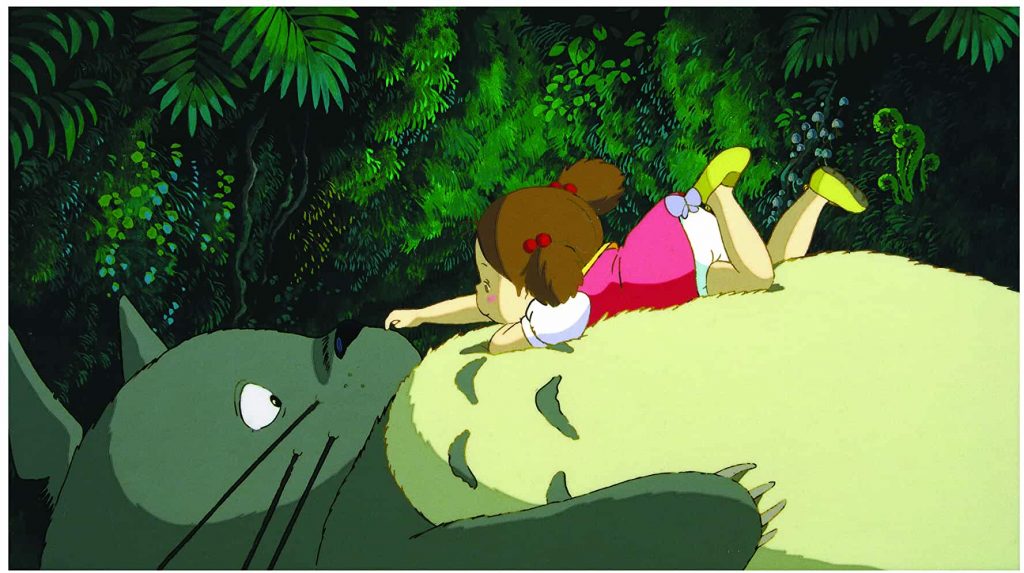
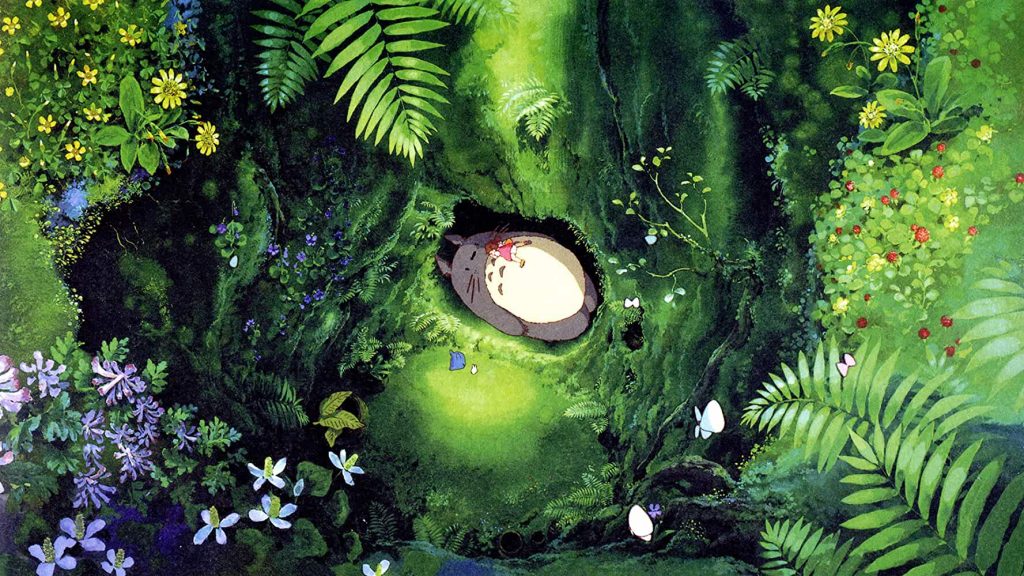
Totoro is a furry giant animal, with whiskers, big eyes, and a bigger smile. He lives in the huge camphor tree in the forest neighbouring Satsuki and Mei’s house.
While the little Totoros collect acorns, the giant one helps it to grow; together they play the ocarina like music instruments at night, sitting high on a branch, guarding the forest, and all the beings living in it.
Totoro in some ways is like a Kami – a spirit in Japanese religion of Shinto – which can be anything, from forces of nature to spirits of an honoured dead person like a King. Possessing both positive and negative qualities, these spirits are to be worshipped and thanked for their blessings and support.
Kami cannot be seen by everyone, but the one whom it chooses to reveal itself to. Being aware of the powers of Kami means being aware of the powers of nature, respecting it, and also showing gratitude for what it grants.
After Mei’s first encounter with Totoro, their father takes both the girls to a nearby Shinto shrine to thank the Kami for looking after Mei and asking it to continue looking after all of them. The shrine is next to the giant camphor tree which Mei happily recognises, but doesn’t find the way to Totoro’s den as she did the last time.
Two Little sisters, Mei and Satsuki
As children look at the world with the hope to see a miracle every second and love as if it is all theirs, it is only Mei and Satsuki who get to meet Totoro. It all starts with Mei, she sees the soot gremlins twice and then the three Totoros. Little Mei’s world, it seems, is still more magical than Satsuki.
When Mei tells Satsuki about Totoro, she tells her father that she too wants to meet Totoro, but on one occasion when Mei accompanies her to the school and draws Totoro’s image on a sheet, Satsuki feels embarrassed amongst her giggling friends, typical of a growing-up kid.
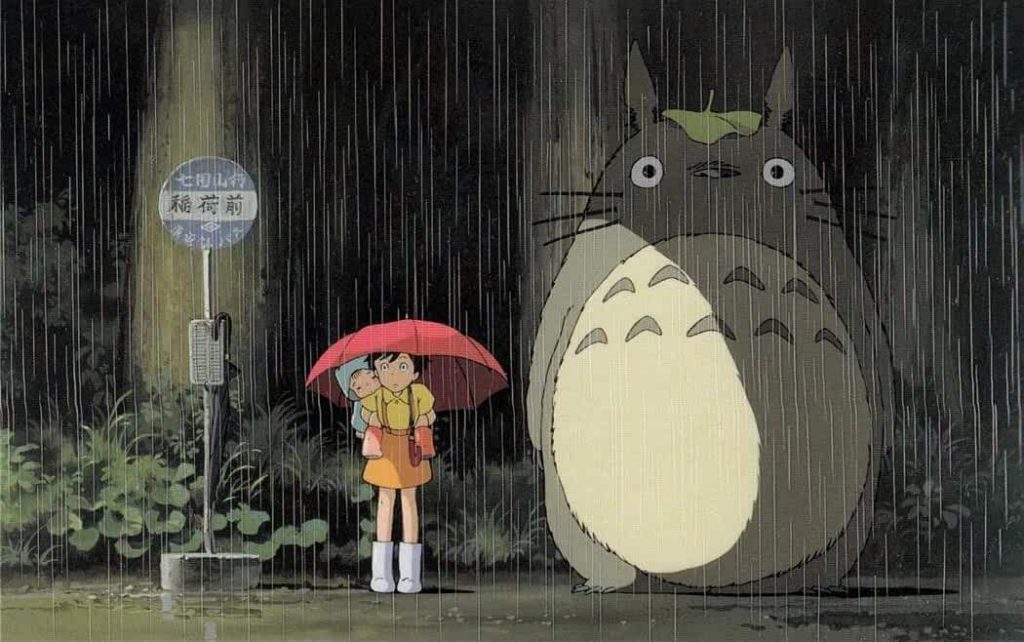
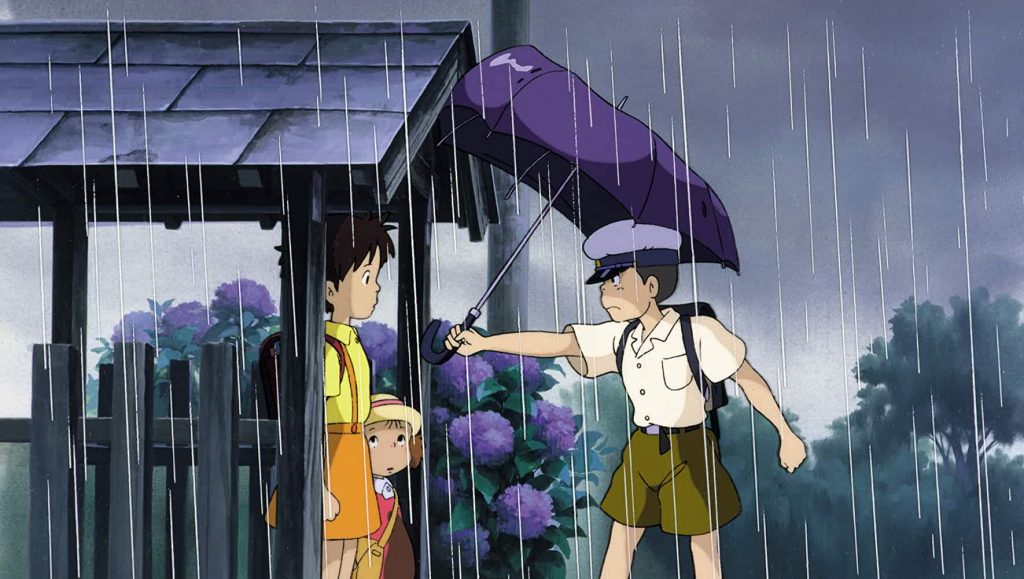
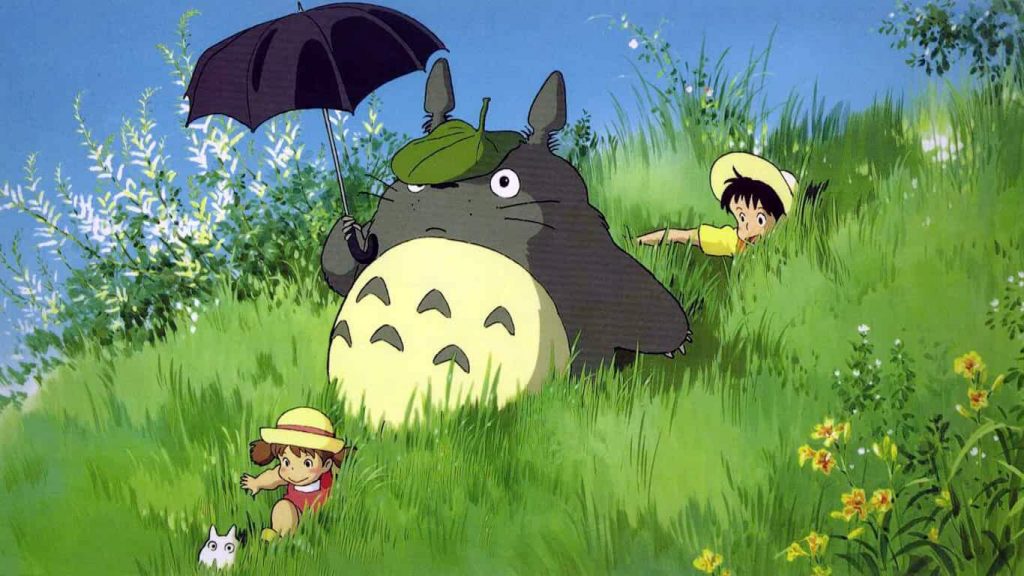
On a rainy late evening, Satsuki and Mei go to the bus stop to receive their father who had not taken an umbrella, there Totoro joins them. Satsuki is elated to see him but stays still. She then gives him the spare umbrella and shows him how to use it.
With a sleepy Mei on her back, Satsuki is surprised to know that Totoro is standing next to them. [Source – IMDB]
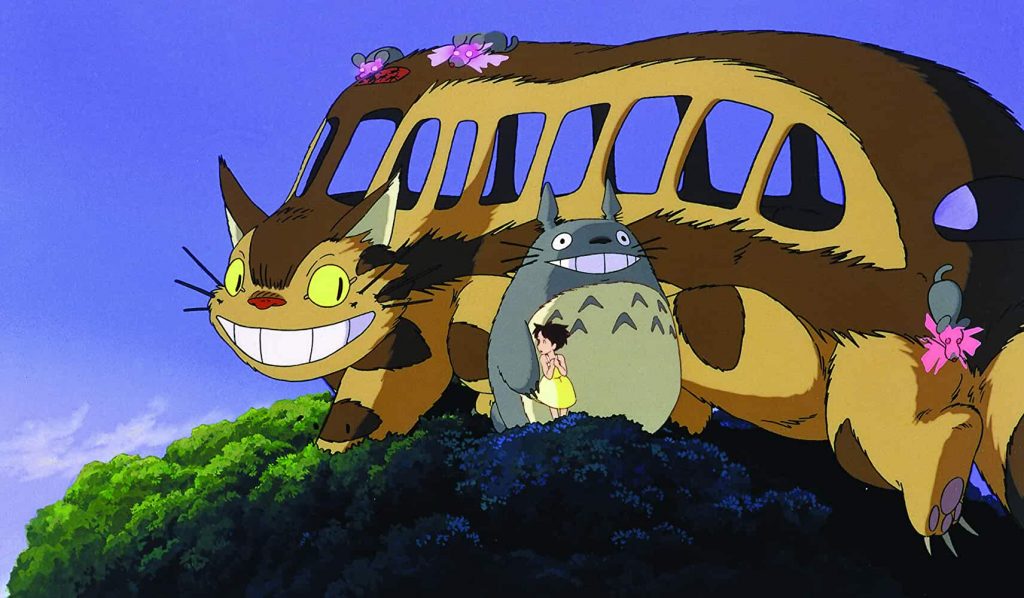
Raindrops falling on the umbrella from the branches above give Totoro the shivers which he enjoys; he jumps up and down and a heavy splash of raindrops fall on them and Totoro beams magnificently. The magic only multiplies then as a Cat Bus arrives there, Totoro climbs on it and leaves.
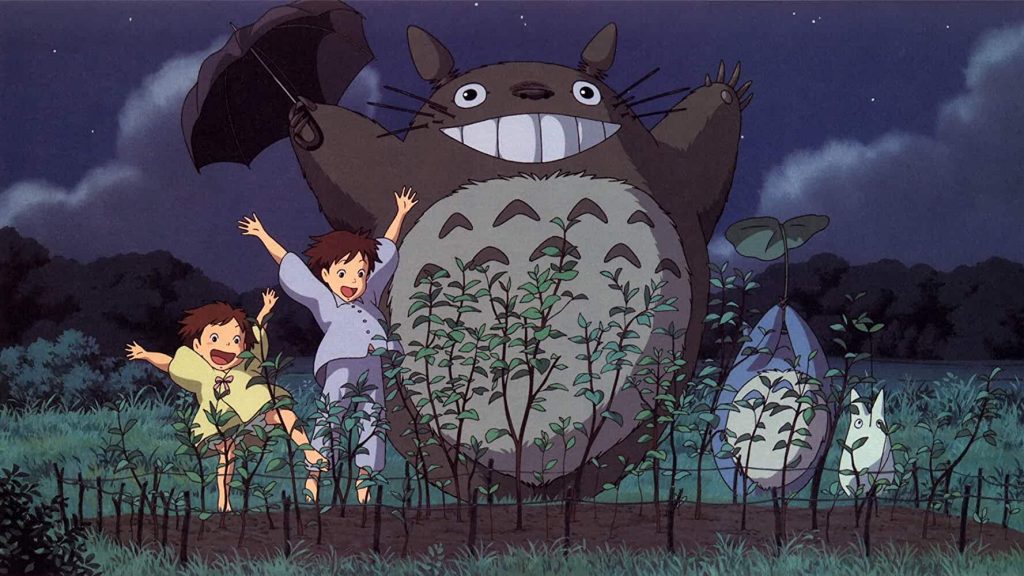
That same night, Totoro comes with his two little friends to silently perform a ritual in the yard where Mei and Satsuki have planted the acorns; the girls wake up and join the Totoros.
Their prayers are heard and the plants sprout magically to form a giant tree, just like the camphor tree, right before their eyes. Totoro then takes all of them to the top of the tree to sit on the branch and play the ocarina.
Next morning the girls find that the tree has vanished, but the seeds have indeed sprung; both of them then repeat the ritual ecstatically shouting “I thought it was a dream, but I was wrong.”
Mei repeats whatever Satsuki says, she gets excited when Satsuki is, dances along and follows her everywhere trying to match her speed, happy to be around her elder sister. But when she gets the news that their mother will not be returning soon as planned, she gets angry.
Both the sisters argue and Mei leaves for the hospital all by herself to give her mother an ear of corn that Granny had said would make her perfectly healthy.
In the evening when Satsuki realises that Mei is not at home, she, Granny, Kanta, and his family all start looking for her. Sure that Mei must have left for the hospital Satsuki takes to the road, running all the way and calling out Mei’s name, but she does not find her there.
Satsuki then goes to meet Totoro, praying to the camphor tree to allow her to meet him; she tells Totoro that Mei is missing and she cannot find her on her own.
Totoro smiles and immediately calls the Cat Bus, the destination indicator blinks Mei’s name, an awed Satsuki climbs on the bus and on its many legs the Cat Bus leaps from one farm to another, tiptoeing from one utility pole to another, finally stopping at the roadside where Mei was sitting and crying.
The Cat Bus then takes both of them to the hospital; there sitting on a treetop the little girls feel relieved to see their parents together and happy.
Both Mei and Satsuki come across as two real-life girls – their mannerism (in the first scene, sitting together in the small lorry, sharing candies), their reactions (when Mei sees the soot gremlins she freezes, holding her frock tightly), their silly arguments (when Satsuki teases Mei that she is afraid at night and that is why she cannot sleep alone), when happy (after meeting the Totoro for the first time Satsuki is overjoyed, she asks his father to hold both of them and they jump into his arms) when sad (both are disappointed to know that their mother will not be coming home soon), all these actions in totality make them appear like two actual kids.
Mama and Daddy Kusakabe
Tatsuo Kusakabe with his dear daughters.[Source – IMDB]
Both Tatsuo and Yasuko Kusakabe are loving, supporting, and open-minded accepting parents. They know that it is a tough time for the girls as they have been staying away from their mother and have shifted to a village for her sake, thus, they do not discourage them from any vibrant idea of theirs.
Whenever the girls talk about soot gremlins, Totoro and the Cat Bus, they both show excitement, honestly interested in their tales.
Tatsuo always listens to them and joins them in their fun activities. Yasuko misses both of them and worries for Satsuki as she knows she takes more responsibility than others do in her age.
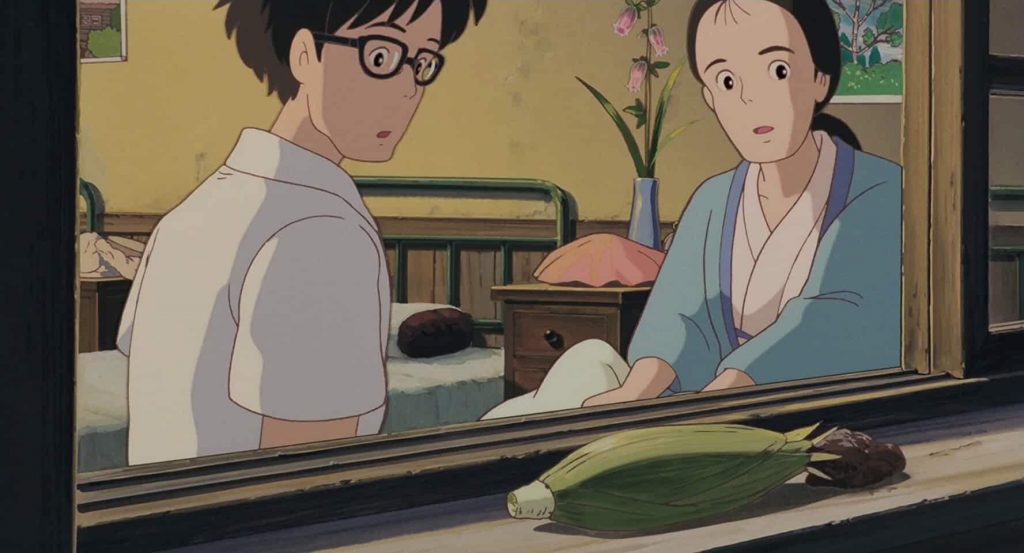
When Yasuko tells her husband that she thought she saw Mei and Satsuki sitting on the tree, smiling, Tatsuo, familiar with the Totoro story by then, picks up the corn with the inscription ‘for mama’ on it lying on the window-sill and says that they must have been here.
Granny and Kanta
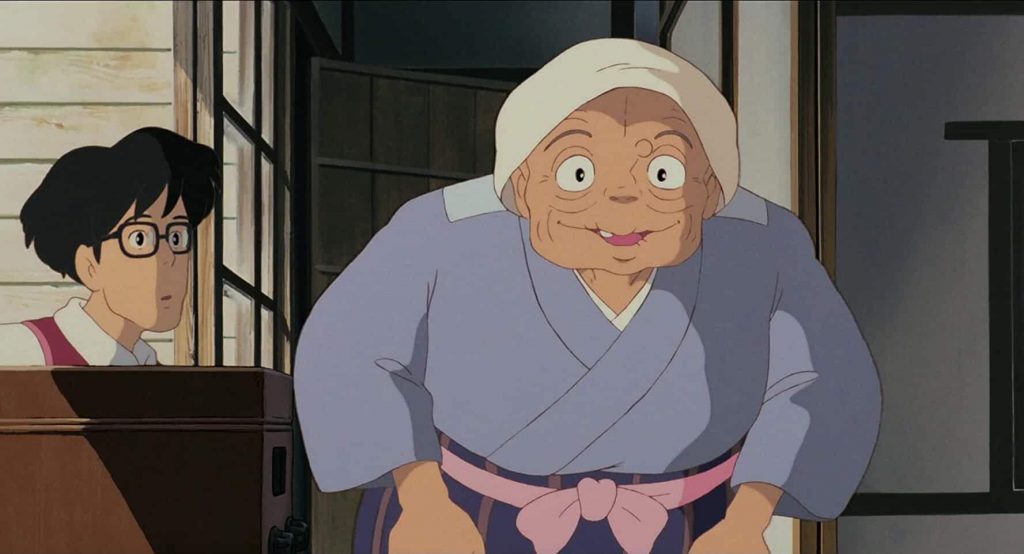
Granny gets happy on knowing that the girls saw the soot gremlins. [Source – IMDB]
Mei and Satsuki’s neighbours, other than the Totoros, are Kanta’s family. While Granny is caring and full of warmth, Kanta hesitates even to talk to Satsuki.
On two occasions – delivering them lunch on their first day and giving his umbrella when it is pouring heavily – he simply hands over Satsuki the lunch box and the umbrella, grunting and without uttering a word.
As time passes by, they become like family to the Kusakabes; when Mei leaves for the hospital on her own, Granny gathers the whole village to look for Mei and Kanta goes to the hospital on a bicycle to check the way for her.
Granny hugs Mei when she returns with Satsuki. The four of them walk back home together as the cheerful closing track plays in the background.
The Charm of the Era
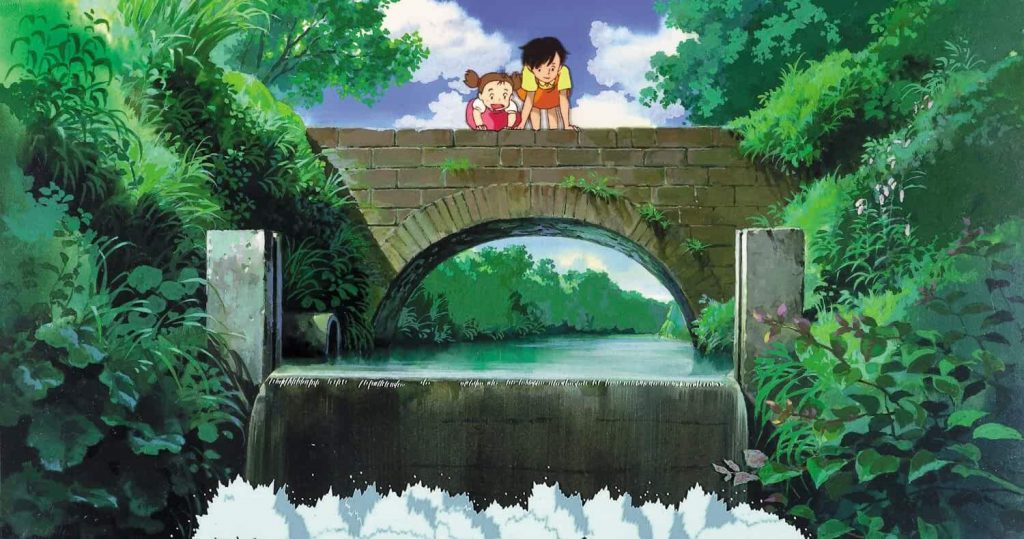
The film is set in the late 1950s Japan when life was simpler and the pace was kinder. On arriving at their new home, Mei and Satsuki get excited about seeing every new thing – the timeworn house (‘it could be haunted’, says Satsuki), the collapsing patio, the soot gremlins, the water pump, the small bridge that takes them to their house, the stream and of course, the giant camphor tree.
The melodious stream near Mei and Satsuki’s house.[Source – IMDB]
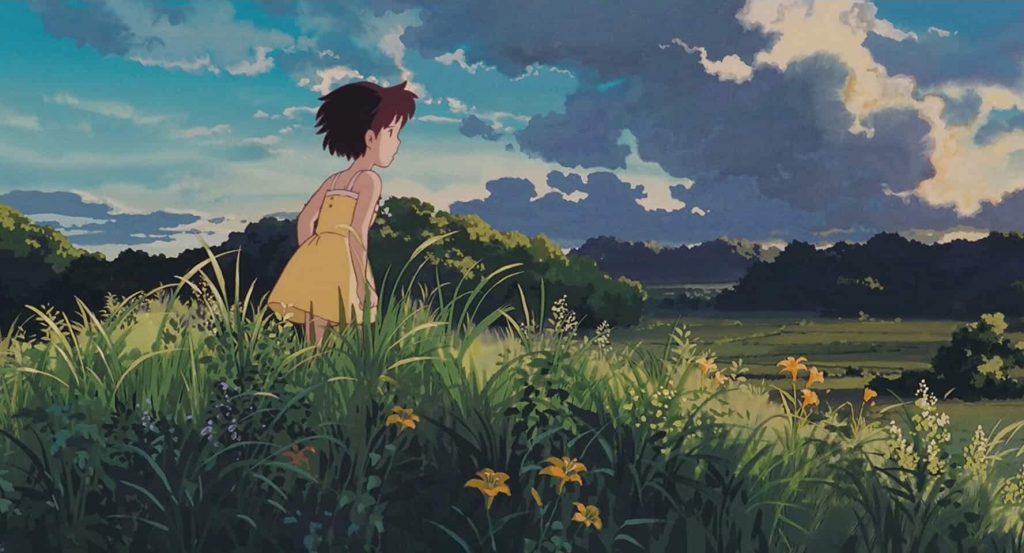
Raindrops falling in the rice paddies, the sudden downpour, the drizzles dripping from tree leaves, the puddles, all these scenes are beautifully captured in the film.
Totoro is overwhelmed with joy when raindrops fall on his umbrella which he is holding for the first time, this brings back memories of childhood.
Such simple happy actions become a habit unknowingly; whether it is raindrops falling on the umbrella for some or say, crushing the dry autumn leaves for others, it always gives us a sudden boost of cheerful energy.
Imagery & Music
The wonderful work done by Hayao Miyazaki and Kazuo Oga, the art director, makes the anime world truly alive.
The cushiony clouds, the rapturous scenery, the quiet stream, and every rock and leaf complement each other, aiding in and not shying from embracing the modernity.
When Mei, Satsuki, and their father visit the shrine for the first time, the ambience and even the cool moistness of the hidden place catches us and we are struck by the glory of the huge camphor tree.
And what gives the imagery this soothing life-like quality is the music in the film. The excellent soundtrack, composed by Joe Hisaishi, gives the film a mythical tone as if opening a door to a magical dream world while keeping it firmly grounded in its times.
Especially the score titled “The Huge Tree in the Tsukamori Forest”, which plays whenever we see the camphor tree in its glory, has become analogous to the spirit of the film. It is an uplifting majestic tune that marks the listener’s entry into a secret world.
The Credits Roll
The story goes on as the credits roll at the end. We see Mei and Satsuki spending time with their mother – taking baths together, reading storybooks – as they had been hoping to for a long time.
The girls continue living in the same region, making new friends, bonding with the old ones, making a snow Totoro in winters, and enjoying their childhood days.
Totoro’s home is one of the best places in the world.[Source – IMDB]
My Neighbour Totoro is considered to be, both by the critics and the masses, one of the best Anime fantasy films of all time. Totoro has become a cultural icon and the film has a worldwide cult following.
Apart from being the company logo and appearing in Studio Ghibli’s other productions, Totoro has also appeared in Disney Pixar’s Toy Story 3.
Such is the love for the film that an asteroid discovered in 1994 and a velvet worm species discovered in Vietnam in 2013 were named after Totoro.
A smiley giant, guardian of the forest, Totoro does not have a dialogue in the film; apart from speaking his name out loud to Mei, he only beams, roars, flies, plays the ocarina, eats and sleeps.
His simplicity makes him a more welcomed, accepted, and believable character by one and all. Mei and Satsuki’s neighbour, the guardian of the forest, Totoro is a true friend, yours as well as mine.
Written and Directed by – Hayao Miyazaki; Production company – Studio Ghibli; Music by – Joe Hisaishi; Cinematography by – Hisao Shirai; Edited by – Takeshi Seyama
Here is a children’s film made for the world we should live in, rather than the one we occupy. A film with no villains. No fight scenes. No evil adults. No fighting between the two kids. No scary monsters. No darkness before the dawn. A world that is benign. A world where if you meet a strange towering creature in the forest, you curl up on its tummy and have a nap.
Roger Ebert, the film critic. Read his review of My Neighbour Totorohere.
Love is pure truth, a divine experience, a way to live more and surpass even death.
It is a sublime fantasy that is real and better than the material world. Love is life’s paradox.
This is the idea that John Donne is expressing in the poem The Canonization. It is a reply as well as a declaration that the poet makes to the world- a world that treats lovers harshly.
He scorns the worldly, he questions the inquisitive, he proves the myths true, he places his love high and announces it as canonized.
The sudden change in his tone doesn’t bother if one recognises the powerful and apt imagery he has used in the poem.
The very first line ‘For God’s sake, hold your tongue, and let me love’ hits hard, but certainly in a good manner. In fact, it catches the interest of the reader at once.
The poem is like a necklace, beaded with beautiful and grand images like –
‘What merchant’s ships have my sighs drowned?’
‘And we in us find the eagle and the dove’
‘The phoenix riddle hath more wit/ By us; we two being one, are it’
‘As well a well-wrought urn becomes/ The greatest ashes, as half-acre tombs/ And by these hymns, all shall approve /Us canonized for Love.’
‘Countries, towns, courts: beg from above/ A pattern of your love!’
‘And if unfit for tombs and hearse/ Our legend be, it will be fit for verse’(Stanza 4) Image by Prawny from Pixabay
These are not empty expressions as every word in the poem is linked with the central theme – love.
If we randomly pick one word from each stanza, it will still be related to the poem.
For example, ‘improve’ (stanza 1) – one who is in love grows as an individual and improves by learning to be selfless; ‘remove’ (stanza 2) – when in love you cannot dwell on hatred, and so the negativity is removed to make space for hope; ‘Mysterious’ (stanza 3) – love is an easy mystery; ‘legend’ (stanza 4) – we all remember love stories as legends, sadly these are mostly incomplete ones; ‘mirrors’ (stanza 5) – love is as reflective as a mirror.
Love is closely related to asceticism in the poem, which is one of the conceits (an ingenious or fanciful comparison or metaphor) used by the poet.
He proves it with great subtlety that the lovers need nothing from the world; they complete each other and hence, know inner peace.
The poet says that the lovers rise to such a level that they become one and enter a divine world, thus leaving the material world behind. They dwell in each other’s simple presence.
In the last stanza, after canonizing himself and his lover, the poet says that his pious canonized love would be celebrated in the world by one and all.
He ends by completing the canonization of his love, placing it on a high pedestal, and separating it from the worldly pleasures.
‘And if no piece of chronicle we prove/ We’ll build in sonnets pretty rooms’ (Stanza 4). Image by Gordon Johnson from Pixabay
Canonization, the title of the poem, seems to be a question and an answer at the same time. As one wonders about how love can be canonized and attain sainthood, the divine nature of the poet’s love presented in the poem gradually justifies the same.
The poet shows that his love is spiritual not merely physical, that his union with his lover has made them blissful and assures that it will radiate amongst the others.
His canonized love is not against the world rather it is for the world, acting as an inspiration. His love is not harming anyone but is a liberating force, just like a saint’s.
John Donne’s The Canonization is a smart poem with brilliant use of wit, the quintessential quality of a metaphysical poet.
He celebrates love in a simple, forthright tone that makes this 17th-century poem wondrously alive in today’s world as well.
‘Alas, alas, who’s injured by my love?’ (Stanza 2)
‘Call her one, me another fly/ We’re tapers too, and at our own cost die’ (Stanza 3)
There is a message hidden in this poem and the title ‘canonization’ is the key to unveil it. Donne wants to share that every one of us, whatever be our rank in the society that runs according to the man-made rules, has the ability to reach the divine state.
Sainthood according to him is not reserved for some but is achievable by all.
What we need is to rise above the material world, to resurrect ourselves through true love. Here the beloved represents anything- a person, God, nature, the entire world.
Love is the best, the all-embracing way to reach the sublime state as it is love that makes a person truly selfless and compassionate.
Even today if someone pursues this path, they will know that they are canonized, for they are in love.
Love is to be selfless and compassionate. Image by Nika Akin from Pixabay
Sound is a sensation and a stimulus; reflected, refracted, and humbly attenuated by its medium, the sound wave propagates. Only the frequencies between 20 Hz and 20KHz comes in the hearing range of us humans.
Voices, calls, laughs, and whispers fill this range of ours, from morning to evening. We consider, approve, discard, ignore, and absorb it as and when we understand the hidden meaning.
*
Colourful message carrying sweet sound waves. Image by Gerd Altmann from Pixabay
The hidden meaning…? Yes, the message that every sound wave carries is the hidden meaning, it shapes this very understanding of ours.
And what an exuberating elusive message a melody is, a wonderful wordless story that nevertheless is discernible, more than that in fact, as it touches and soothes our heart and soul.
Bansuri, a bamboo flute, taps a tune, using wind as the source and wind as the medium, carrying the message as far as possible, resonating beyond the visible, accepting all, conquering all.
Two and a half ample octaves and the bansuri deciphers happily the message using the Sargam (solfege); a subtle and soulful tune reads it to us.
Lord Krishna, the Jamun coloured Hindu deity with a peacock-feathered crown, is always depicted with a bansuri in his hands. Various stories tell us how Krishna, the charmer, used to mesmerise the listeners, stopping the time as if to unveil the beauty of the cosmic play.
*
The jamun coloured Krishna Flutist. [Source – 4art.com]
*
The leading character in several ancient Hindu religious, mythological and philosophical texts, Krishna plays his bansuri to win Radha’s heart, to celebrate the victory over evil, to turn impossible into possible and routinely for shepherding cows (he played a melodious tune on the bansuri and the herd of cows themselves returned to him).
*
Lord Krishna playing flute and shepherding cows along with his elder brother Balrama and friends. [Source – indiafacts]
Natya Shastra as well as the other Vedic texts associated art and music with the Supreme, calling it the spiritual means to rise above, concentrate on and connect to one’s consciousness, witness it and attain Moksha (enlightenment, release).
Why would one make a creative artist’s job tougher by leaving the great responsibility of enlightening the receiver on her? Let art be for art’s sake.
Right! But apart from just being true, pure art, what if say a tune played on a bansuri leaves a listener illumined, will this not add to the beauty of the melody? It absolutely will.
If it deciphers the message for the listener, showing her more than what is on the surface, by additionally doing absolutely nothing, then surely the message is intrinsic to the composition.
Wonderfully it all also depends on perception. Synesthesia is a condition in which one sense (for example, hearing) is simultaneously perceived as if by one or more additional senses, such as sight, thus, in such cases sound involuntarily evokes an experience of colour, shape, and movement.
Read what the first recorded case of synesthesia was about –
“The earliest recorded case of synesthesia is attributed to the Oxford University academic and philosopher John Locke, who, in 1690, made a report about a blind man who said he experienced the colour scarlet when he heard the sound of a trumpet.”
And so everyone perceives it (the message, meaning, and life) differently, one feels, sees, and hears differently.
Vibrating air… that is what sound actually is; a sound wave cannot travel in the vacuum of space. Sound, an exclusive phenomenon on earth, then is indeed truly special.
And maybe that is why music is therapeutic in nature. It heals a troubled heart, it enlivens the mood, it calms a tired mind and often transcends the listener to a blissful state.
Instrumental musical compositions evoke for every individual a ‘thought’ within, yet to be uttered. The message it then delivers is always a favourable one, a high spirited one.
And a bamboo flute always keeps the message sweet, earthy and peaceful.
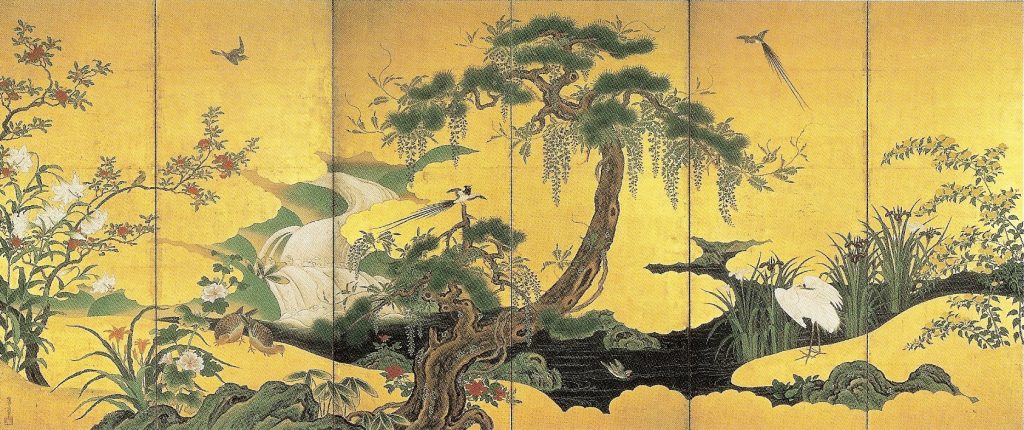
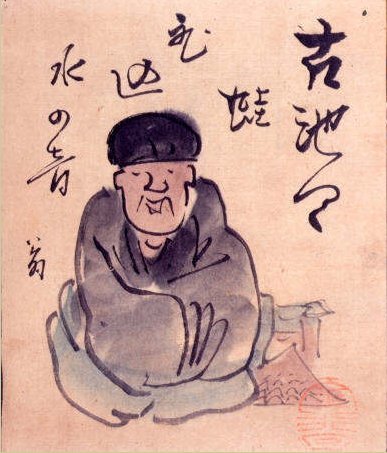
Let us go back in time, a few centuries back, in the mid-17th century to be precise, to meet Matsuo Basho and embark on a journey to the interiors of Japan.
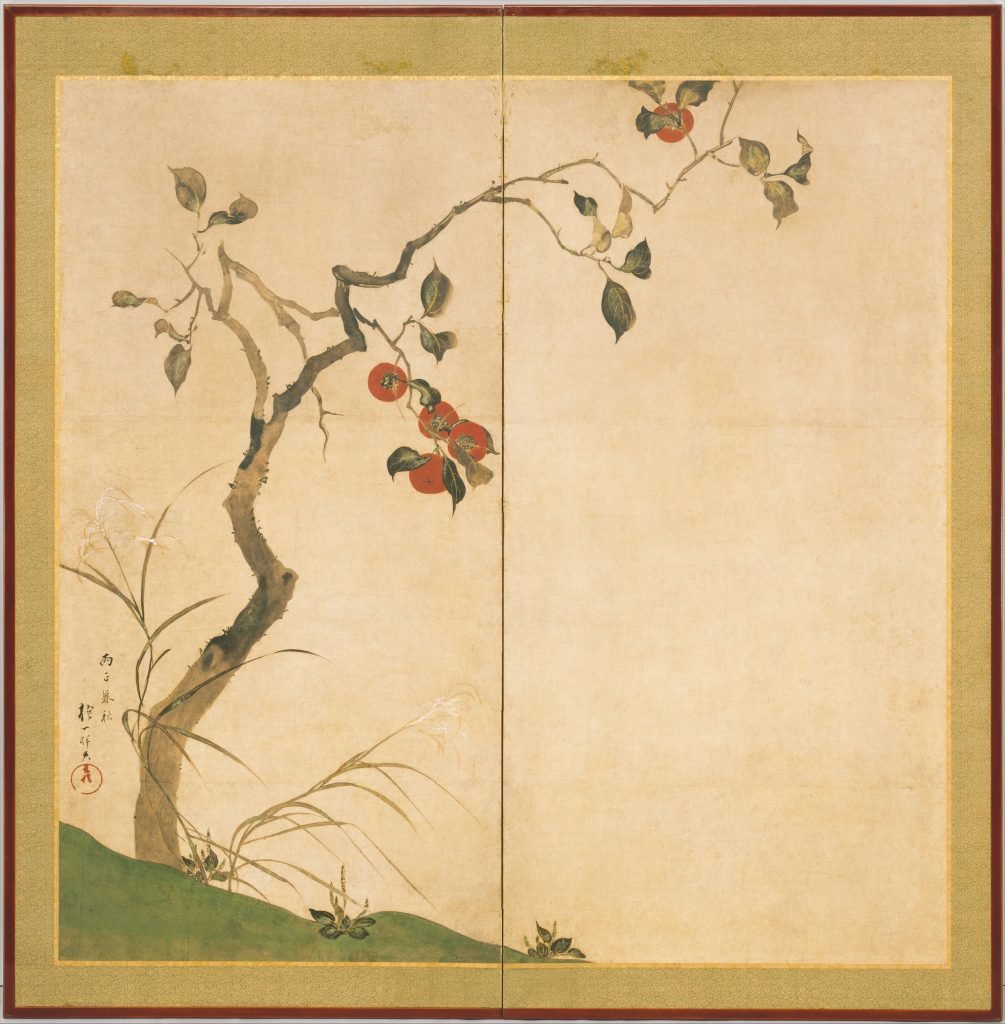
Folding screen with Birds and Flowers of Spring and Summer by Kano Eino, a 17th Century Edo Period Japanese painter. [Source – Wikipedia]
A fabulous poet, known for his Haikus, Basho wanders giving voice to nature, the moon, the earth, the seasons, the rain, the monkey, the dragonfly, the cicada, and everything that he observes.
He paints his dreams in the air; the flora breathes that air and blooms like a dream.
Let us go and learn this art from the master himself.
Falling sick on a journey
My dream goes wandering
Over a field of dried grass.
Basho has fallen sick, he is old now, this haiku is usually considered as his farewell poem, but our journey has just started, we need to travel back a few more years.
He is funny, oh, but let us keep going back in time for we need to learn the art of painting dreams in the air, remember. Stay focused!
The rough sea
Stretching out towards Sado
The Milky Way.
Sado is a city in Japan’s Sado Island and Basho travels there to witness the vast sea and the endless sky.
Look, at night the sea becomes a mirror for our galaxy.
Seasons come and go, each one is beautifully recorded in Japanese poetry; Kigo, the representation of and the reference to the seasons is still a part of Japanese culture and literature.
Different seasons, different Bashos –
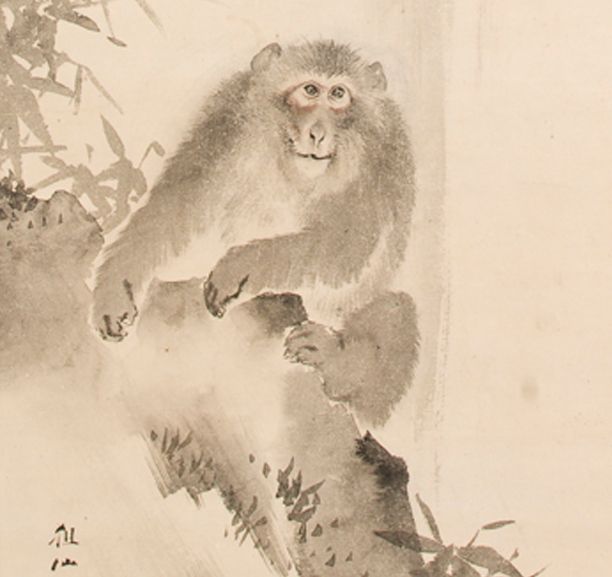
First winter rain-
Even the monkey
Seems to want a raincoat.
Monkey and Waterfall by Mori Sosen, a Japanese Edo Period painter, 1747 – 1821), Honolulu Museum of Art. [Source – bing.com]
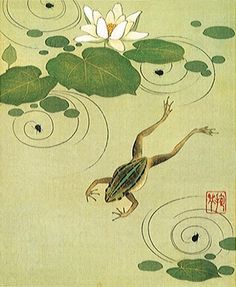
I heard it too, the splash of water, you all must have heard it as well, somewhere, sometime… here, right now the frog’s jump turned the clock back, ending the journey, bringing me to the present.
That ancient pond of time glimmered with stories abound and I was in one, the frog living its routine life made me surrender to the present moment and splash, I returned back.
Basho’s work, what a wonderful portal to the enchanted dream that can be perceived anytime, by anyone…
I started blogging back in the year 2011 following my brother’s lead, unaware of the world of bloggers, without any plan of action, happy simply to write one, happy to share my stories on Home Chimes.
This is what I wrote in my introduction earlier-
“I dreamed of Home Chimes a long time back with my eyes open. Since then, I am on a journey to understand that dream.”
It was indeed like a dream because I do not remember why I came up with this particular name. I remember that I wanted it to do something with the word ‘chimes’, but that was it.
After I selected the name and started blogging, I found out that there used to be a magazine in the late 19th century in London that was also named Home Chimes. And that it went out of publication around the year 1894. You can read about this magazine here.
I was very thrilled to know that Jerome K Jerome was amongst the many writers who got their work published in this magazine. Such a wonderful thing it is, I thought. But then this new information made me wonder if I should change the name of my blog to be truly authentic.
I did not change it. The happy coincidence forced me to keep exploring the hidden meaning behind Home Chimes and to keep writing about the stories I became a part of.
One fine day a simmering thought spoke to me, the devotion with which I write these blog entries and the joy that it gives me, it said, is immense, and I realised then that the blog holds a very special place in my life. Gleefully, I stepped forward. Neither a hobby nor a medium, my blog should be simply what I do.
I am a writer, I love the art of storytelling. And like lightening it hit me that it is time now to turn to the second chapter – Chiming Stories.
Dear all, with much gusto I have begun and I promise that the second chapter would be a wonderful one. Tales of this and that world, of today and tomorrow… just to give colour to your thoughts and add rhythm to your flying time, ‘Chiming Stories’ is here to tell you a story. Oh! And a good chunk of it will be about the lotus-eyed one, because I love him.
From my dear old Blogger I have now shifted to the fantastic WordPress, the sound reason behind it is – I wanted a high-quality website and the complete freedom to create it.
Both the responsibility and risk are mine now. Voila!
“O muse, bless me that I write well and become the best in chiming stories.”
Amen! Ya-hoy!
P.s. – I apologise for the glitches you must have noticed (and will notice in the coming weeks as well); it is because I am still in the process of developing this website and am doing it all by myself, kindly bear with me. Thanks!
What is tolerance… the capacity to endure hardships and… and the willingness to accept beliefs, respect the opinions that are different from our own.
Tolerance, they say, shows that you are educated for you listen, you debate and you rule out what is not plausible.
You stick to what gives you clarity and what appears to be true, true for one and all because we, the people, are walking forward together.
The boundaries are superficial.
And so the intolerant idea that in its core aims to divide, to break, to segregate is a foolish one, it does not succeed in the long run.
But oh, oh, we are complex beings, we are slow and we glow with pride or we moan with guilt and we disturb the peace, we freeze the disease in our minds and resist the resolution till the very end of the war.
We the humanity and I the individual still do not know who is more powerful… powerful not only to survive but powerful enough to understand, to forge a balanced world, to see through eyes unclouded by hatred… powerful enough to show tolerance.
The three voices are saying the same thing.
It is the mark of an educated mind to be able to entertain a thought without accepting it.
Aristotle
The highest result of education is tolerance.
Helen Keller
Tolerance implies no lack of commitment to one’s own beliefs. Rather it condemns the oppression or persecution of others.
Golden me and the golden light. [Source – Pixabay]
*
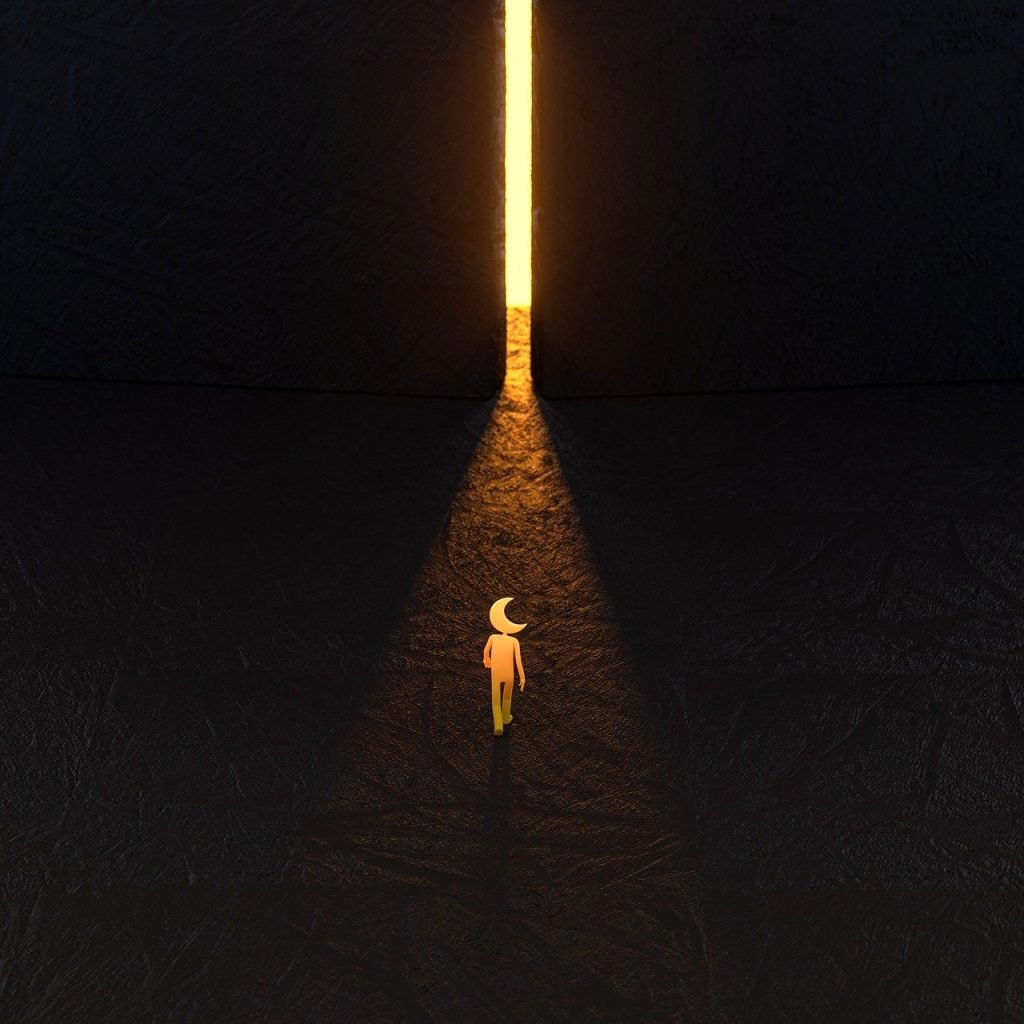
Four giant steps forward and six steps sideways, a room with no window, locked in it forever.
The thoughts buzz tirelessly, not letting the music of a quiet mind to settle.
The walls are painted daily, it shouts ‘I blame you’ boldly.
But there is light, it comes from underneath the door, sometimes mixed with the chirping of the birds. It fills the jail with a happy calm light. It does.
And the key, kept on a tiny table beside the door, never moves itself to unlock the door. It just waits.
Amusingly, the happy calm light never ceases to be. It wishes us to breakout.
Pale Blue Dot by Voyager 1 Space Probe. [Source – Wikimedia Commons]
*
We, this people, on this small and drifting planet
Whose hands can strike with such abandon
That in a twinkling, life is sapped from the living
Yet those same hands can touch with such healing, irresistible tenderness
That the haughty neck is happy to bow
And the proud back is glad to bend
Out of such chaos, of such contradiction
We learn that we are neither devils nor divines
*
This excerpt is from a refined piece of poem by Maya Angelou which shared then and is sharing still the truth.
We all call a pale blue dot in this magnanimous universe our home, and then we forget. For what else can it be if not weak memory that we repeat the same blunders and invite catastrophes?
We are full of contradictions, we are the chaos, we are neither devils nor divines… and yet we are the miraculous, the true wonder of this world. Why?
Because we can think, we can create, we can sing and dance, we can understand the science behind everything, and we can write a poem to share with everyone A Brave and Startling Truth.
Because deep down all each one of us want is peace. Yes, but only if we remember… if we remember to think.
*
When we come to it
We, this people, on this wayward, floating body
Created on this earth, of this earth
Have the power to fashion for this earth
A climate where every man and every woman
Can live freely without sanctimonious piety
Without crippling fear
When we come to it
We must confess that we are the possible
We are the miraculous, the true wonder of this world
I am joy running free/
freely flying, fluttering, soaring in a valley/
Of joy am running free.
Greetings!
A storyteller, following the ancient tradition of cave chroniclers, standing in vrikshasana (the tree pose) on a hill top (it is sunny, but windy), breathing in and out stories (relishing it all, but at times overwhelmed), declares animatedly that she will continue to – tell stories, share rare story gems, and connect with the pacy universe while also keeping the website ad-free.
Big thanks to my readers. Stay tuned!
Also, a humble request to the new subscribers to check the spam folder after subscribing. Silly (but necessary) confirmation emails often land there instead of the bright inboxes. Merci!
Ya-hoy!
Chiming Stories (formerly Home Chimes)
P.S – Supporting a storyteller is good for the world’s health (and undoubtedly, for the storyteller’s health as well). Shower some love by sharing, commenting and subscribing to the Weekly Newsletter.
Gabbeh, the 1996 film, is a simple tale of a gipsy girl, her clan and the way their life goes on. Unfolding beautifully just like an artist painting a canvas, Gabbeh quietly touches the grand questions.
Ranked as one of the greatest British films of all time, The Lavender Hill Mob confides in the audience, letting them see, feel, laugh and think without tickling persuasively with a joke here and a punch-line there.
Godard… Breathless and Alive
A Tribute to Jean-Luc Godard, the Film Philologist who Reinvented Cinema.
Yes fly! For walking on the second track is dull and usual, but dreaming high, high, high requires tools. Tools like the right pair of shoes, a chirpy, gritty soul that eats butter-jam dreams, a soul that drinks milky-milky creams.
Silver cascade shimmering the night sky, music to the waves and surreal beauty to the eyes, the Moon loves the art of discipline.
It may be difficult to believe for the Moon’s splendour defies time, it stupefies the clock, it follows the path of a dreamer, but how could this be possible if the Moon knew not discipline?
In this moment, I am a little bit of this and a little bit of that, I am complete and incomplete, I am pleased and uncertain, I wish for nothing and I know I have to wait.
Because the distance covered reminds me of the hurdles I have crossed and the ones I could not, it reminds me of a throbbing past and a dreamy future and it reminds me of how much time is left.
Meredith and the Green Lake
Illimitable Splendour
A joy so complete without any rise or fall, so free without any time corners, so real without true being false, false being true.