Someone (amused) – “Really! I didn’t know, oh, so that is why that day she didn’t come? Oh, hmm, I didn’t message or anything, just saw on the group… what, her boss what? Now am feeling bad for her… yeah, she deserves it, but yaar, she too lives from pay-cheque to pay-cheque… oh, what!”
Another one (expressionless) – “Hmm… hmm… No, no, you see it, see it for yourself… hmm… hmm… you see it. No, oh then sell it for free, what’s it to me… hmm…”
A jogger walks briskly, she is listening to music or a podcast.
Two pals sitting on the bench-
“In our days, things were better ji, no race, now it is all a race, take my son-in-law for example, switching jobs so frequently, is it a joke? No loyalty ji towards an organisation, only loyalty to ‘package’.”
Big yawn!
“No-no, you’re very right…”
“But I don’t say anything, I just said, this is not right according to me, rest it is up to you.”
Stray dogs bark. Gets quiet then, one can hear the birds.
“You love me or not?”
“Don’t start again!”
“You take a stand then, what ‘don’t start again’, decide, I am clear, but you’re not. Please!”
“Come-on! I am tired. Hey, hey, wait!”
“Leave me!”
“Okay-listen, listen! Hear me out.”
“They didn’t fire me, okay!! I have decided to quit, enough is enough. No, I am fine, you don’t need to do anything!!! I am fine!! Yes, I am crying, but you don’t need to worry about me, I am fine.”
“Yeah, but fruit juices… hmm, yeah, it is sugar-rush, no fibre, yeah… of course, better, but hmm, yeah, soups and add some lentils, in small amount, yeah, trust me, that tastes so good, and so healthy, yeah, yeah, yeah… nuts of course, but soak them overnight, only then, yeah…”
“It is all over now! I said it, had to. Yesterday, hmm, we met, same place, said it directly, had to.”
“I am so proud, she worked so hard… yeah, it is one of the bests in the US… we… sure, this weekend… right, will keep that in mind, you just make up your mind… ha-ha-ha-ha!! Hmm… oh, she will be leaving next month…”
“Is Vihaan coming?”
“Na, he isn’t!”
“Rishika, you’re coming right, I need company ya!”
“As if, you won’t be alone there.”
“No, come on!”
“Nidhi is coming too.”
“She is? See!”
Giggles and laughter.
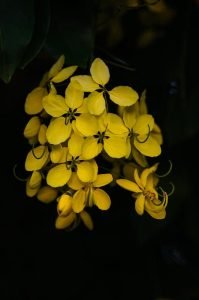
Some joggers before leaving stop to have chaat right outside the garden. Some swiftly and some slowly walking souls keep entering and exiting. Wind blows and the trees sway, leaves fall and that fragrant flower bearing tree lets go off its beautiful burgundy-coloured flowers, look another one is dancing its way down.
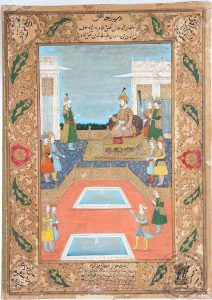
A storyteller appeared… and cross-legged, excited, whispering, wondering, quiet, blank yet touched by warmth, we sat in a circle around him.
As if the giant tree with creepers, fungi, lichens and company, stepped back humbly, only to create a space for us listeners and the storyteller.
As if the wind played softly, swaying, singing a chorus in the background, only to live the tale being told, only to collect and pass it on.
As if the quiet birds stopped chirping or playing Chinese-whispers, only to let the melodious melody of the storyteller resonate.
As if the fragrant river turned into a dancing rivulet, only to water the story.
As if the blessed earth, steadied the spinning sky for a bit, only to partake in the narration.
As if the jungle beasts, big and small, furry and feathered, befriended the now and stopped the time, only to witness the storyteller’s old and endless Gatha.
As if the words, rhymed and bold, simple and gold, measured well and sold, performed in unison, only to let the storyteller’s story by all be known.
Glory to the known that welcomes the unknown.
Photo by Jagriti Rumi; Courtesy – KP
Photo by Jagriti Rumi; Courtesy – KP
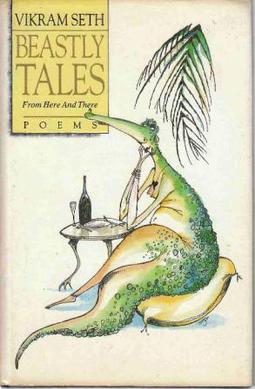
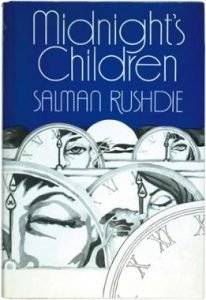
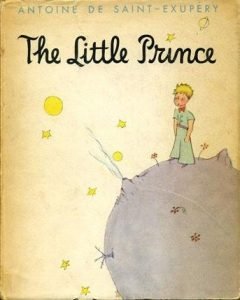
First Indian edition. [Source – Wikipedia]
*
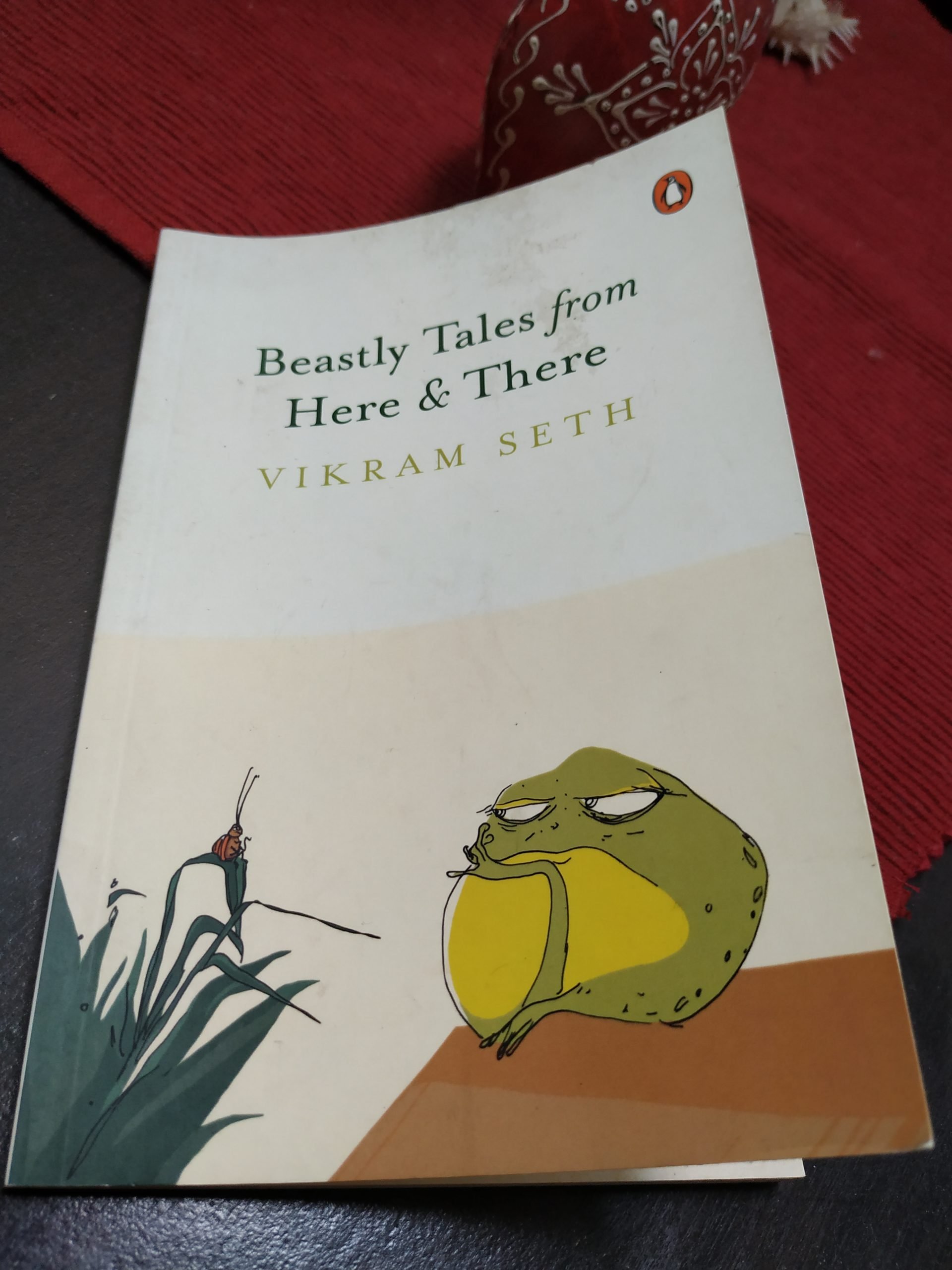
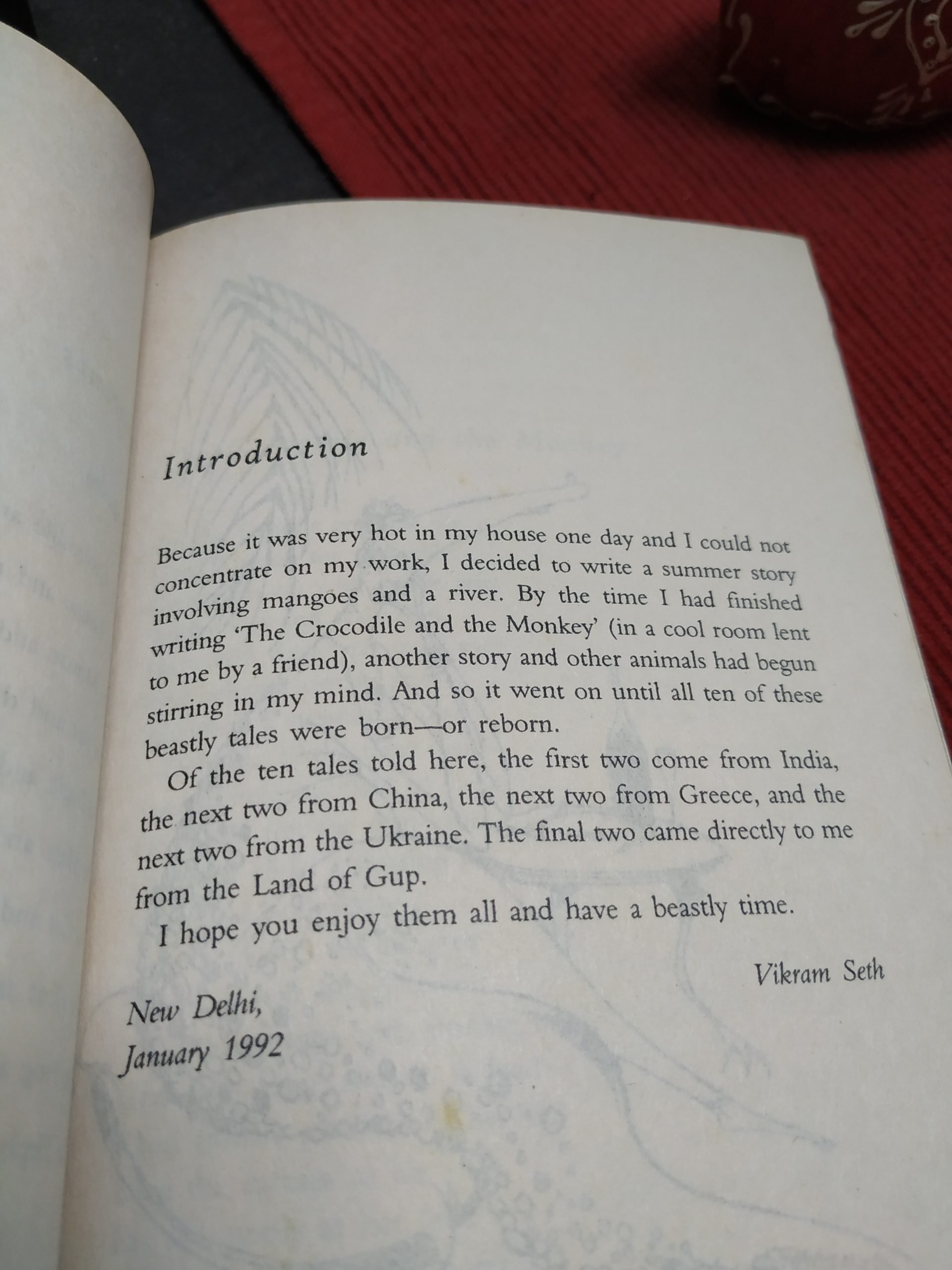
The absolutely fantastically amazingly brilliant book Beastly Tales from Here & There by Vikram Seth inspired the blogger to write this piece as a tribute to the author and as a short, crisp sort-of-a-coverage of the book.
It is a must-read for anyone interested in life, stories and the art of storytelling.
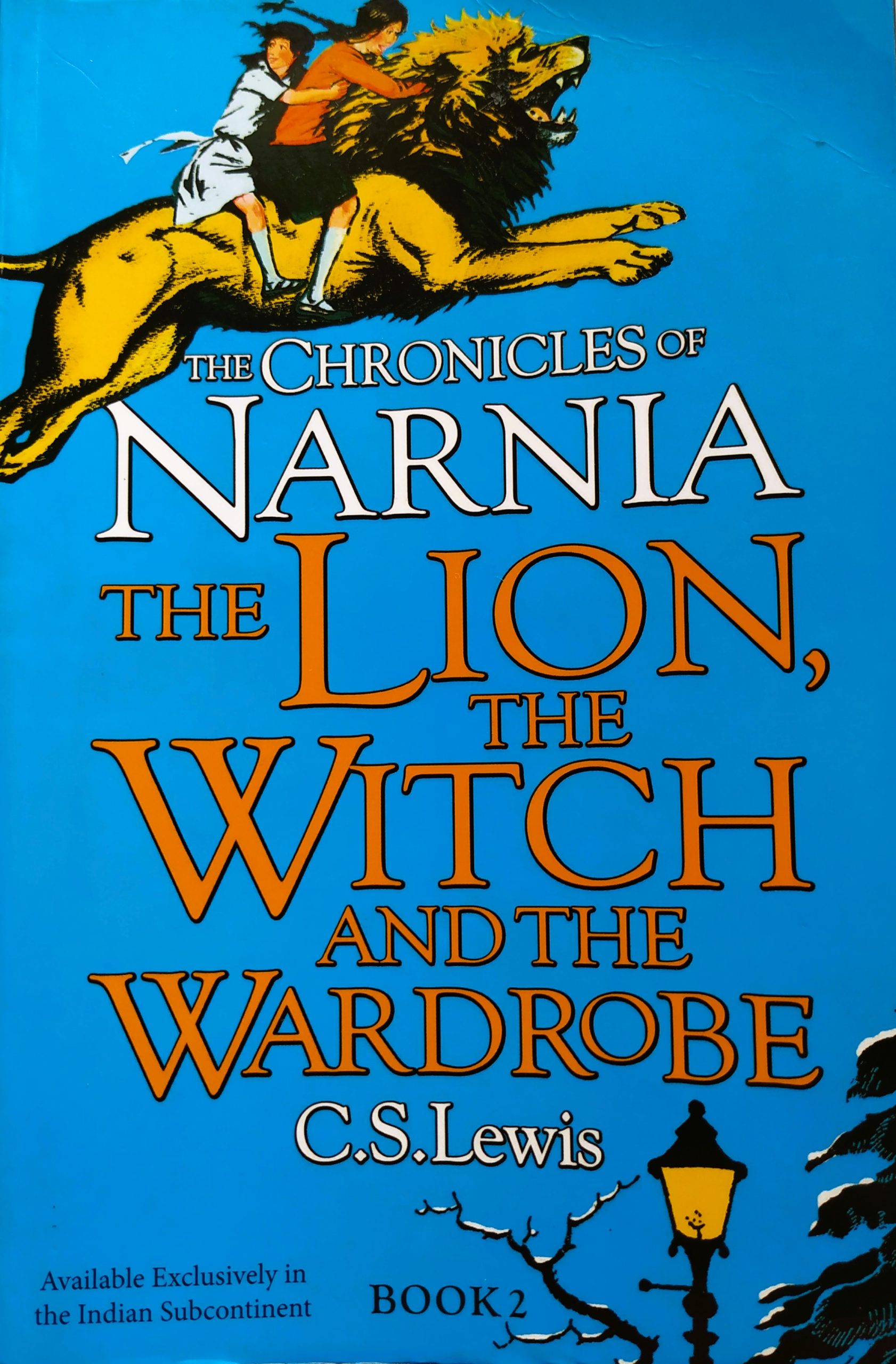
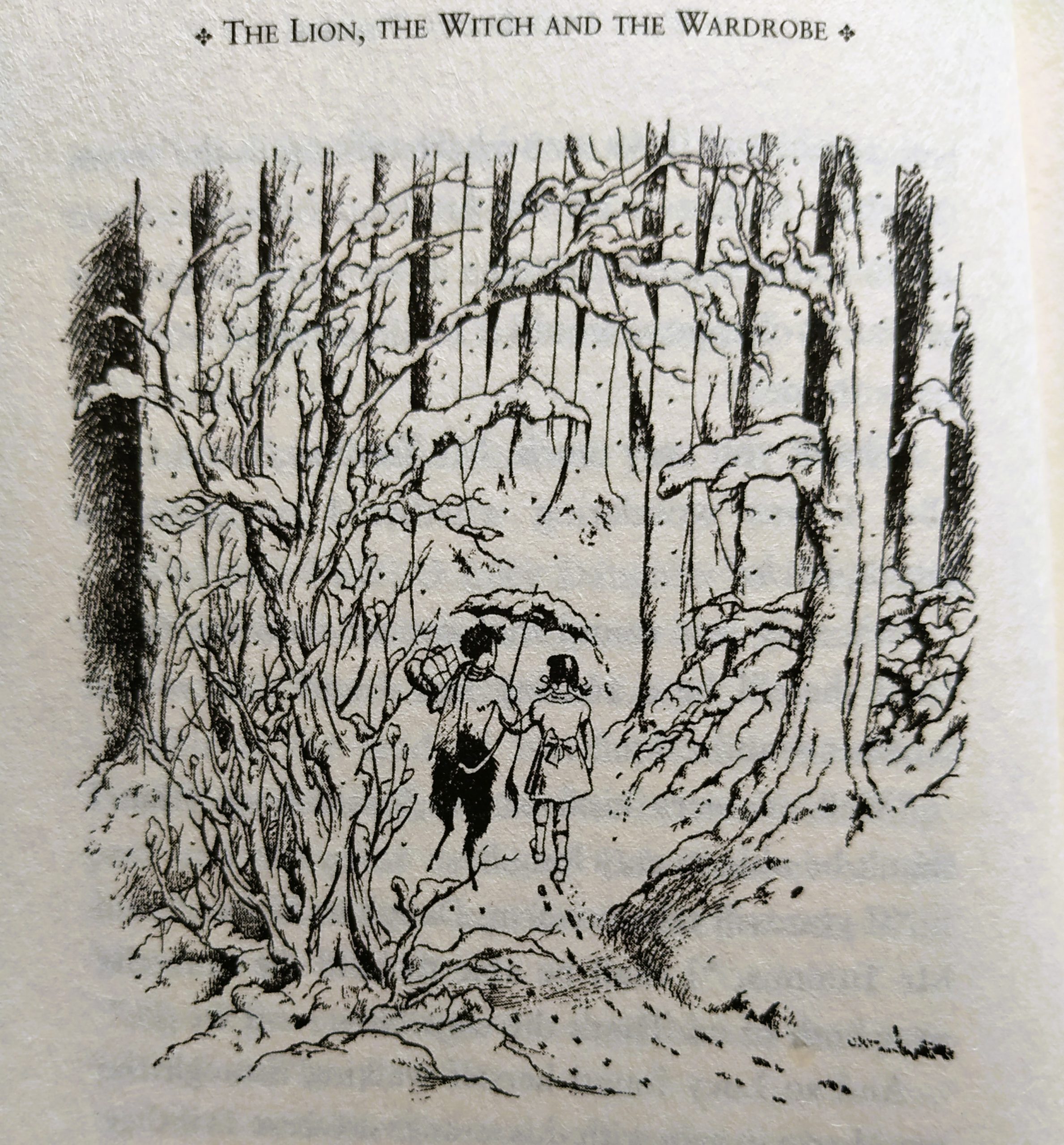
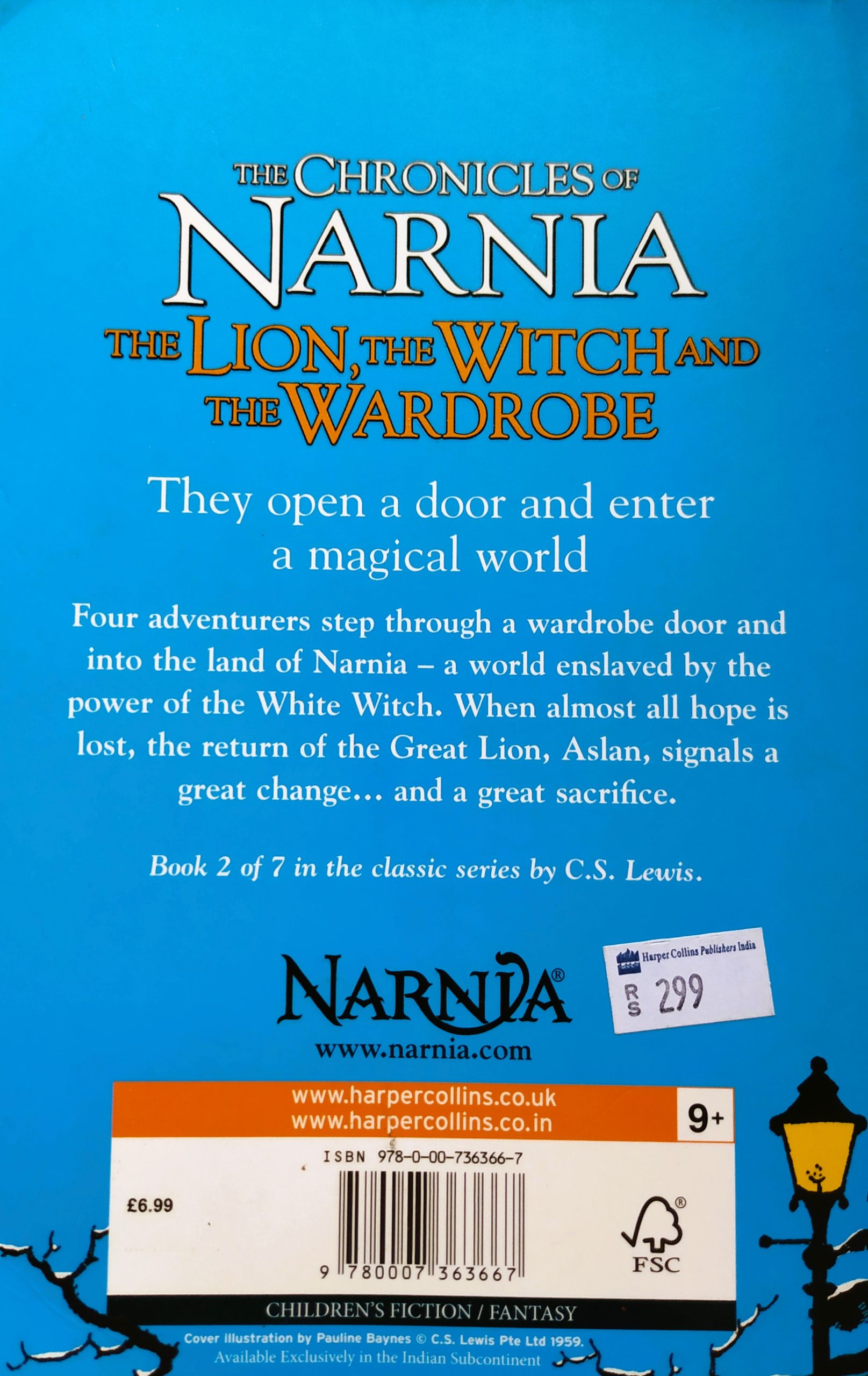
But as they went on walking and walking – and walking – and as the sack she was carrying felt heavier and heavier, she began to wonder how she was going to keep up at all. And she stopped looking at the dazzling brightness of the frozen river with all its waterfalls of ice and at the white masses of the tree-tops and the great glaring moon and the countless stars and could only watch the little short legs of Mr Beaver going pad-pad-pad-pad through the snow in front of her as if they were never going to stop. Then the moon disappeared and the snow began to fall once more.
Chapter 10 – The Spell Begins to Break
*
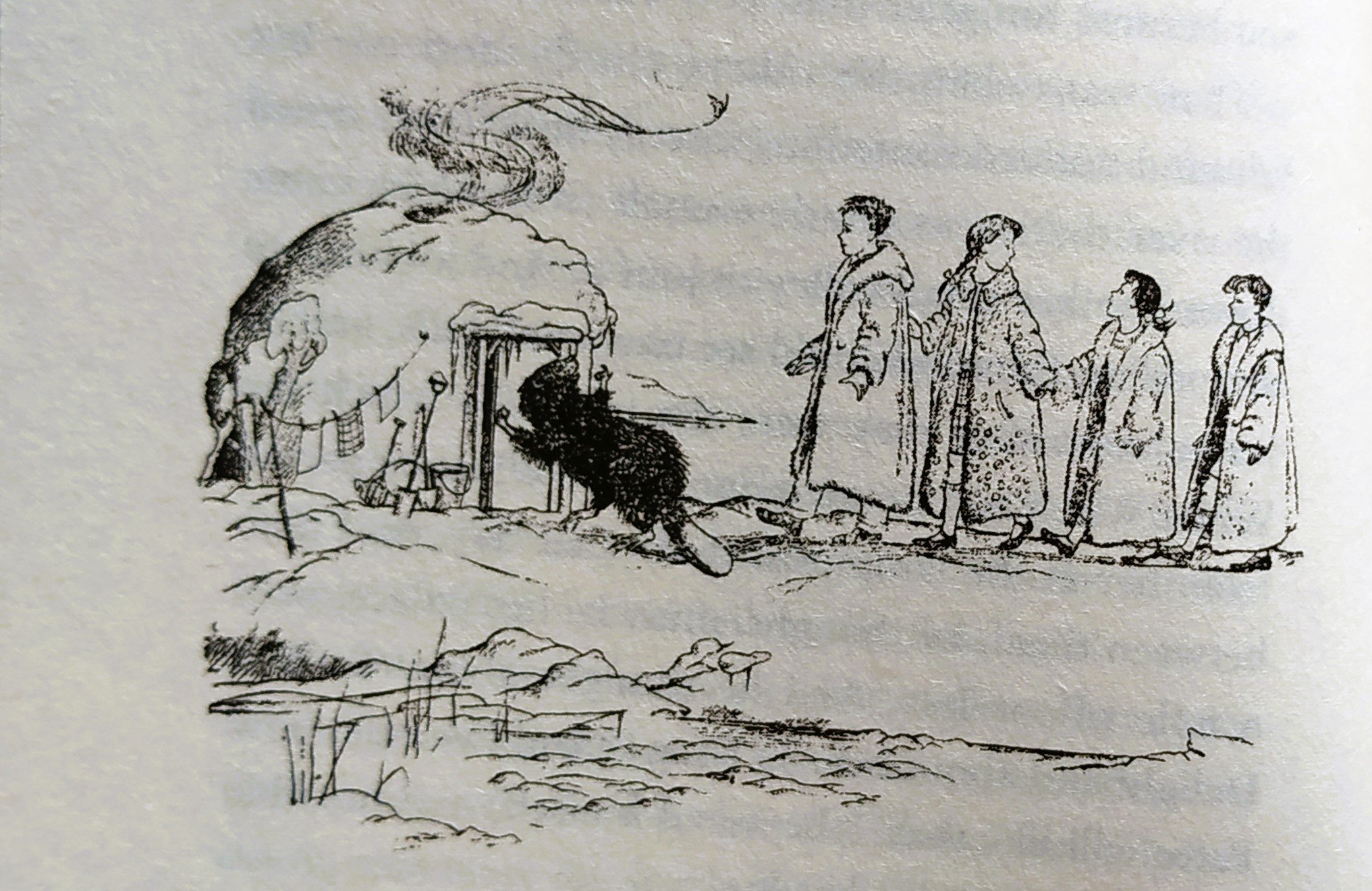
They were pretty tired by now of course; but not what I’d call bitterly tired – only slow and feeling very dreamy and quiet inside as one does when one is coming to the end of a long day in the open.
Chapter 12 – Peter’s First Battle
Dear Godfather,
Though not in Narnia – oh this wonderful secret burns brightly within, always showing the way through whimsical times – but in this not-so-glaringly-magical world, there is something that reminds me of Narnia and that is – you’ll find it strange – the act of walking.
Yes, walking and especially in the woods, but also just walking you know, in the garden or any rough road, walking silently, worrying less and losing myself in the surroundings, walking transports me, like every step walked on the land of Narnia did.
Hmm… It seems ordinary, especially when I think, compare, weigh, measure, imagine and get emotional. But when I don’t, when I simply forget to do any of that, I am able to simply walk and that is when the joy of walking makes me feel so sweet.
Do you know, only that day, I lost myself when walking aimlessly towards my house, landing safely, feeling light hearted and cold but in a gentle way.
My journeys on foot in Narnia were plenty, full of dangerous adventures too, but I believe it connected me to the pace of the magic unfolding, for magic was routine there, and so was walking, on the snowy land to the grassy ones through the woods and across the streams, one walked to keep the magic alive within.
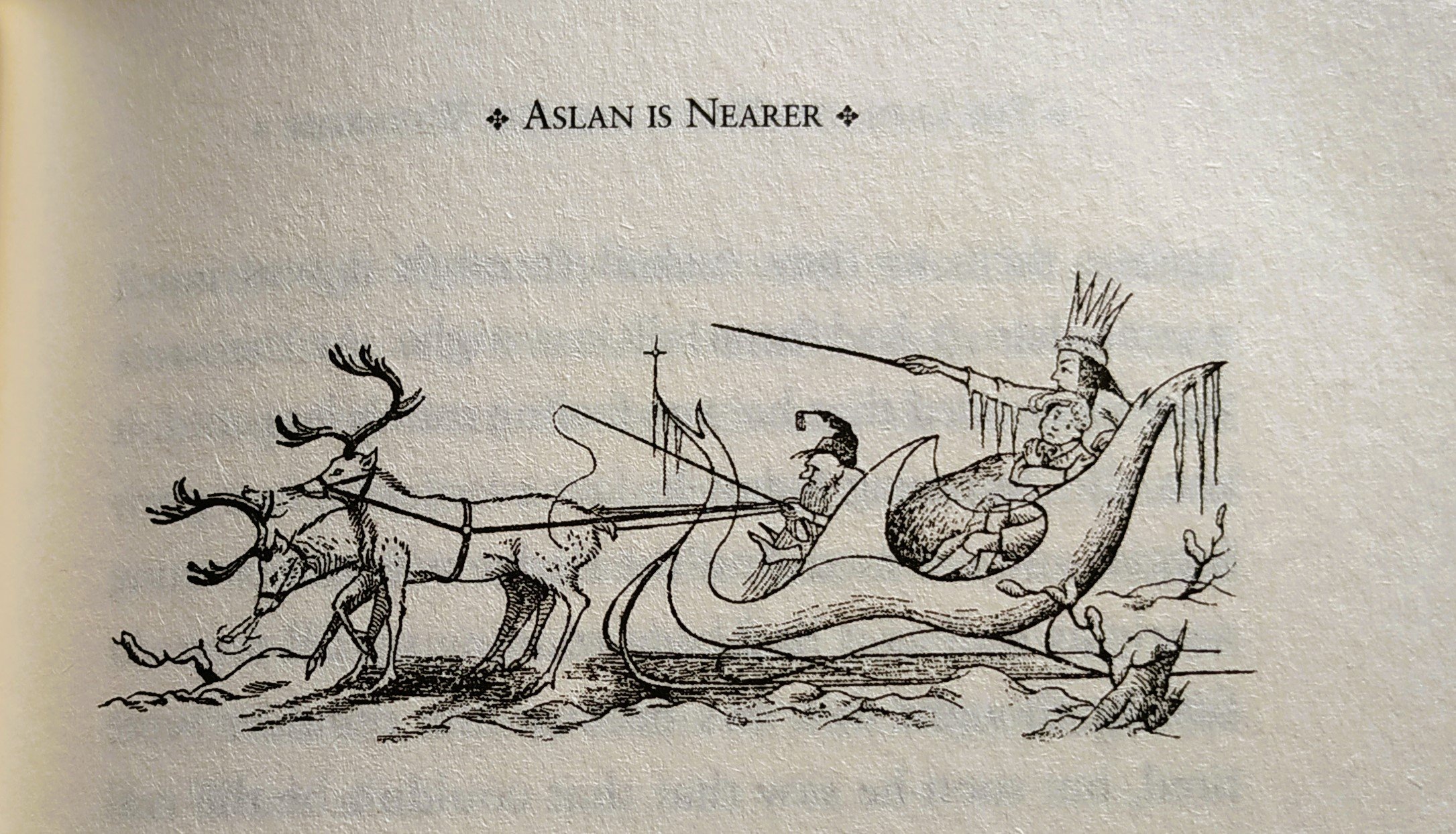
Godfather, is it one of the reasons for the Witch’s downfall, for she walked less and used the sledge, until, of course, Aslan… oh, I miss Aslan.
But I don’t feel dismal about it, dear Godfather, I long for Narnia, but I don’t cry, could be because I walk, via lovely pathways, wardrobes, parks, and in the town too, and through the village roads, whenever I can…
Thanks for the most wonderful gift one could ever give a goddaughter!
And indeed, Lucy Barfield, a spirited bright person, an artist, loved the book.
“What I could not do for myself the dedication did for me. My Godfather gave me a greater gift than I had imagined.”
Diagnosed with multiple sclerosis at 28, she led a life under restrictions, nevertheless, she continued to shine and must have again walked and, without looking for it, found Narnia for that is what a robin sang about to me.
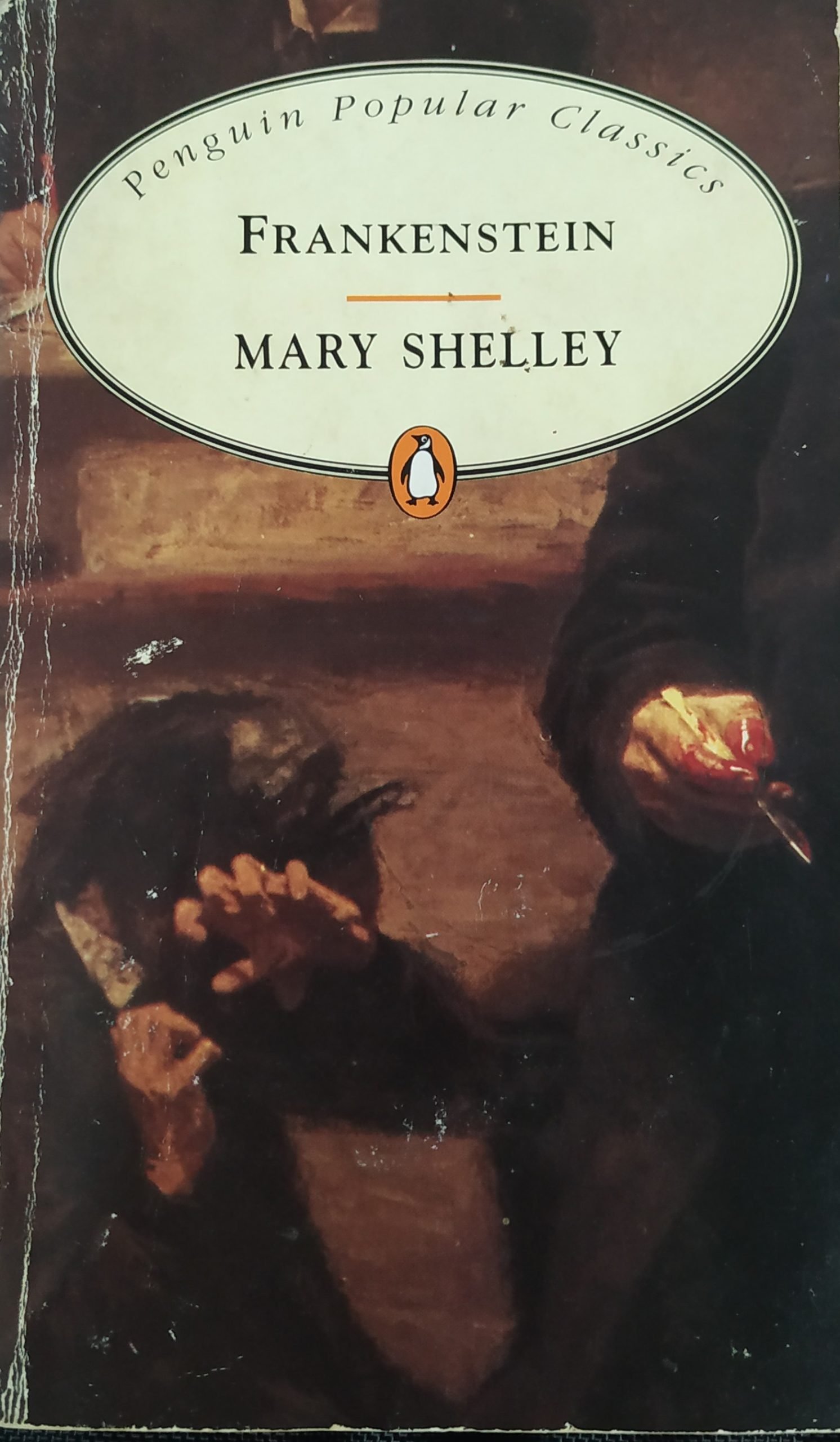
Call it a myth, an experiment, a mistake, it retells, at the same time approaching the same unknown vision, the story of Victor Frankenstein – a man who humbly tries to be god.
The novel retells, and is still retelling like a folktale in the air, how Victor Frankenstein’s passion for alchemy, chemistry and natural philosophy acted as a catalyst for his many experiments on lifeless frames he gathered from cemeteries.
Long, maddening but exact and taciturn, expeditions, not to a far off land (not as of now), but inside the laboratory, expedition to the depths of knowing the dead and undead, to the threshold of unruly desire and undue greed, greed to dominate.
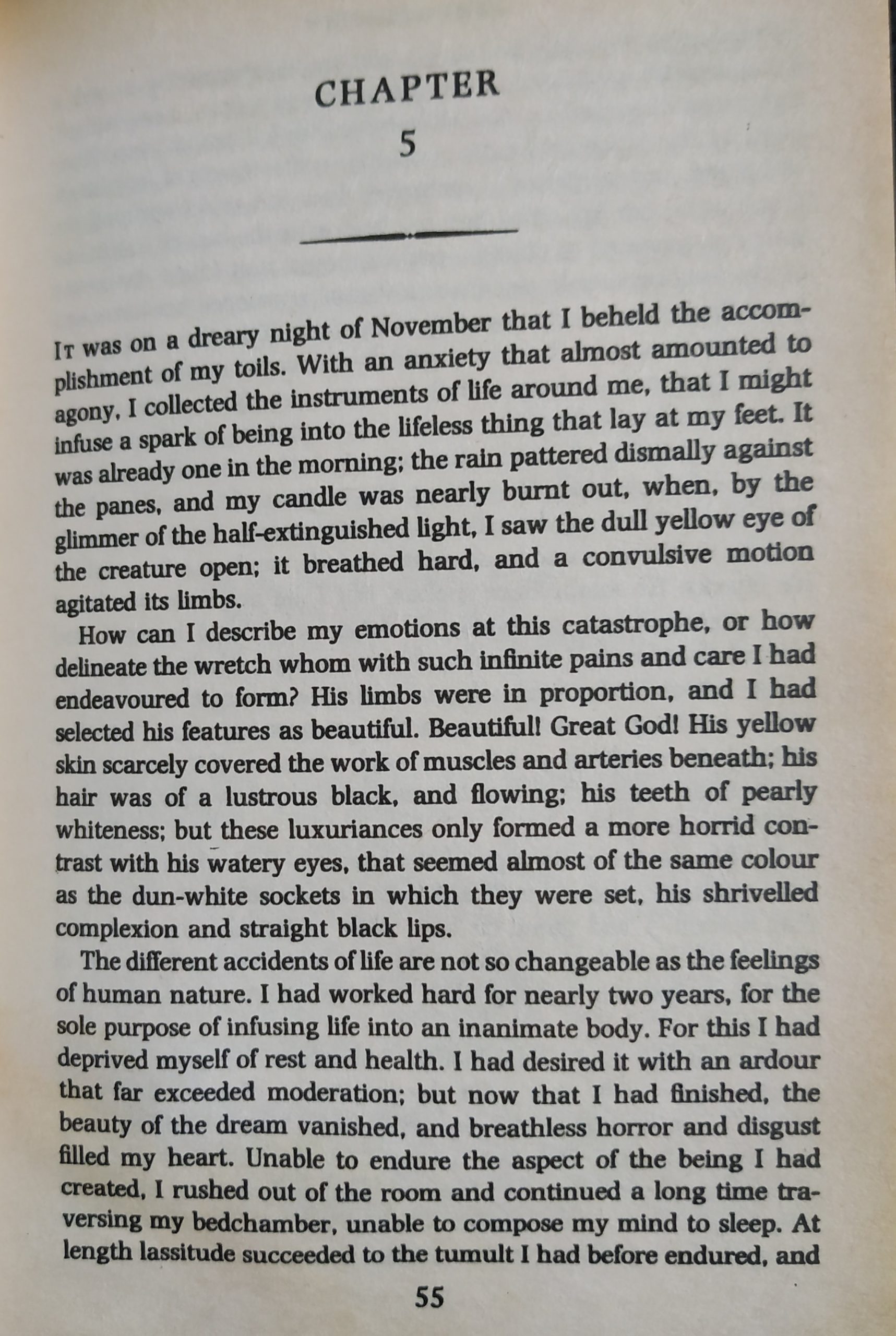
It was on a dreary night of November that I beheld the accomplishment of my toils. With an anxiety that almost amounted to agony, I collected the instruments of life around me, that I might infuse a spark of being into the lifeless thing that lay at my feet. It was already one in the morning; the rain pattered dismally against the panes, and my candle was nearly burnt out, when, by the glimmer of the half-extinguished light, I saw the dull yellow eye of the creature open; it breathed hard, and a convulsive motion agitated its limbs.
How can I describe my emotions at this catastrophe, or how delineate the wretch whom with such infinite pains and care I had endeavoured to form?
Chapter 5, Frankenstein by Mary Shelley
The creator fled away from his creation forgetting that the two are now tied to each other by a thread – a thread stronger than creator’s own shadow, voice and thoughts. Victor created a monster, not on that ‘dreary night of November‘, but over a period of time. Absolute neglect and abhorrence left the monster no choice but to be one.
Even when he learns the ways of the world – living in a hovel, grasping in silence what a family life means, secretly helping people around, picking their language and deciphering meaning in what he could read – he faces rigid rejection to whomsoever he turns to.
Shunned, he questions his existence and finds the winter weather leaping away after answering him with a static silence.
Fear fosters fear and with such weakness and anger the monster acts, brutally he acts, making sure that his master hears all about it. The monster kills Victor’s younger brother William and thus begins the downfall of both the creator and the monster.
Darkness and gloom overpower Victor and with the deaths of his best friend, fiancé and his old father, he becomes as lonely as the monster.
The pure white snow at the North Pole, that appeared to be engulfing the earth and the sky alike, could not make the monster anything less than what he had become – he was a curse, told Victor to his new friend, Robert Walton, an explorer and closed his eyes forever, hoping that in death he may find victory over his loathsome creation.
And this once Victor was right, the monster decides to put an end to his grotesque life too.
A little bit of gleaming sunshine, valley fresh flowers and joy too may feel subdued in this novel by the inky rainy nights and foggy, grey skies, but that is because it stays true to its core – a tragedy, but a modern one where the hero nurtures his flaw, unaware yet certain at first, lamenting and regretting later, truly owning it as a dead man.
Victor Frankenstein borne the brunt of such a curse that no one may ever dare to face, even in the advanced world, maybe only by mistake, but not as a determined goal and even if one did, in the times to come, such a creation will know what happened to Frankenstein’s monster and will know it only too well.
Until then, Frankenstein will continue to live, in our memory, for the sake of the curse and so will his monster.
When I placed my head on my pillow, I did not sleep, nor could I be said to think. My imagination, unbidden, possessed and guided me, gifting the successive images that arose in my mind with a vividness far beyond the usual bounds of reverie. I saw – with shut eyes, but acute mental vision – I saw the pale student of unhallowed arts kneeling beside the thing he had put together. I saw the hideous phantasm of a man stretched out, and then, on the working of some powerful engine, show signs of life, and stir with an uneasy, half-vital motion. Frightful must it be; for supremely frightful would be the effect of any human endeavour to mock the stupendous mechanism of the Creator of the world.
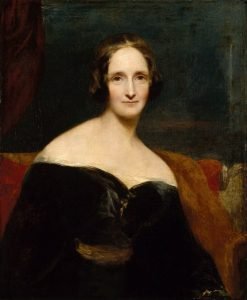
At 18, when she began writing Frankenstein, Mary Shelley had thought of it to be a tale no longer than a few pages, at 20, the novel, after initial rejections, got published anonymously – customary for most female writers of the period – with a preface by her husband, P.B Shelley.
Some thought P.B Shelley or his father-in-law, the philosopher writer William Godwin, to be the author of this phantasmagoria and Mary Shelley surely was influenced by both, but her close encounters with death that tortured her, but kept her alive, very much like the Titan god of fire, Prometheus, made her who she was.
Mary Shelley wrote in her diary – “Dream that my little baby came to life again – that it had only been cold and that we rubbed it by the fire and it lived – I awake and find no baby – I think about the little thing all day.”
Mary got her name from her mother Mary Wollstonecraft, a feminist writer, who died soon after giving birth to her. Even though deprived of this pious golden bond, Mary Shelley nurtured it solitarily, just like Frankenstein’s creation.
Percy Bysshe Shelley’s world became her world when she, at 16, fled with him, well aware that the journey ahead will be more perilous than it ever was. Percy, then 20, was already married, penniless and somewhat on the run from his creditors. After his first wife’s death, the couple got married and just for a few shy years they happily lived together.
Too strong a wave, was Mary’s beloved, for he rose to meet the light on a stormy night on the sea and drowned unabashedly. Mary Shelley kept the remains of his heart as keepsake and continued to edit and publish his poems posthumously.
Patience of deep sea grew in Mary Shelley and she decided to live – for her only son and her pen. She wrote novels, short stories, travelogues and biographies both to earn a living and stay close to the phantasmagorical world of stories.
The idea of Frankenstein came to Mary Shelley in a half-waking nightmare in the summer of 1816. She had been staying with her husband and Lord Byron on the shore of Lake Geneva when at Byron’s suggestion they were all challenged to make up a ghost story.
– Frankenstein (Penguin Popular Classics)
The summer of 1816 later came to be known as ‘the year without a summer’ because of the eruption of Mount Tamboro in Indonesia that sent clouds of volcanic ash throughout Europe, North America and Asia.
Torrential rain and grey gloominess filled the sky, it must have, when Mary Shelley sat down to write Frankenstein. And this only favoured her, even if she didn’t realise it, as she managed to breach the measurements of time in presenting a vision, hideous and terrifying, but intact and alive.
And so, it walked, with our desires and knowledge meeting, it walked – Frankenstein’s monster walked.
A phase is defined as any stage in a series of events or a process of development; while we all go through different phases in life, at times we either forget to notice or simply become fearful of transitions, inadvertently being ignorant about the fact that this phenomenon is universal. In this short poetry collection, the blogger has attempted to capture this subtle yet powerful phenomenon – phases that are observable in every journey undertaken.
A happy piece! Kintsugi is the Japanese art of repairing broken pottery by mending the areas of breakage with lacquer dusted or mixed with powdered gold, silver, or platinum. – Wikipedia [Photo by Motoki Tonn on Unsplash]
*
For a better experience, listen to the wonderful, magical tracks before reading on –
*
Listen to Little Talks here –
*
‘Cause though the truth may vary This ship will carry our bodies safe to shore…
Little Talks, Of Monster and Men
And this journey forward that seems uncertain, unforgiving, perilous, and so lonely transforms into a key – a key that unlocks both the Pandora’s box of adversities and the heart’s orchestra.
String, woodwind, brass and percussion music, always on stand-by, ready to win-over the adversities melodiously, has given the heart’s orchestra a good name.
What if the monster charges with an army or is two-headed or many eyed or has tentacles? Hey-hey, hey-ho, the key that unlocks, also locks… it is all up to you and your heart’s orchestra performance.
Psst! Listen, all monsters aren’t evildoers, but they are music lovers for each one has a heart. Good luck!
Listen to King And Lionheart here –
*
And as the world comes to an end I’ll be here to hold your hand Cause you’re my king and I’m your lionheart
King and Lionheart, Of Monsters and Men
And this journey that seems to have ended with our destruction, our death, and yet alive, we silently stare, scar-faced and overwhelmed, at our sacrifice blooming at the right place, at the right time…
Tired steps befriend the trodden grass… and at last the haunting echoes fail… the Lionheart rises again.
Listen to Dirty Paws here –
*
The bees had declared a war The sky wasn’t big enough for them all The birds, they got help from below From dirty paws and the creatures of snow
Dirty Paws, Of Monsters and Men
And in the middle of a war, when you turn around to see and cannot distinguish between the mad faces, you become one with them and fight fiercely until you remember, you too are a creature that breathes.
Breathe, breathe, breathe and continue for that is the call…
Listen to Love Love Love here –
*
Oh, ’cause you love, love, love When you know I can’t love You love, love, love When you know I can’t love You love, love, love When you know I can’t love you
Love Love Love, Of Monsters and Men
And what hurts the most in this forgotten life of ours… unfulfilled love that can be fulfilled and yet…
When love love love turns you into a piece of Kintsugi pot, smile for now you have been repaired.
Listen to Mountain Soundhere –
*
Of Monsters and Men is an amazing indie rock band from Iceland. They have a knack for amalgamating folk stories, emotions, joy, pain and the magical into their songs that almost every time matches with the universe’s wavelength.
Listening to their music is like sitting around a bonfire on a bright winter night… and like playing with the breeze in the summers.
Dancing and chirping, posing, frolicking, a bird –now on this branch, now on that – living in Godard’s city in black and white 1957, knows not the language and yet doubts Patrick. And rightly so for that philanderer never hesitates; quick-witted, he charms the ladies into believing him and his stories and “well, it is just a coffee date”, he says casually.
Only later do they find – Charlotte and Veronique – why All the Boys Are Called Patrick, because they were talking about the same Patrick, that is why, and look here he goes, in a taxi, with another beauty.
*
Patrick (Source – Le Cinema Club)
Ahm Ahm! (Source –
roseydoux.tumblr.com)
Charlotte and Veronique (Source – Le Cinema Club)
’64,’65,’66
The birdie dares and continues living while in Godard’s city in three back-to-back years – ’64,’65,’66 – the voices – twice in black and white and once in colour – speak the language of simultaneity… and of confusion, surplus, discrimination… expressing it through every medium, especially the medium called love.
Just see, simultaneously in love, out of love, whimsically, the next moment knowingly, executing the plan and fate’s execution, the Band of Outsiders – Arthur, Odile, Franz – dancing the Madison dance, breaking the Louvre record, firing gunshots, breakaway… winning and losing simultaneously.
*
The name of the production company ‘A Band Apart’ founded by Quentin Tarantino Et al. comes from this film by Godard. (Source – Wikipedia)
Dance ‘the Madison dance’ along with the trio –
*
The Louvre record–
*
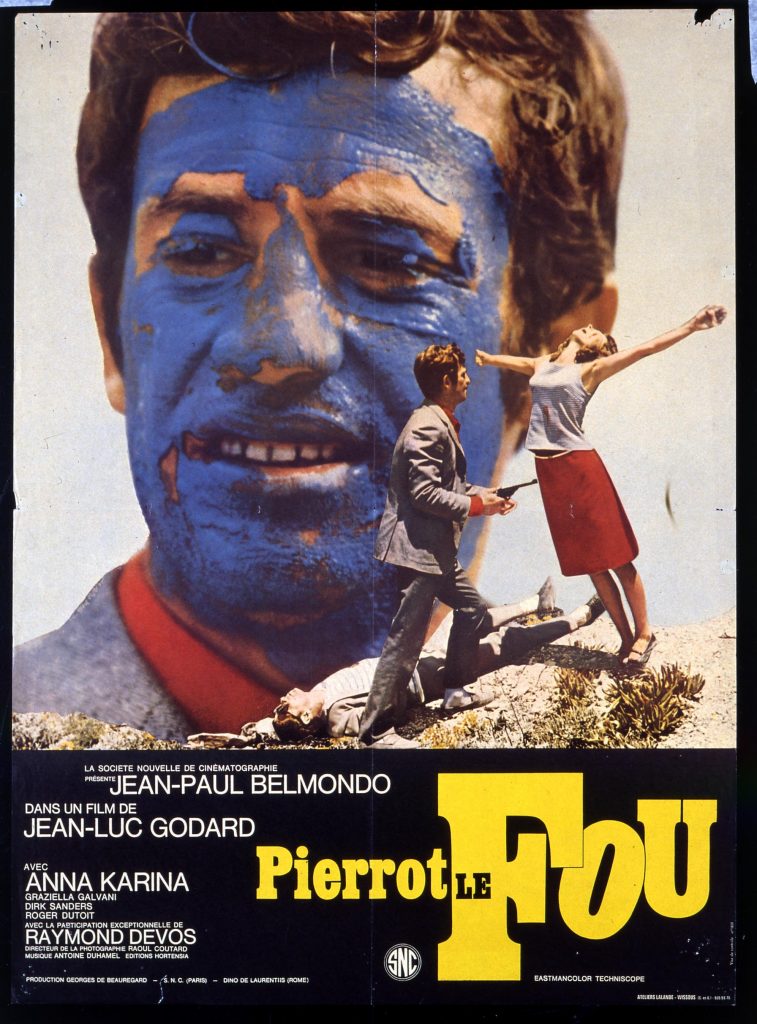
And meet the fool, Pierrot the Fool, who runs away in the search of and is chased by meaning. Along with his ex-girlfriend, Marianne, he protects everything new that he has accepted and acts, confidently and in confusion simultaneously.
Poor Pierrot’s search ends, finally, it does; he finds, though quite late, that he was wrong about Marianne and right about the bomb. But as said before, he was so late that… dhamaka!!!
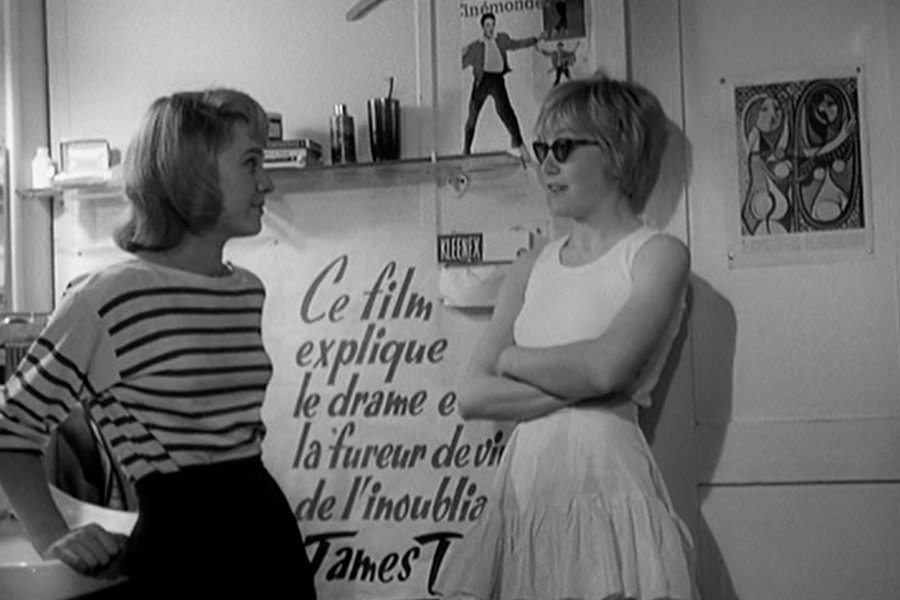
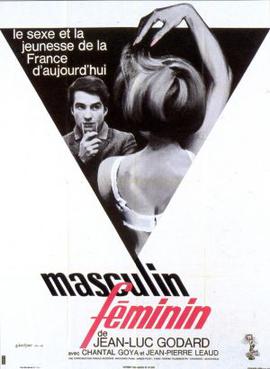
Next year, in Godard city, the questions ‘he’ asked ‘her’ and the questions ‘she’ asked ‘him’ were all documented; the answers were young, naïve and in late teens and early twenties. Fun and spirit jarred the running time.
A singer, her two girlfriends, a lover, his journalist friend, elections, peace in Vietnam and everything in fashion voted in the favour of 1966 and against each other.
Starring the child from The 400 Blows, now all grown up and Chantal Goya, a Ye-Ye singer playing a Ye-Ye singer. (Source – Wikipedia)
Godard’s dog Roxy Mieville plays an important role in the film. (Source – UniFrance)
Jump to the year 2014!
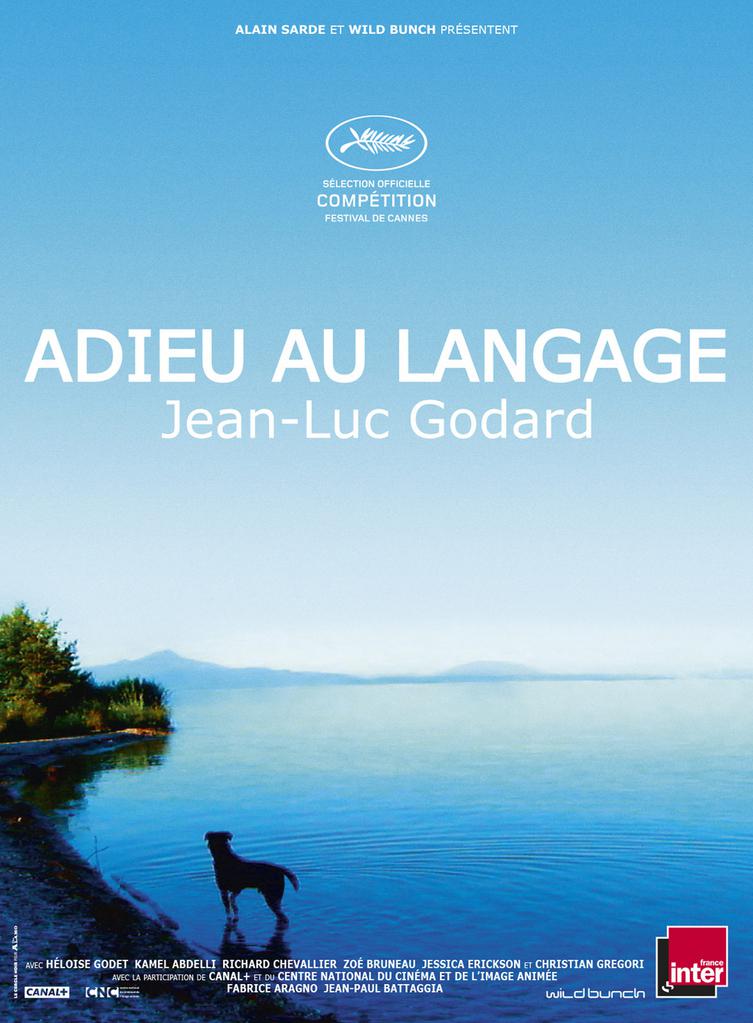
Jean-Luc Godard’s Goodbye to Language (Adieu au Langage), a 3D essay film is a mind-boggling experiment.
Speaking about all that we encounter in life – through a car’s windshield, superimposed images, from a stray dog’s POV, in the colour red, rose red – the narrator speculates, maybe, regarding the dearth of something crucial at the centre and our unobservant impatient nature.
Maybe it shows also the fast culture that admires and nurtures weak concentration. Maybe we have missed the train… but then we can always walk if we remember how to that is.
The fun part is that ‘adieu’ in some parts of Switzerland where French is spoken, the parts where the film was shot, may mean both goodbye and hello.
“One of the best films ever made” – Sight and Sound magazine (Source – Wikipedia)
Time-travel again!
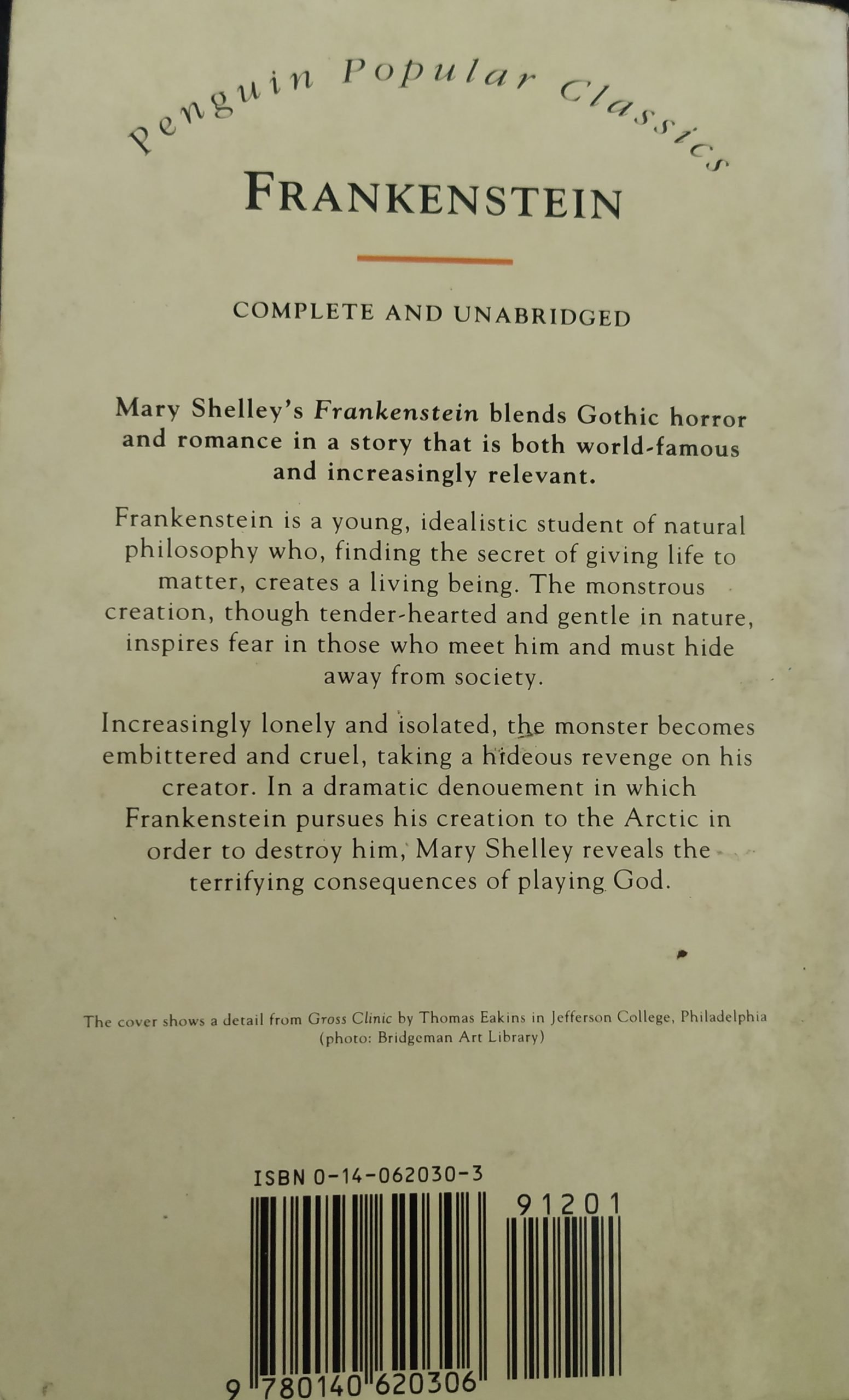
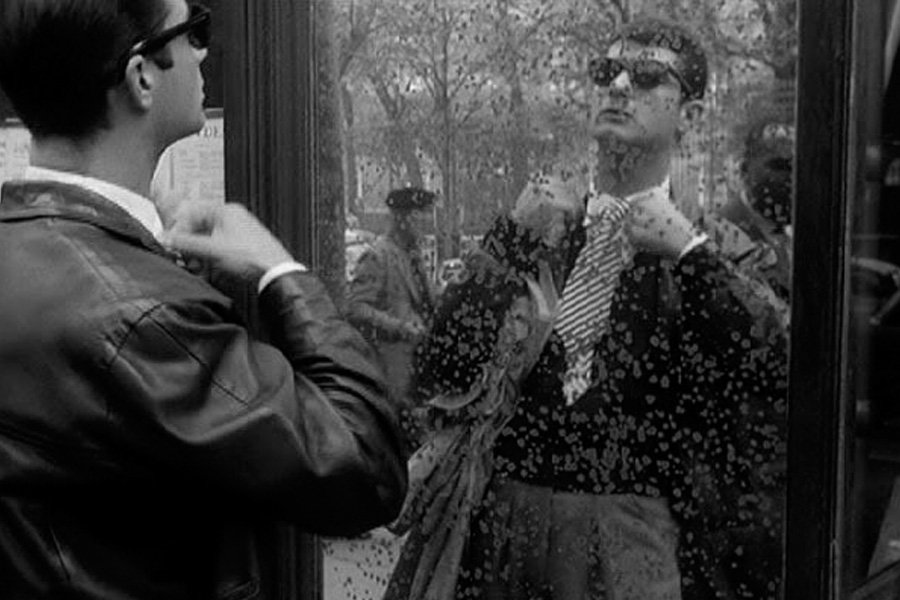
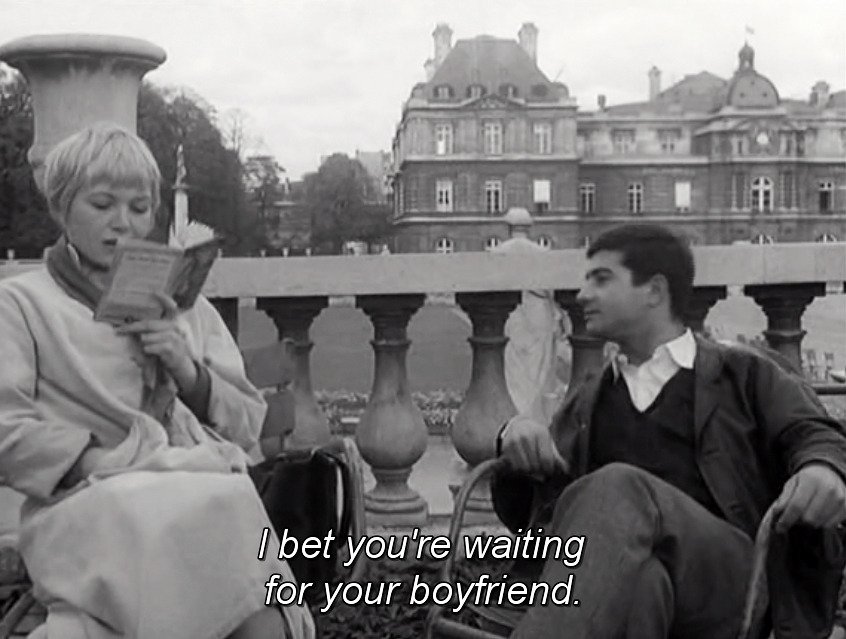
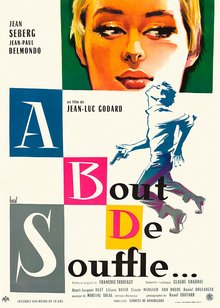
Godard’s Paris, the year 1960; a criminal, Michel, is absconding and in love with Patricia. The boulevards, narrow lanes, tricky corners, buildings, stairs, doors, rooms, windows are together mocking – in black and white – the seriousness attached to delayed decisions, and also, questioning the pettiness shown towards whims.
Before becoming a news headline, Michel lives a simple life of a goon with a free future in vision and a blurry present; blurry but sweet and tender, like a half-dream seen in a half-sleepy state.
Patricia, an aspirer, a daydreamer, not a native, asks a lot of questions –
*
“Have you been to Monte Carlo?”“No, Marseilles.”
“What is a horoscope?”“Horoscope? The Future. I wanna know the future. Don’t you?” “Sure.”
“Why are you so sad?”“Because I am.”“That’s silly.”
“What would you choose between grief and nothing?” “Grief is stupid. I’d choose nothing. It’s no better, but grief is a compromise. You have to go for all or nothing. I know that now.”
“What is your greatest ambition in life?” “To become immortal… and then die.”
*
See, she asks such questions and gets such replies from Michel and others, like Parvulesco, the French writer/ philosopher she interviews in the film. Not always coherent and never definite, the answers make Patricia smile.
The car, the coffee, the cigarette, the smoke, the sprint, the bullet gradually push Michel and Patricia to either take a decision or act whimsically.
They do both – a decision is made, a whim wins over – but the timing and consequences differ. The only similarity is that they both make a news headline-worthy move!
*
A simplified trailer of a mosaic film –
*
A simple storyline that Godard twisted and moulded anew every day before shooting, Breathless’ distinctive visual style, editing, character portrayal and life-like quirky humour made it one of the leading films of the metamorphic French New Wave cinema.
The film’s originality and unique construction, after so many eras, continue to reform the cinema.
Experimenting, exploring, challenging fearlessly, Jean-Luc Godard postulated, presented and celebrated a new film philosophy; trying to build a bond with the viewer, his films demand attention, awareness especially if a political joke is being shared or if lovers are looking London talking Tokyo or if life is shown getting a speeding ticket or if an absurd gesture appears twice and the viewer tries to copy just for fun…
*
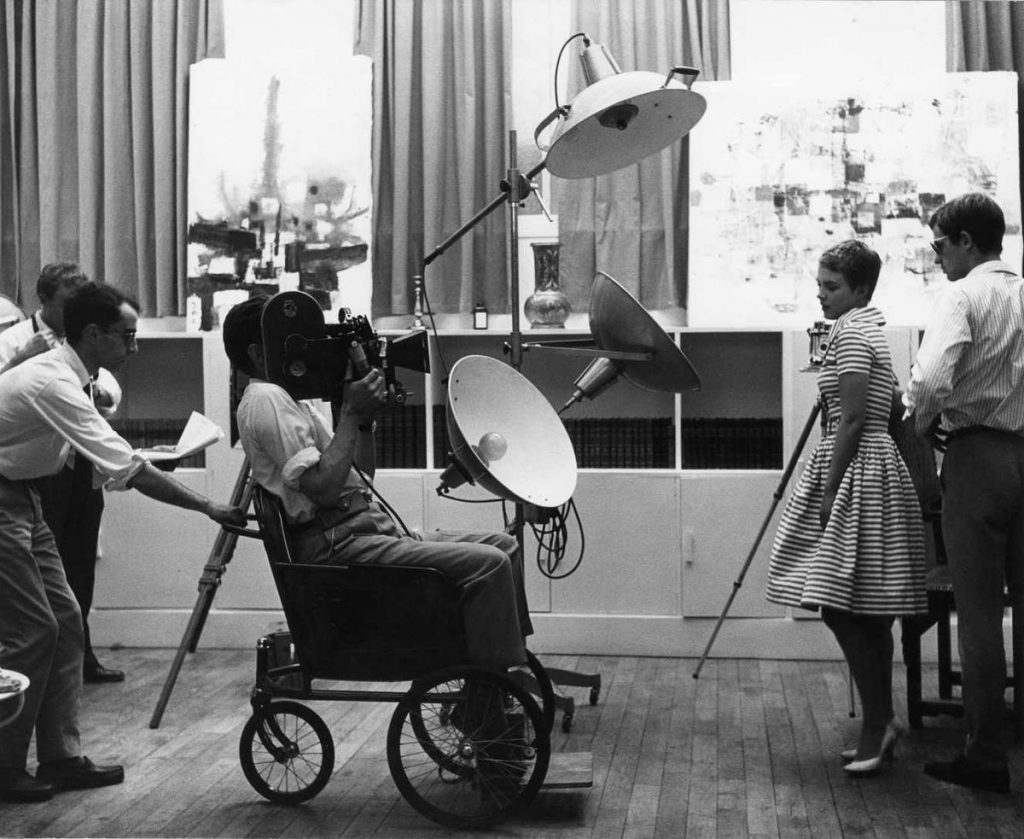
Godard pushing cameraman Raoul Coutard (on a wheelchair for a tracking shot) during the shooting of Breathless. (Source – The Hindu)
“Au revoir, à la prochaine”, said the bird in French i.e. ‘goodbye, until next time’, for the bird has subscribed to an OTT platform where some of Godard’s films are streaming.
Cinema lovers, what’s the time?
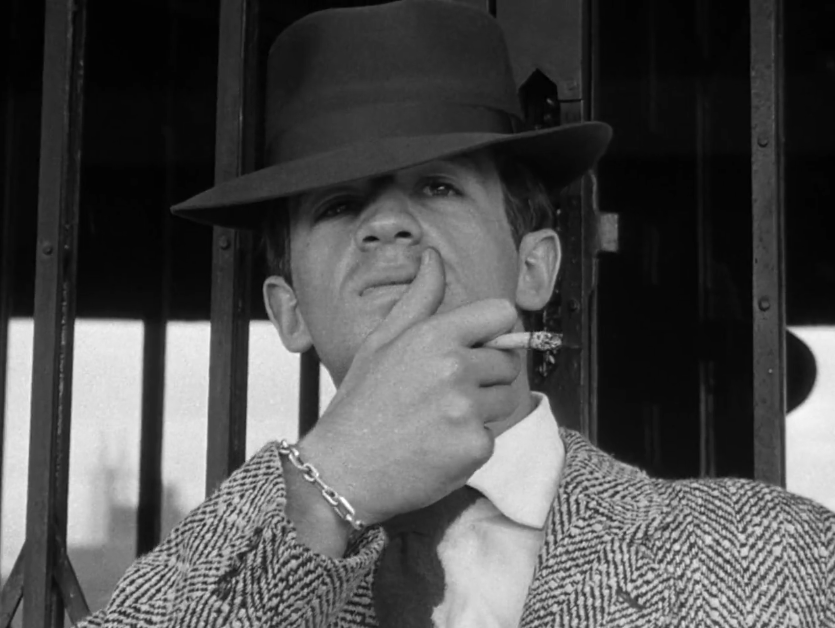
Time to imitate Michel’s gesture from ‘Breathless’ where he is shown imitating his favourite American actor, Humphrey Bogart…
Nature too believes in this mantra. [Source – Pixabay]
शुभस्य शीघ्रम अशुभस्य कालहरणम।
Shubhasya shighram, ashubhasya kaalharnam.
Translation – Do not delay when planning to do something good, but when inclining towards the opposite, think twice.
Contemplation is good and needed. Action is better and a must.
Plans in a potli-mind take time to come out, yes, for they are grand ones, created meticulously, weaved with love.
Inspired thoughts build this glass minar with intricate designs, colours of hope and success and appreciation and a little bit of all that is magical in this universe. We fly high when planning in a potli-mind.
Now how to fabricate such a tall glass minar in reality? Where to start from? How do we know if the time is right?
And what about all the ‘ifs’ and ‘buts’? Oh, and our dominating ‘know-it-all self’ that loves to put a stamp on every new thought, issuing summons, calling the poor thought a fraud, out-of-our-league or an impossibility, come what may?
Or worse, comparing it with the giant called the OTHERS?
Maybe this is the moment to tell yourself, shubhasya shighram, why wait to do something good.
Maybe this is the time to take the first step towards that glass minar, an overwhelming act it may feel at the beginning, but by the end, whatever the result is, we get enriched, we understand the rotating world and our bumbling selves a little better.
What a brilliant mantra then, a pocket sized mantra!
So, my friend, go ahead with that plan… because shubhasya shighram, shighram shighram.
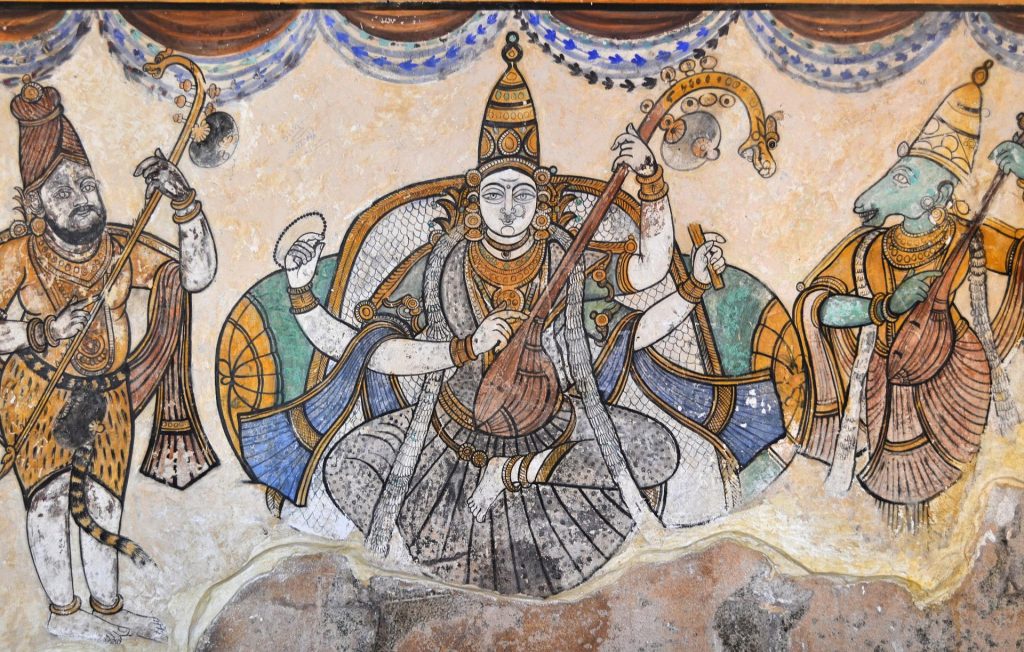
Gather around, the storyteller is here. [Source – Pixabay]
“There is no village in Inida, however mean, that had not a rich sthalapurana, or legendary history, of its own. Some god or godlike hero has passed by the village – Rama might have rested under this papal tree, Sita might have dried her clothes, after her bath, on this yellow stone, or the Mahatma himself, on one of his many pilgrimages through the country, might have slept in this hut, the low one, by the village gate. In this way the past mingles with the present, and the gods mingle with men to make the repertory of your grandmother always bright…”
Author’s Foreword, Kanthapura, Raja Rao
*
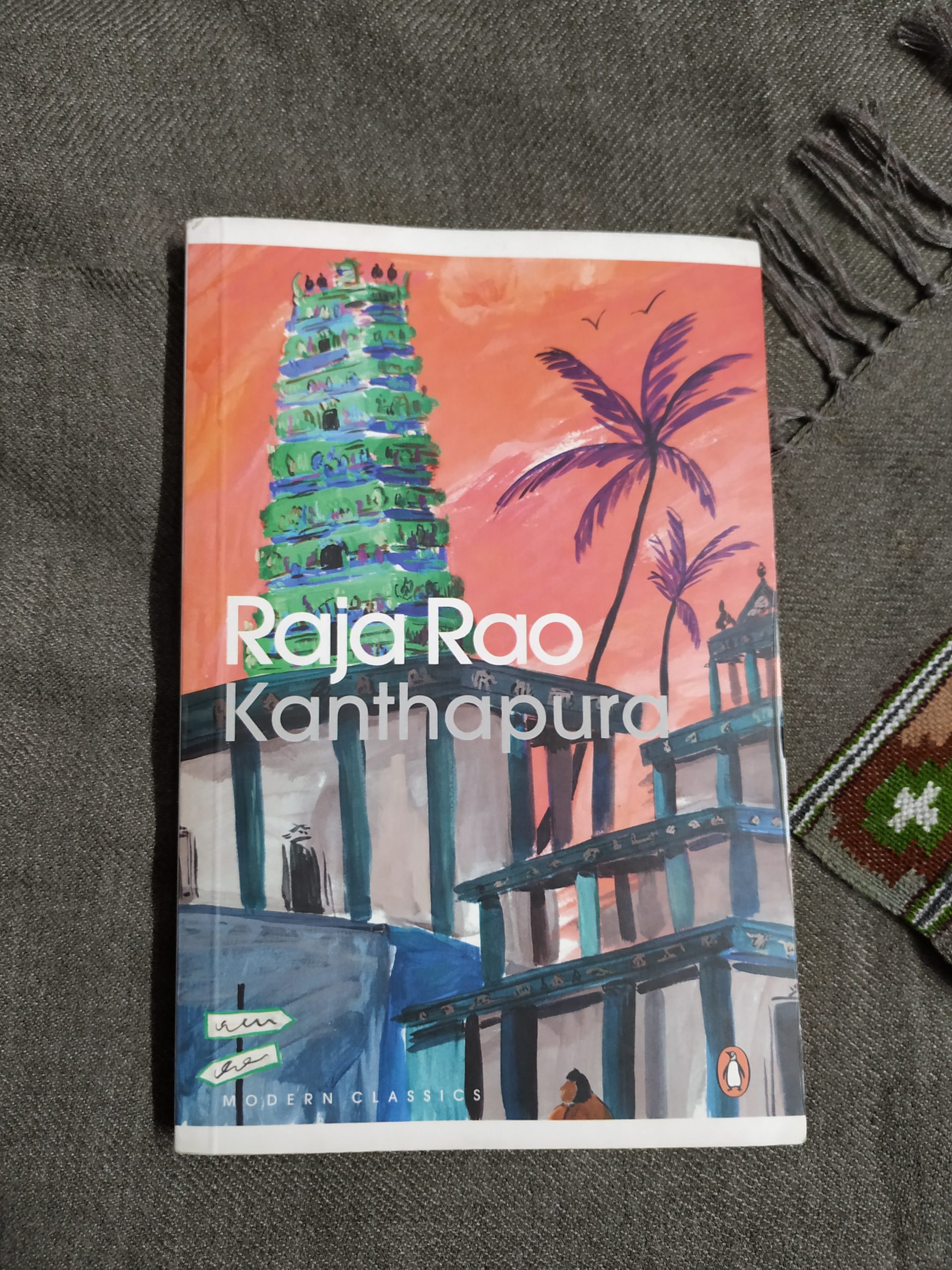
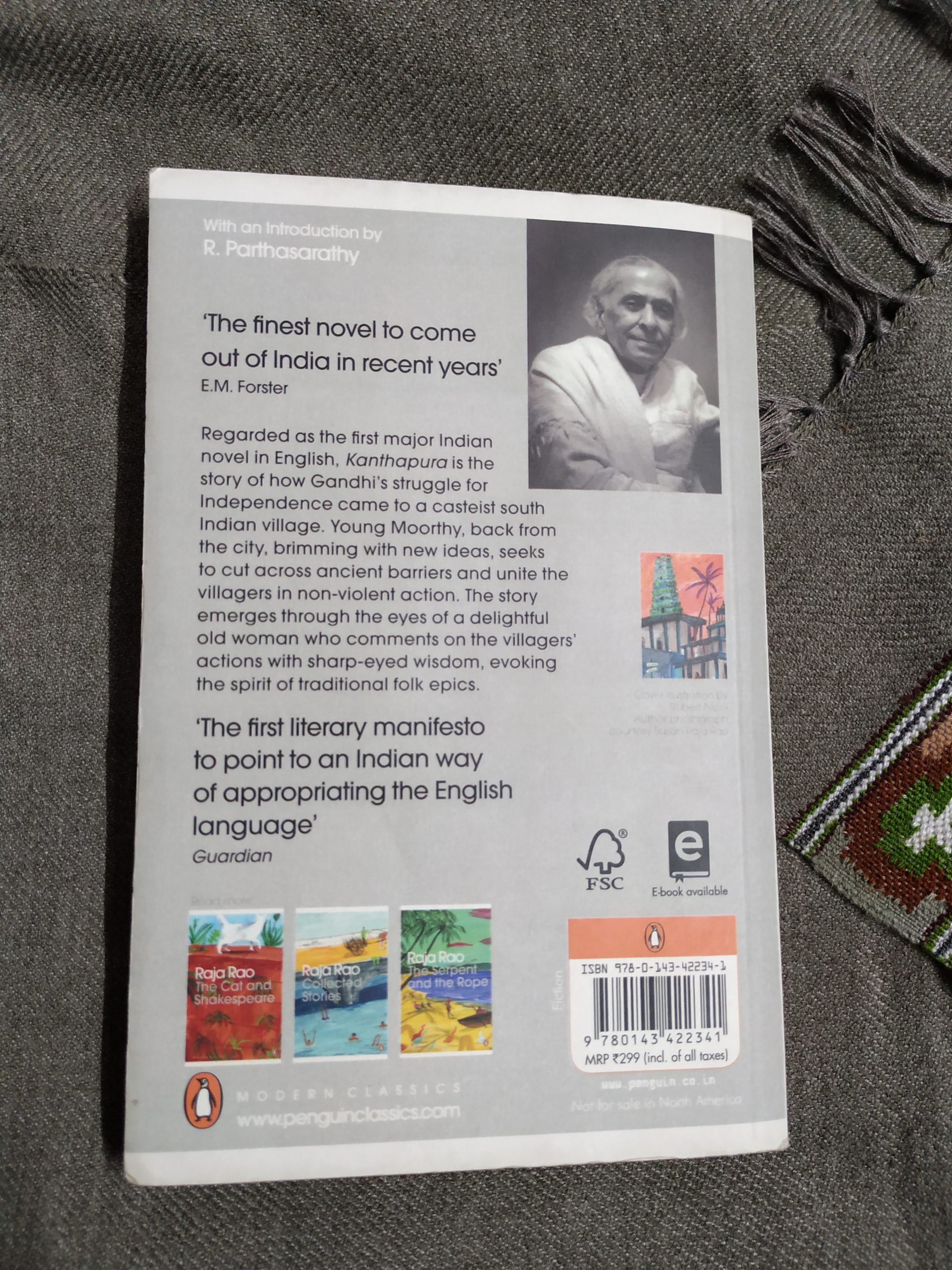
Kanthapura is a 1938 novel by the wonderful, most eloquent writer, Raja Rao – one of the finest amongst the Indian English novelists.
The novel shares the ‘Katha’ (traditional Indian style of storytelling) of a South Indian village, Kanthapura, that rises in tune with the Gandhian movement, imbuing everyone with the colours of Swaraj.
Achakka, an elderly lady, narrates this story as if she is telling a folk epic; passionately she shares, and you dare not disturb her, for she once lived in Kanthapura, high on the Ghats, high up the red hills, where Kenchamma, the goddess, reigns and blesses them all.
Achakka tells before anyone asks the reason behind the red earth – it is all blood that was shed in the battle between Kenchamma and a demon; Kenchamma won.
“Kenchamma, Kenchamma,
Goddess benign and bounteous,
Mother of earth, blood of life,
Harvest-queen, rain-crowned,
Kenchamma, Kenchamma,
Goddess benign and bounteous.”
*
Photo by Jagriti Rumi
Photo by Jagriti Rumi
Photo by Jagriti Rumi
“One has to convey in a language that is not one’s own the spirit that is one’s own. One has to convey the various shades and omissions of a certain thought-movement that looks maltreated in an alien language. I use the word ‘alien’, yet English is not really an alien language to us. It is the language of our intellectuall make-up – like Sanskrit and Persian was before – but not of our emotional make-up.”
Author’s Foreword, Kanthapura, Raja Rao
*
Writing in the Indianised English Raja Rao’s Kanthapura moves in a serpentine style, meandering boldly to present the Indian thought.
From Achakka, the narrator, to Moorthy the Satyagrahi, to the two widows – Rangamma, the wise, and Ratna, the defiant who was married at 10, to Ramakrishnayya, Patel Range Gowda, Bhatta, the Sahib, Bade Khan, Seenu, the Pariahs, Potters, Weavers, Coolies, children, cattle and strays, together they weave this sthalapurana tying it not to a time and place, yet speaking of a true era.
*
“There must be something in the sun of India that makes us rush and tumble and run on. And our paths are paths interminable. The Mahabharata has 214,778 verses and the Ramayana 48,000. The puranas are endless and innumerable. We have neither punctuation nor the treacherous ‘ats’ and ‘ons’ to bother us – we tell one interminable tale. Episode follows episode, and when our thoughts stop our breath stops, and we move on to another thought. This was and still is the ordinary style of our storytelling…”
Author’s Foreword, Kanthapura, Raja Rao
*
Flowing like a river, the story of Kanthapura, whether consumed mid-way or at any given point, continues to be powerful, calm and vibrant.
The distinctive style/ form of the story is the protagonist as it very straightforwardly propels the story, colouring all the plots, characters, twists and turns, monologues and prayers, speeches and rebukes, songs, celebrations and sufferings alike.
The form glues the novel’s world beautifully, heartily – not one cardamom plant or the fragrant sandalwood forest or the moon eyed gods and goddesses are unaware of what Moorthy discussed with Rangamma and Patel Range Gowda in the secret Congress meeting and what the whispering hearts shared, and what the sari-clad, bare feet, hands-busy-cooking offered their families and the deities.
*
Oh goddess, will my wish come true? [Source – Pixabay]
Everyone and everything moves ahead together like twigs, leaves and swans in a river.
Even the readers become an essential part of this ‘sthalapurana’ because sooner or later they sit down in a humble gathering to tell the others about a tiny village named Kanthapura.
The river… sketching its way ahead… [Source – Pixabay]
The Negro Speaks of Rivers
by Langston Hughes
*
I’ve known rivers:
I’ve known rivers ancient as the world and older than the flow of human blood in human veins.
My soul has grown deep like the rivers.
*
I bathed in the Euphrates when dawns were young.
I built my hut near the Congo and it lulled me to sleep.
I looked upon the Nile and raised the pyramids above it.
I heard the singing of the Mississippi when Abe Lincoln went down to New Orleans, and I’ve seen its muddy bosom turn all golden in the sunset.
*
I’ve known rivers:
Ancient, dusky rivers.
My soul has grown deep like the rivers.
Rivers – streams, creeks, brooks or rivulets – love to flow; flowing towards a sea, lake, an ocean or another river, and at times also drying out. Rivers love to flow just like life.
Most of the earlier civilisations prospered when they settled around rivers, channelizing the same love when drinking its fresh water.
And when mankind sat in a circle around the fire and created stories – of the sun, the moon, the thunder and the wind – they fostered their imaginations and decided to pass on the love running in their blood to a lovely supreme one.
Different supreme ones took the centre stage at different places and myriad dramas unfolded that the rivers watched quietly, flowing, gushing with joy every moment.
Resisting neither the rocks nor filth, accepting the dead and plastic bottles alike, it continues to flow… for now.
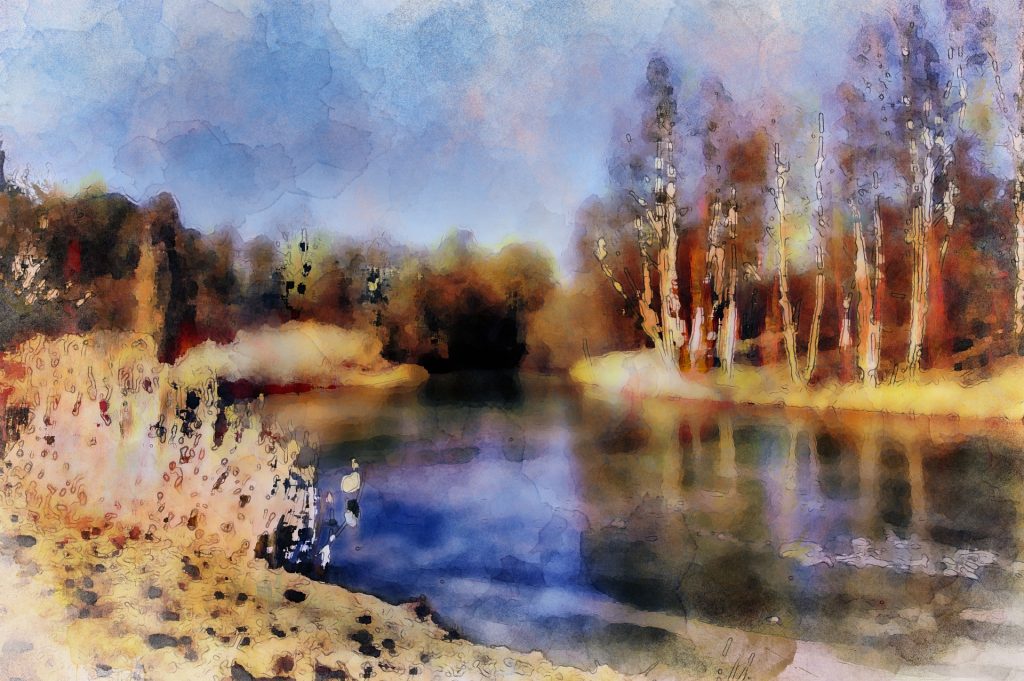
Still like a mirror, moving like a reflection… [Source – Pixabay]
Langston Hughes in his poem The Negro Speaks of Rivers connects the human soul with the world’s ancient rivers; the hands that cupped to drink water, the feet that crossed the river, whatever race it belonged to, felt the same damp calmness every single time they drank water and crossed the river.
Written during the early twentieth century when African Americans struggled to achieve equality and justice, Hughes, presenting a powerful historical perspective in this poem, emphasises the link between his ancestors, the ancient rivers and the rest of the human civilisation.
The Euphrates, often believed to be the birthplace of human civilisation, the Congo, powerful and mysterious, that saw the rise of many great African kingdoms, the magical Nile that carries with poise the secrets of the great Egyptian pyramids, the folklorist Mississippi that shared here the tales of Abraham Lincoln and American slavery – shows how rivers carry the past in its depth, carrying it always with love.
And the one who sees with love can sense the connection between rivers and souls, between them and us; we all started this journey together, the rivers are a testimony.
“I’ve known rivers:
Ancient, dusky rivers.
My soul has grown deep like the rivers.”
Experience and history, though often oppressive, have not extinguished but rather emboldened the development of a soul, the birth of an immortal self, the proud ‘I’ that now speaks to all who will listen.
I am joy running free/
freely flying, fluttering, soaring in a valley/
Of joy am running free.
Greetings!
A storyteller, following the ancient tradition of cave chroniclers, standing in vrikshasana (the tree pose) on a hill top (it is sunny, but windy), breathing in and out stories (relishing it all, but at times overwhelmed), declares animatedly that she will continue to – tell stories, share rare story gems, and connect with the pacy universe while also keeping the website ad-free.
Big thanks to my readers. Stay tuned!
Also, a humble request to the new subscribers to check the spam folder after subscribing. Silly (but necessary) confirmation emails often land there instead of the bright inboxes. Merci!
Ya-hoy!
Chiming Stories (formerly Home Chimes)
P.S – Supporting a storyteller is good for the world’s health (and undoubtedly, for the storyteller’s health as well). Shower some love by sharing, commenting and subscribing to the Weekly Newsletter.
Gabbeh, the 1996 film, is a simple tale of a gipsy girl, her clan and the way their life goes on. Unfolding beautifully just like an artist painting a canvas, Gabbeh quietly touches the grand questions.
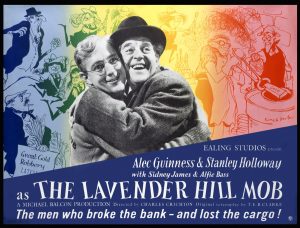
Ranked as one of the greatest British films of all time, The Lavender Hill Mob confides in the audience, letting them see, feel, laugh and think without tickling persuasively with a joke here and a punch-line there.
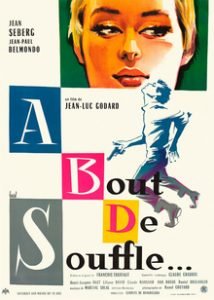
Godard… Breathless and Alive
A Tribute to Jean-Luc Godard, the Film Philologist who Reinvented Cinema.
Yes fly! For walking on the second track is dull and usual, but dreaming high, high, high requires tools. Tools like the right pair of shoes, a chirpy, gritty soul that eats butter-jam dreams, a soul that drinks milky-milky creams.
Silver cascade shimmering the night sky, music to the waves and surreal beauty to the eyes, the Moon loves the art of discipline.
It may be difficult to believe for the Moon’s splendour defies time, it stupefies the clock, it follows the path of a dreamer, but how could this be possible if the Moon knew not discipline?
In this moment, I am a little bit of this and a little bit of that, I am complete and incomplete, I am pleased and uncertain, I wish for nothing and I know I have to wait.
Because the distance covered reminds me of the hurdles I have crossed and the ones I could not, it reminds me of a throbbing past and a dreamy future and it reminds me of how much time is left.
Meredith and the Green Lake
Illimitable Splendour
A joy so complete without any rise or fall, so free without any time corners, so real without true being false, false being true.