Her picky parrot was partying somewhere and the crystal ball was dead, though she chanted to switch it on nevertheless, the old fortune-teller, with a trademark red-riding-hood cloak, was keen to predict the future. “Your future”, she squeaked suddenly.
Looking at the fixed-price board she beamed unambiguously.
“No, tell me about your future, predict first one for yourself”, said the customer confidently, sternly. “I’ll pay you extra.” The customer took out three silver coins and kept them on the table.
Fortune-teller’s eyes sparkled, slowly but firmly she picked the silver coins, mumbling to herself, gleefully, she hid the coins in one of her many pockets. Grinning, with some plans in her mind, she casually said, “I don’t believe in predictions.”
One hand still clutching her silver coins, she realised her mistake. “I-I mean, I can change the future. I often play with my-my future predictions.”
After a short staring competition between the two, she rudely said, “Now listen to what I foresee for you.”
“If you are any good, first predict your own future”, the customer said adamantly, taking out one gold coin and placing it near the crystal ball. The old fortune-teller’s toothless, sweet smile made her look delicately pretty.
She nodded her head, picked the rugged bag that was lying on the floor next to her and rummaged for something in it, happy and mumbling once again. Nimbly, she took out a tiny tin box, tore a paan in half, placing it in her mouth to the right side, she readied herself.
“Hmm, I carry five things with me you see, magical objects, I change the future as I please using these… mm (enjoying the paan) first is that precocious little parrot of mine, little nuisance, for ages now I have been looking after this (gestures towards the empty birdcage)… parrots are picky you see, mine feels he is a filthy gourmet (laughs loudly)… once he flew away, returned only a week later, bloody I almost fried him that day (more laughter)… but my parrot keeps me grounded, taking care of this fine finicky red-green creature I never lose focus when I sit down to alter my future life… if I mumble a wrong spell, my parrot rebukes me brazenly (laughs and relishes the paan).”
*
“My magic staff (points towards a wooden quarterstaff resting silently against the tent wall), partly made of dragon bones, many centuries old… swish-swash and the scene changes magically… ask those two thieves I met near, near (trying to remember the town’s name, coughs a little)… they thought an old dame like me, what can I do, I broke their noses, hit them with my staff non-stop, then I broke their ankles, heels and their filthy toes. Tempest-no-tempest, I always face it head-on (with an emphatic look raises a finger as if pointing towards her head), head-on, come what may… ya-hoy, I have built new paths where…where there were no lands you see, me and my magic staff.”
*
She tried to pick the gold coin that was silently shining brighter than the crystal ball sitting next to it, but the customer took it back and said, “what about the other three magical items?”
Visibly displeased the old fortune-teller swallowed the paan and then mumbled something, possibly some curses.
“Hmm… this crystal ball is no ordinary crystal ball, I can see the future and the past in it. But don’t ask me to see your past, I cannot make it work for others, what a shame! If you can give me two gold coins, I can give it a try, hmm? No? Sissy!”
The customer looked at the crystal ball and pondered.
*
“This crystal ball shows me my past, times when I acted like a goof and times when I was a spectacle, I balance things, add condiments accordingly, that is the recipe to a pickled life. And here, see-see this red cloak it has so many pockets, I keep my charm books in it, plus (takes out an old hand-mirror from one of the pockets) this mirror, it is also magical. Do you want to buy it? Hmm? Think wisely!”
The old fortune-teller showed the inside pockets of her cloak, she tried getting up but her aching knees refused to budge. The customer got up and turned to leave.
*
“Listen, special offer for you… buy this cloak and get one of my charm books for free; refer to it when stuck somewhere or attacking an enemy, this is the best way to create a bright future; (gets up slowly, grunting and pushing her chair backwards) buy this mirror then, magical hand-mirror, price -one silver coin only, ask it when you have failed and it will brazenly speak the truth, I always use it, did it just before you came in, and see I have moved on, so… hey!”
The customer turned, keeping the gold coin on the table said, “I would need all the five”, then smiled and left.
The old-fortune teller, as if transfixed, picked the coin, checked its authenticity and kept it safely in her pocket. As she sat down slowly, her parrot flew back in; she cursed him badly before offering him half of the paan.
If you were the customer, which magical object you would have bought and why?
The certainty of it being the night promises us of the erubescent dawn. It is an inky night, it has been for aeons and aeons… and, mind you, she uses charcoal-ink… for the stove is still burning, she never forgets to collect woods.
And so, with her inky fingers she writes messages, anecdotes, dead secrets and stolen dreams on the walls in the kitchen.
A custom followed since antiquity, now the charcoal-ink smells of these quiet cursive messages. It talks about the dark night and the breaking of the dawn.
Her inky fingers will turn red with the dawn.
But Sita needed all the strength she could muster to face the big trial awaiting her. After that, it was one straight path to a single goal, wifehood. The veena was a singularly jealous lover.
Then one morning, abruptly, without an inkling that the choice that was to change her life lurked so near, Sita gave up her love. She tore the strings off the wooden base, and let the blood dry on her fingers, to remind herself of her chosen path on the first difficult days of abstinence.
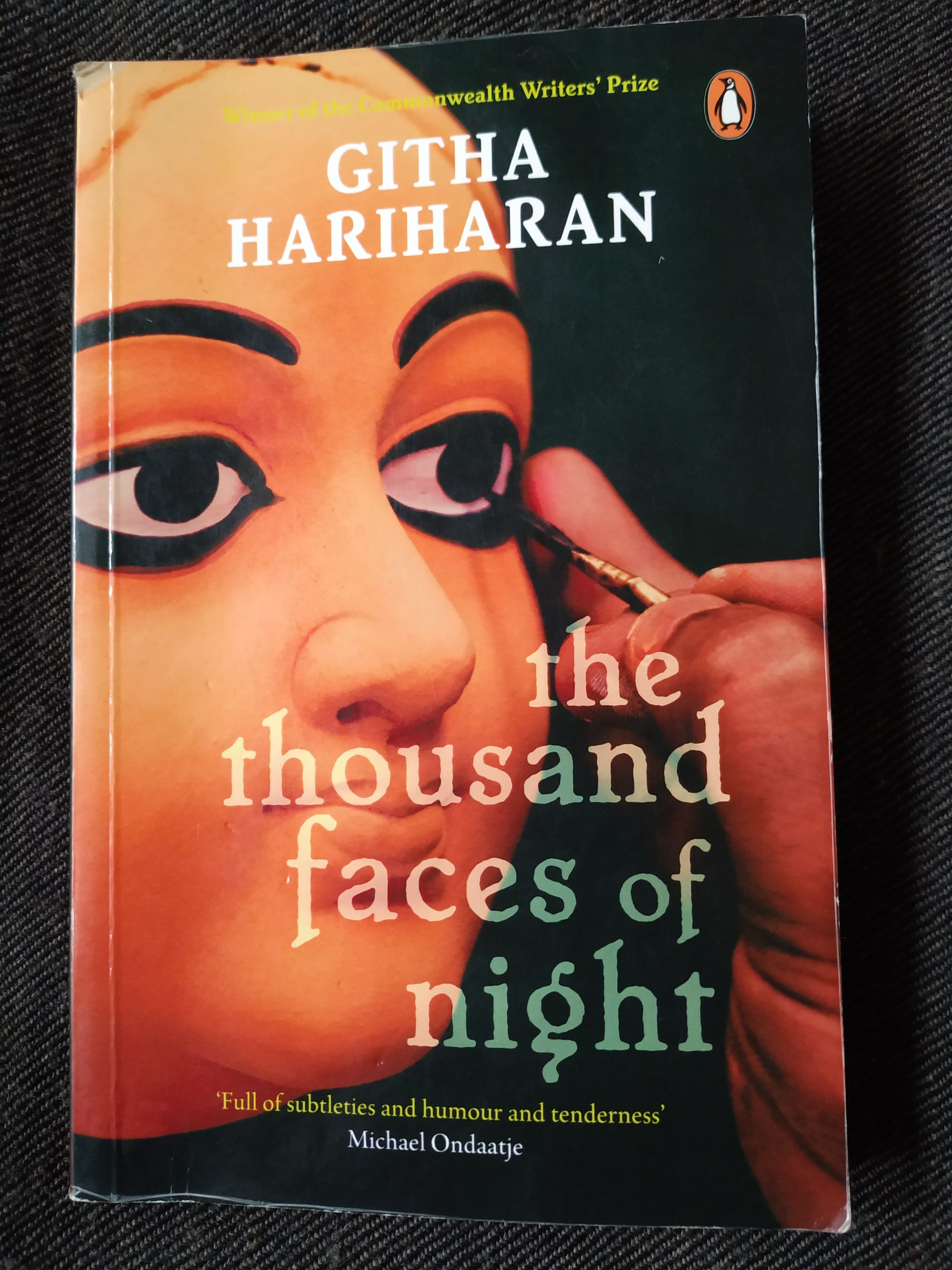
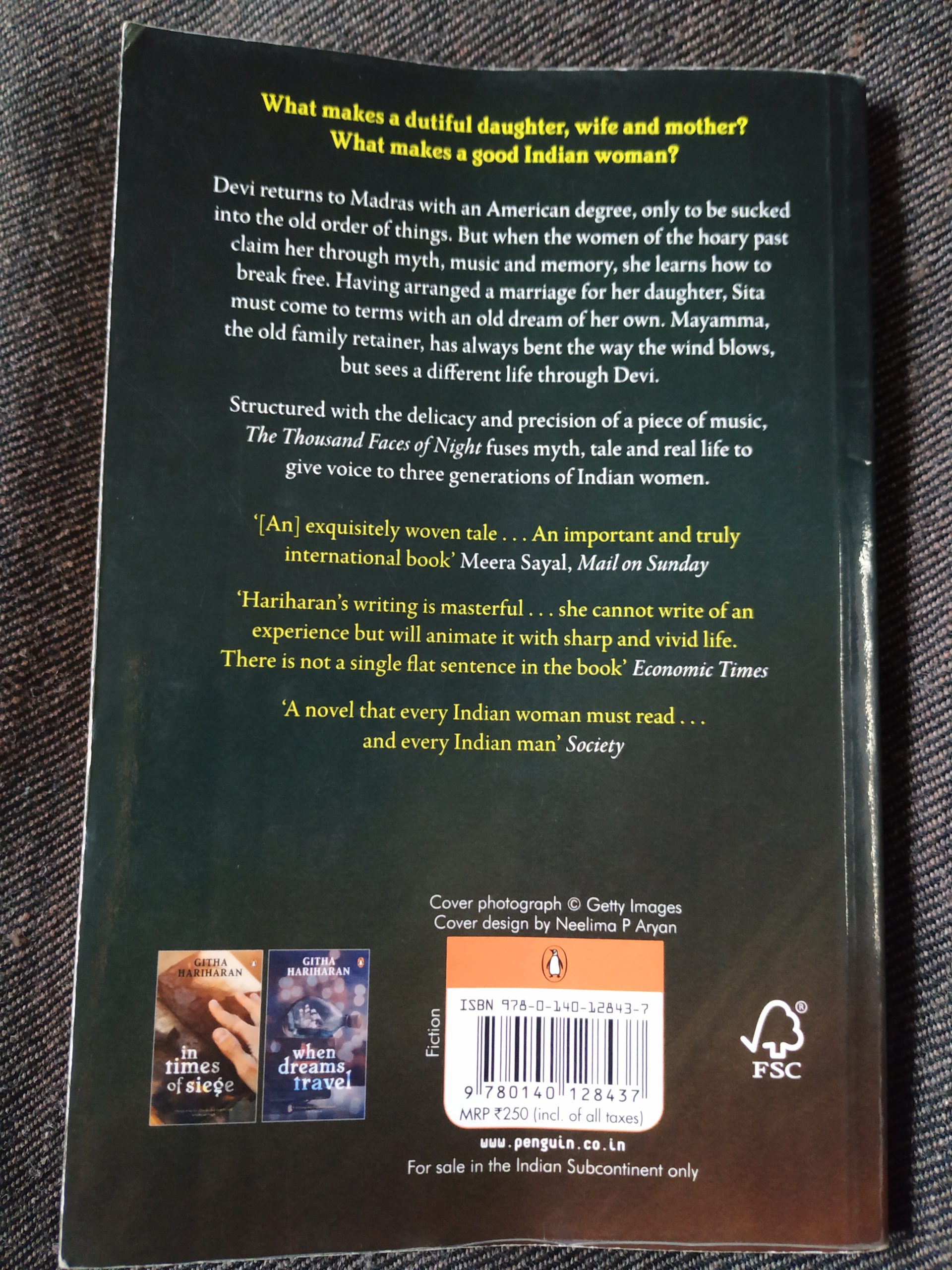
The Thousand Faces of Night (1992) is written by the astounding Githa Hariharan. The novel is a melody sung and composed at night that captures the thousand faces of the moonless, starless night.
It narrates the many tales of Indian women – the celebrated mythical ones and the limited editions – with such excellence that the novel takes the shape of a woman carrying a heavy potli bag full of tales.
The tales, entangled badly, still echo well and dramatise their essence. The tales are spicy and heart wrenching and true.
*
Earthenware… they hold intact their stories, cultures for centuries. [Source – Pixabay]
Devi, Sita, Mayamma – daughter, mother, maid – kindle fire that burns time, others and themselves. And so powerful is this fire that life gathers around it to get some inspiration.
Delicate like earthenware, painted beautifully, allegedly breakable, they hold intact their stories, cultures for centuries; you must have seen the pieces of such earthenware dug out from archaeological sites, displayed in a museum safely.
Their resilience never fails them even if it means to walk alone, against the tide, the familiar sunshine. Devi, the present, dares to break away, in her agility, eager to explore, moving away from Mayamma and Sita, the past.
Posing in front of the patriarch, they contribute to his legacy/magnificence. After foolishly spending a long time and suffering from backaches, Sita straightens up and Devi dodges the mockery, while Mayamma continues.
The patriarch sees Mayamma and smiles, Mayamma bows and cusses silently. She prays for Devi.
After etching their charcoal-inked messages on the kitchen walls, the three ladies change the notation of their melody slightly, making the raga, still sung at night, fresher.
*
I must have, as I grew older, begun to see the fine cracks in the bridge my grandmother built between the stories I loved, and the less self-contained, more sordid stories I saw unfolding around me. The cracks I now see are no longer fine, they gape as if the glue that held them together was counterfeit in the first place. But the gap I now see is also a debt: I have to repair it to vindicate my beloved storyteller.
Not mine own fears, nor the prophetic soul Of the wide world dreaming on things to come, Can yet the lease of my true love control, Suppos’d as forfeit to a confin’d doom. The mortal moon hath her eclipse endur’d, And the sad augurs mock their own presage; Incertainties now crown themselves assur’d, And peace proclaims olives of endless age. Now with the drops of this most balmy time My love looks fresh, and Death to me subscribes, Since, spite of him, I’ll live in this poor rime, While he insults o’er dull and speechless tribes: And thou in this shalt find thy monument, When tyrants’ crests and tombs of brass are spent.
The idea of timelessness, eternity, immortality must be true as we wish, look and aim for it in some way or the other. Imagining living continuously, building and creating happy ways of life, chiselling and shaping the continuous source of happiness, we forgetfully live with the idea of forever.
The decisive time gone by, the melting present and the secret future, though definite, knows the indefinite. And one is lured, naturally, to know and identify with the indefinite. Why? For the indefinite is the absolute. So? The absolute appears to be complete, eternal, beyond the cyclic drama and free. Then? We may be a part of it or we too may want to be complete. And so? I don’t know, I am living forgetfully with the idea of forever, remember.
Shakespeare, the greatest and most famous playwright ever, via his works, attained immortality and this is what he celebrated in Sonnet 107. Full of creative splendour, he announced his lead on rusty cenotaphs and statues of the rulers.
The Battle at Gavelines and Elizabeth I at Tilbury (Pastiche). The painting presents a stylized account of the battle of Gravelines between the Spanish Armada and the English fleet, including the beacons, Elizabeth’s address at Tilbury, and the battle itself in a single montage on three jointed pieces of fine tabby-weave linen. [Source – Wikimedia Commons]
“The mortal moon hath her eclipse endured”
That the grand, rock-hard, grave and lovely moon too continues its finite journey, eroding gradually, black red white, suggests that the moon knows well the infinite’s will. Or else why will it so humbly accept its role? This long journey, then, is no less than a quiet meditation. The deep circular craters are the timekeepers and the moon knows it.
One of William Shakespeare’s renowned 154 Sonnets, Sonnet 107 is often linked with the contemporary events of the time: the defeat of the Spanish Armada (1588), Queen Elizabeth’s death (in 1603), the Long Turkish War (1593-1606); the Armada charged in a crescent formation, Queen Elizabeth was also called Cynthia (name of the Greek moon goddess), the Ottoman Empire’s flag boasted the crescent moon symbol.
In times so precarious, one would want to hold on to a secure thought or remember the limits of mortality, mocking unabashedly the warmongers and peace-lovers alike, or even hope to create something timeless.
Read the wonderfully crisp commentary on Sonnet 107, here.
Like flowers threaded to form a sheet, woven intricately, the free white petals settling in a designed pattern, accepting the arrangement with joy, like an endless beaded wave of fragrant flower-colours, the ragas also weave intricately musical framework that evokes fragrant feelings in a quiet listener’s mind.
Just like the perfection-loving flowers – the humble sepal, the vibrant petal, the ambitious anther – the ragas too know how to bloom to perfection. Capturing the exact mood that exudes the season’s essence perfectly, the ragas effortlessly scent time making it beautifully appreciable.
*
The scented time celebrates the raga – in Vilambit laya (slow tempo), Madhya laya (medium tempo), Drut laya (fast tempo) – accepting every melodic improvisation, evolving with each performance, never bothering with change, rather ushering it with consistent Riyaz (practice).
Overwhelming calculations keep the ragas free from vegetating and from the burden of the past that at times tries to confine its spirit, but almost always the spirit remembers to break free.
The many notations, the Swara, bring forth incessant improvisations, giving space to every emotional twist, forming an intricate, fragrant Mandala.
The ragas symbolise, like a flower threaded sheet, intricacies of life… and more.
Lat uljhi suljha ja balam
Piya more haath mein mehndi lagi hai
Lat uljhi suljha ja balam…
Mathe ki bindiya bikhar rahi hai
Apne hi haath laga ja balam
Lat uljhi suljha ja balam…
*
(Translation – Disentangle my hair, dear beloved/ I have applied henna on my hands/ So come and disentangle my hair, dear beloved/ The bindiya too is spreading on my forehead/ Correct it for me with your own hands, dear beloved/ Disentangle my hair, dear beloved)
This Bandish* in raga Bihag decorates time with a jasmine-rich fragrant emotion that vehemently values love and life.
*Bindiya – a colourful dot mark (of vermilion) worn between the eyebrows, especially by married Hindu women.
*Bandish – a composition in Hindustani classical music.
Listen to a melodious version of this bandish now.
Now a clear dot… now hazy… mixing with the clouds through and through, then beaming alone gloriously. Splattering moony clay, then rubbing it, greasing with it the deep dark sky.
Mirroring all the romantics and dream-talkers, the moony clay moulds itself to fit into the beholder’s eyes and patient hearts. It listens, nods and registers its reply with the artist.
Moony clay – an assiduous storyteller, slowly moving away – happily builds the wavy waves and like a sand clock shows the slipping time its way.
Singing joyously, dancing leisurely, the moony clay creates and fills the heart with hope, lost in splendour.
See how it re-shapes, re-writes its journey, certain of uncertainty in knowing… in knowing it all.
Is it the time for the fluttering bird to take a dip in the tiny cool puddle, and for the other one, that flame-throated bulbul, carrying a silky grass leaf to that topmost branch of that lush happy tree, to finish weaving its nest?
And is it the time for the Oo slithery snake, zigzagging like a threatening thought, to just be itself and rest in the sun, simply meditating, with its uncanny sense of smell taking in the jungle’s fragrance?
And… and is it the time for the slim sharp golden jackal, dancing a slow jazz twist otherwise, to sit under a tree with a full stomach, attentive ears and a cheerful beam?
And ohhh… is it the time then… for the lion-tailed macaques, frolicking as a rule, to alert-a-l-e-r-t-ALERT all in the jungle about the royal king’s visit?
Is it the time… I don’t know… there isn’t a clock in the jungle that tells time. Is there? Yes, there indeed is.
The animal and plant kingdom are joyful disciplined folks, every species, diurnal and nocturnal, breathe in the jungle’s air, finish all its chores on time, maintain a balanced diet, sip water leisurely and quietly rests zzz…
They keep following the clock that shines up in the sky – they follow the shadows and the white shimmery light at night and the rhythmical wind and the damp, dry, crumbly and chilly seasons.
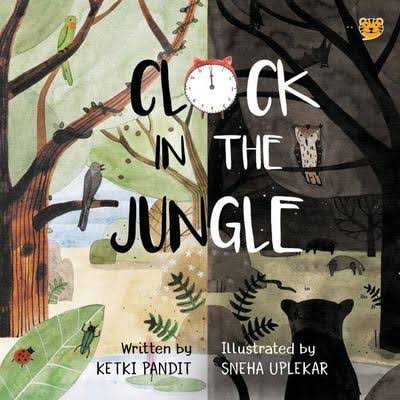
Clock in the Jungle (written by Ketki Pandit and illustrated by Sneha Uplekar) narrates in verse this saga of the punctual wildlife, revealing a powerful secret that every species adhere to by choice, the simple sweet habit of keeping the clock always running.
Listen to this another story that utters no word, that is as silent as a voiceless thought, behold its magic, it will enchant you, surprise you and remind you of the climate’s call.
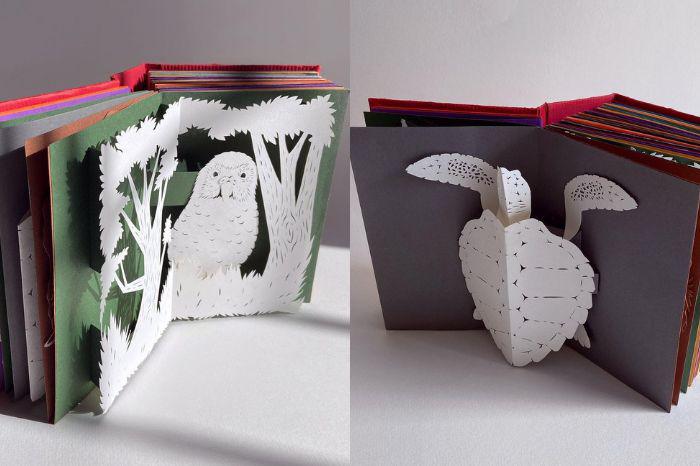
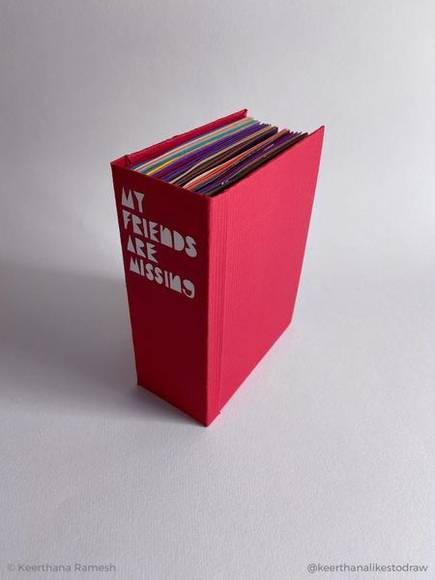
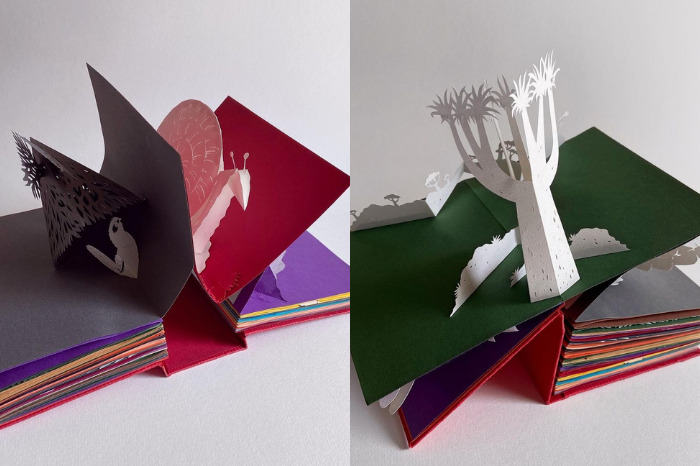
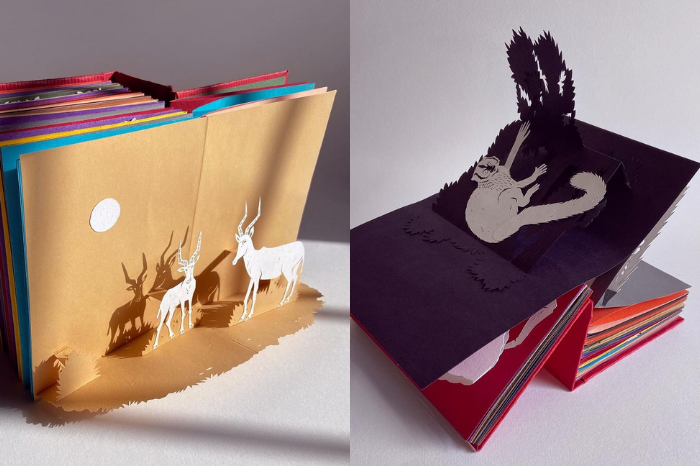
My Friends Are Missing (by paper artist Keerthana Ramesh) is a pop-up book that introduces us to thirty endangered species in the world, delicate, quiet and tolerant beings, that are battling the climate’s challenge, positioned at the forefront, they continue to face the impatient and greedy world’s madness.
Just like in the pop-up book, these species with a functioning clock and a devoted heart, step forward in the drastically changing world where their natural habitats are transformed into a smog-loving, power-hungry factory that clickety-clack runs in the anti-clock direction, challenging the earth’s circadian cycle.
“The damage is ours, the curse is ours, the solution won’t come from the aliens”, said a Kemp’s ridley sea turtle before taking a dip in the Gulf of Mexico.
And what the elusive bird, New Caledonian Owlet-Nightjar, commented in 1998 isn’t clear because it vanished before the reporter could pen-it-down and hasn’t been spotted since then.
Only our blue-green planet knows where this elusive bird resides, but she won’t tell for she loves mysteries. Our lonely planet is not so lonely as so many hidden mysteries and stories unfolding simultaneously accompany it; our dear earth provides a home for all.
In How The Earth Got Its Beauty (written by Sudha Murty and illustrated by Priyanka Pachpande) Mother Earth, decades after the creation of the planet, disguised as a little girl meets three sisters – Sunaina, Shyama and Seeta – to find out if humans are living peacefully and she finds out that the three sisters desire for something else in their lives. Will Mother Earth grant their wishes?
The story emphasises values like patience, compassion and empathy, highlighting also the selflessness and power of Mother Earth; the author writes, “Whenever humans become selfish and uncaring towards Mother Earth, she makes her presence felt and restores the balance in the world.”
We, the forgetful ones, so often forget about our home, not the walled-well-lit-well-decorated-space, but the beautiful breathing planet that never forgets us even when it rotates ceaselessly, matching its clock with the burning star’s every aeon.
Tick-tock-tick tock…
It is time for a treasure hunt, go to the jungle and look for a clock, then walk in the direction its three hands (seconds, minutes and hours) point at, one day at a time, and look for the endangered species. Be patient and kind, focus on the treasure, the great grand treasure, value it, it is your home, your only home.
Grab these wonderful books now –
Clock In The Jungle by Ketki Pandit, Illustrated by Sneha Uplekar (click here);
How the Earth Got its Beauty written by Sudha Murty and illustrated by Priyanka Pachpande (click here).
And also flip through Keerthana Ramesh’s My Friends Are Missing –
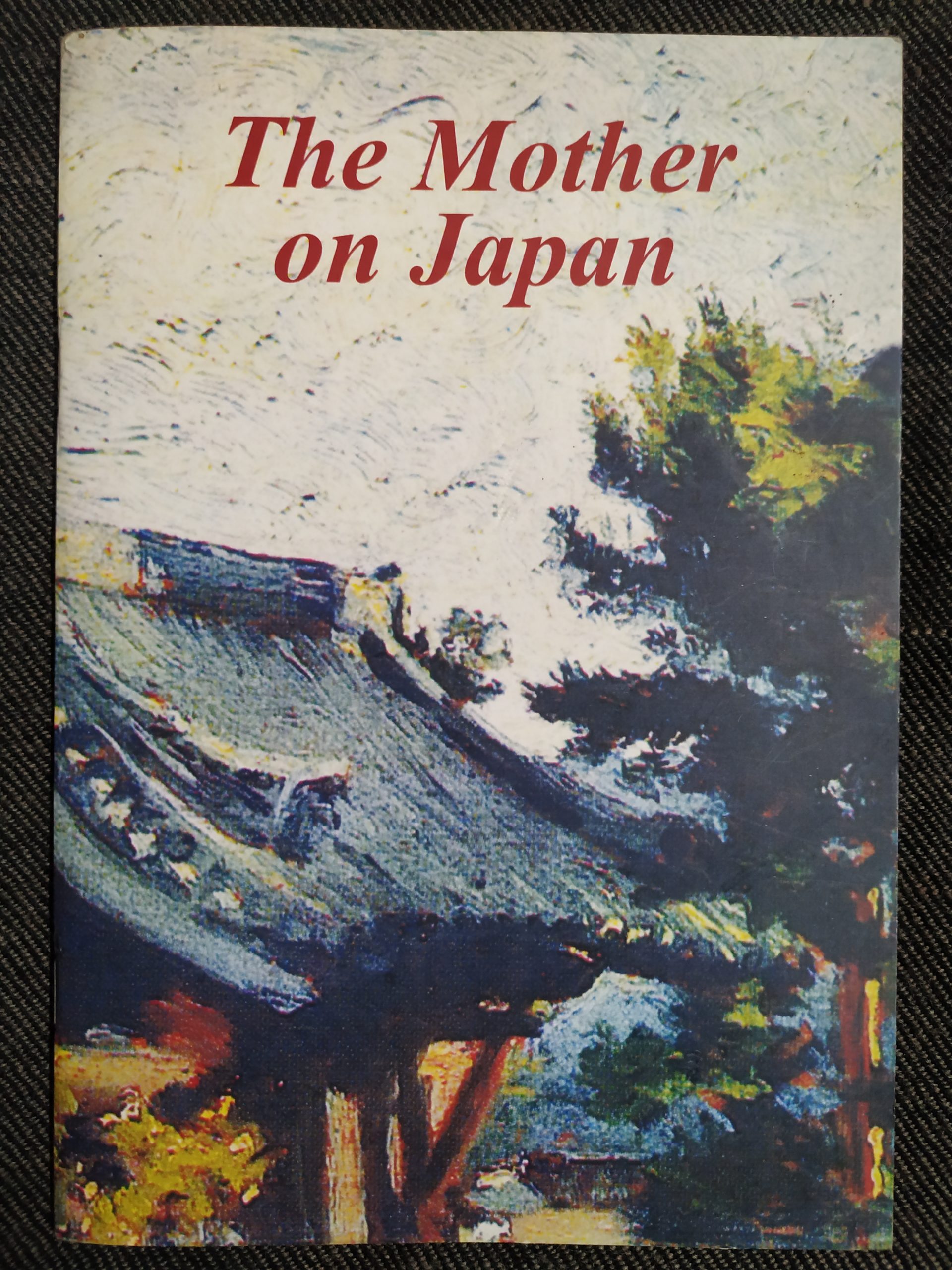
Seeing through a lens that sees things as it is, in its truest form, looking at a broken feather as a feather, not denying its reality, not giving it a quality, experiencing the moment quietly the Mother wrote about Japan. She wrote about its perfection/ beauty-loving people, the value given to nurturing kids, the dedicated women, the Japanese restrained-balanced-subtle art and the transient life.
Roof of the Daiunji Temple in Kyoto, painting by the Mother. (Book cover) [Photo by Jagriti Rumi]
The Mother on Japan [Photo by Jagriti Rumi]
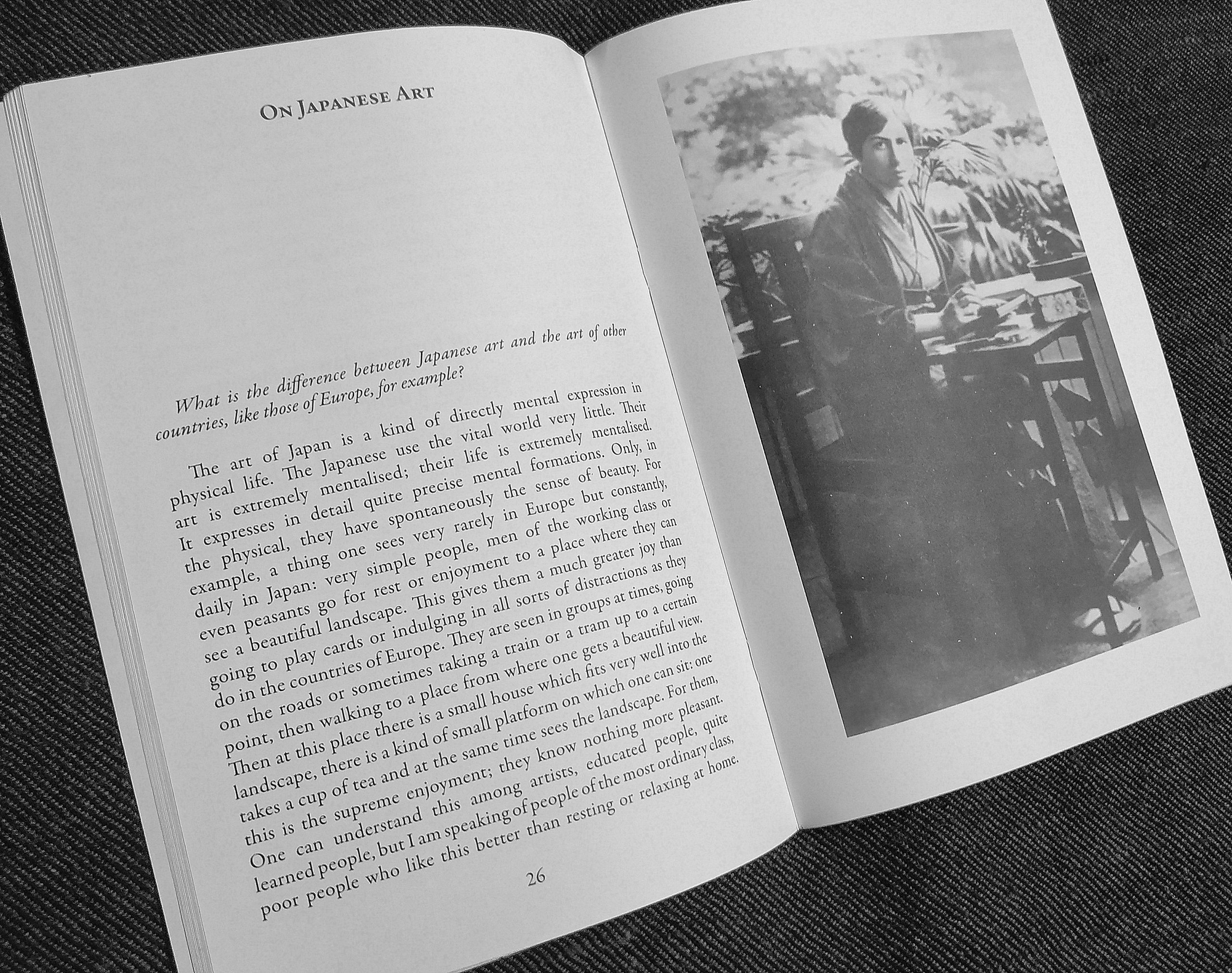
The Mother on Japan [Photo by Jagriti Rumi]
The Mother on Japan [Photo by Jagriti Rumi]
The Mother on Japan [Photo by Jagriti Rumi]
The people, she observed, not via reactions, but by silent selfless actions showed how much they cared for someone; happy to persevere they worked to fulfil the task at hand, devoted harmoniously and absolutely in the present moment, aware about nothing else.
*
Taking long walks to a garden in spring or autumns and spending time there or climbing the steep stairs to reach the monastery at the top of the hilltop, the people (of every and any class), she noticed, believed in beauty and peace.
*
“…very simple people, men of working class or even peasants go for rest or enjoyment to a place where they can see a beautiful landscape. This gives them a much greater joy than going to play cards or indulging in all sorts of distractions as they do in the countries of Europe. They are seen in groups at times, going on the roads or sometimes taking a train or a tram up to a certain point, then walking to a place from where one gets a beautiful view.”
“For instance, in autumn leaves become red; they have large numbers of maple-trees (the leaves of the maple turn into all the shades of the most vivid red in autumn, it is absolutely marvellous), so they arrange a place near temple, for instance, on the top of a hill, and the entire hill is covered with maples.”
“Well, an artist who goes there will experience an emotion of absolutely exceptional, marvellous beauty. But one sees very small children, families even, with a baby on the shoulder, going there in groups. In autumn they will go there. In springtime they will go elsewhere.”
The Mother (Questions and Answers, The Mother on Japan 12 April 1951)
Image of the Buddha, painting by the Mother. (The Mother, Paintings and Drawings, Sri Aurobindo Ashram Trust, 1992) [Photo by – Jagriti Rumi]
While reading about the 1919 flu and how the Mother fought back the negative, dark energy, one thinks about the present pandemic and hopes to win like the Mother in the end.
The glorious cherry-blossom trees in bloom – pink, white, vivid joyous pink – and the narrow paths that take one to wonderful places, with old Japanese houses on both sides, presented the Mother with a paradise puzzle…
*
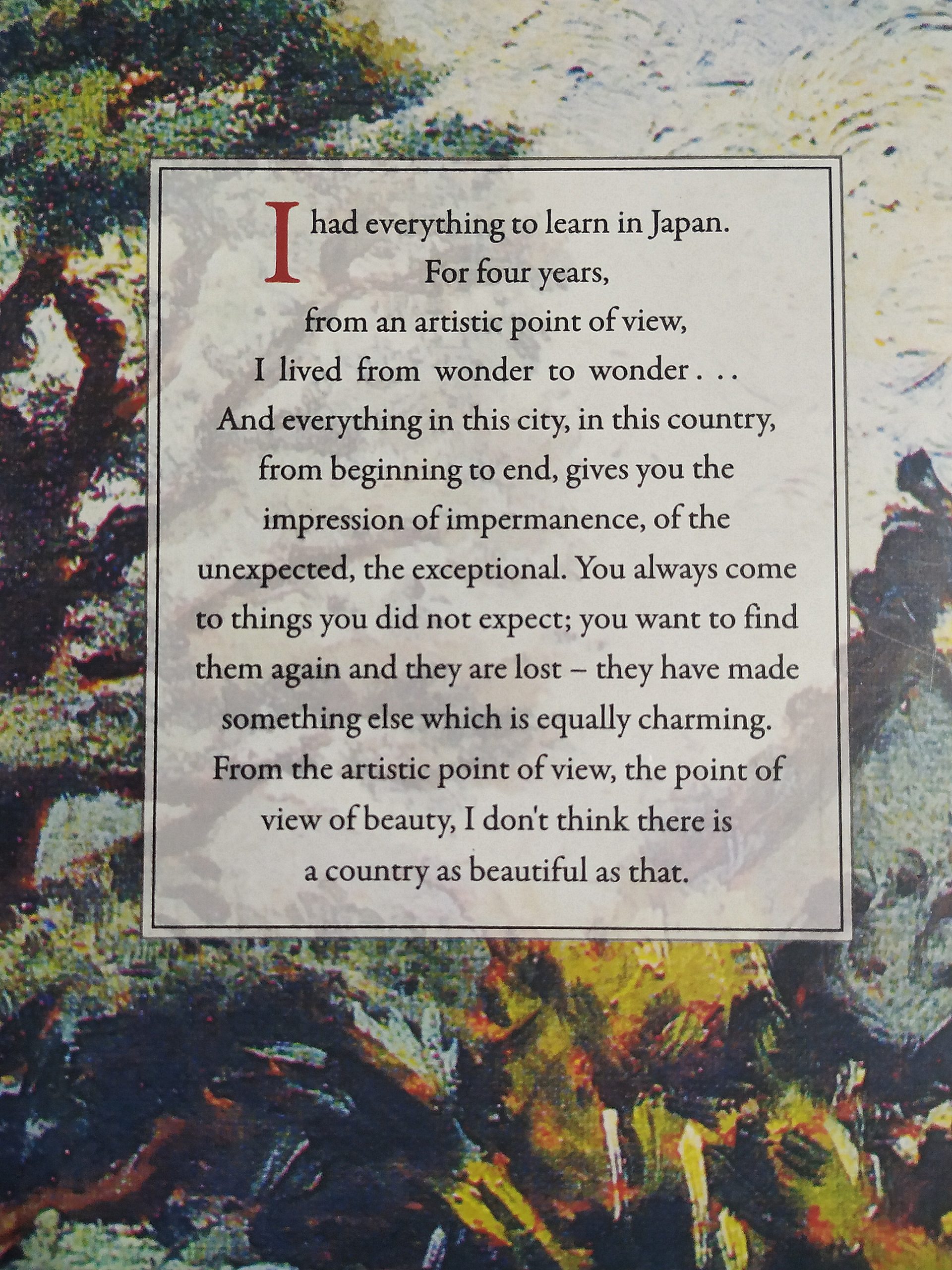
“Then you go wandering around – always one wanders at random in that country – you go wandering and all of a sudden you turn the corner of a street and come to a kind of paradise: there are magnificent trees, a temple as beautiful as everything else, you see nothing of the city (Tokyo) any longer, no more traffic, no tramways; a corner, a corner of trees with magnificent colours, and it is beautiful, beautiful like everything else. You do not know how you have reached there, you seem to have come by luck. And then you turn, you seek your way, you wander off again and go elsewhere. And some days later you want to come back to this very place, but it is impossible, it is as though it had disappeared. And this is so frequent, this is so true that such stories are often told in Japan. Their literature is full of fairy-lore. They tell you a story in which the hero comes suddenly to an enchanted place: he sees fairies, he sees marvellous beings, he spends exquisite hours among flowers, music; all is splendid. The next day he is obliged to leave; it is the law of the place, he goes away. He tries to come back, but never does. He can no longer find the place: it was there, it has disappeared!… And everything in this city, in this country, from beginning to end, gives you the impression of impermanence, of the unexpected, the exceptional. You always come to things you did not expect; you want to find them again and they are lost – they have made something else which is equally charming. From the artistic point of view, the point of view of beauty, I don’t think there is a country as beautiful as that.”
The Mother (Questions and Answers, The Mother on Japan 12 April 1951)
The crayon doodles, chalk scrabbled floor and walls, silly games of following the clouds, the butterflies and the wind, toying with fairy tale thoughts, dancing in the rain, eating snowflakes, and living in the inverted fable world… all this and every other childhood memory comes alive in Miyazaki’s masterpiece anime, My Neighbour Totoro.
Those whispers, secrets, and myths that we all have heard, in which the happy spirits rise to guide the one who dares and bridges her to the magic around, which world-wide have different versions, which are absurd yet possible, forms the core of this motley work.
Two little girls, Satsuki and Mei, move to the countryside in Japan along with their father, Tatsuo Kusakabe. Mama Yasuko Kusakabe is not well and so she is admitted to the hospital which is closer to this countryside house.
“But she will recover and come back home soon”, says Dady Tatsuo, “when, will she be back by tomorrow?” asks four years old Mei, “there she goes again with tomorrow”, says Satsuki and they all laugh.
Mei is courageous, she even catches a soot gremlin to show it to Satsuki but it ends up only in making her hands black.
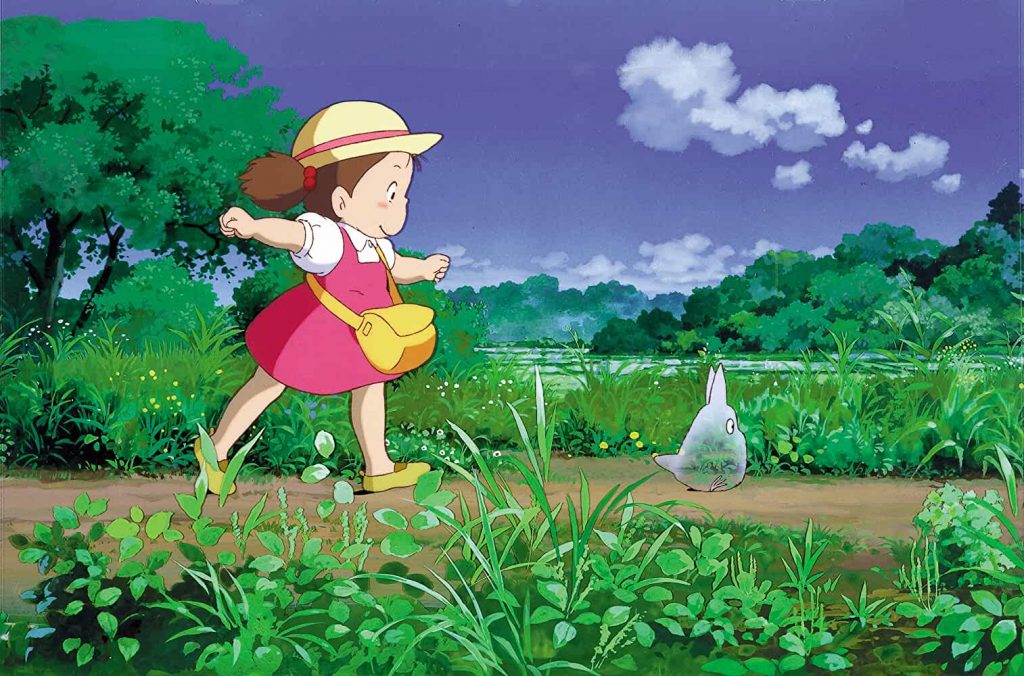
As Satsuki goes to school, little Mei plays around the house alone; carrying her packed lunchbox, she explores the place with a clear and light mind, giggling, following two small bunny-like Totoros to the colossal camphor tree and ultimately meeting the big Totoro there.
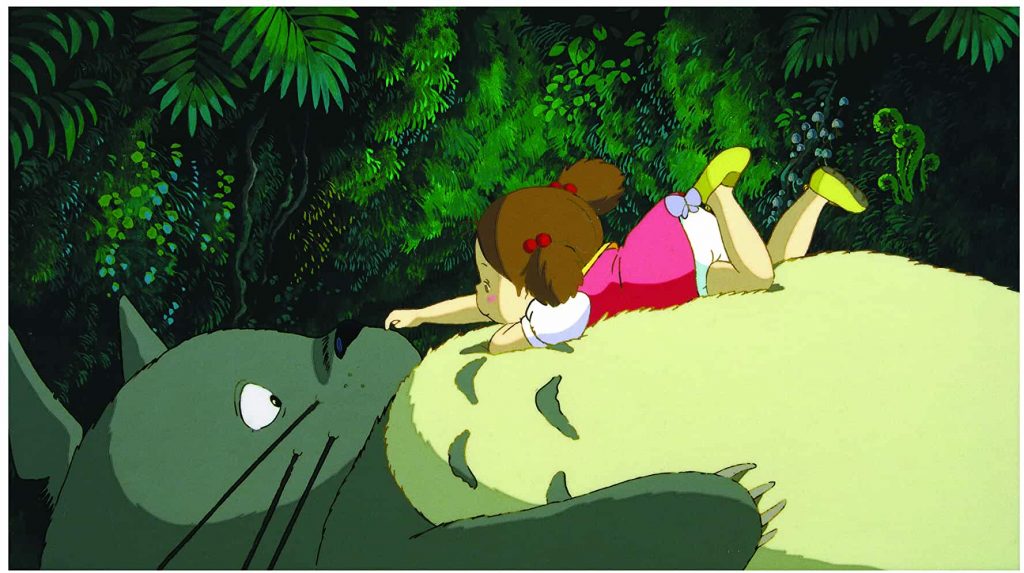
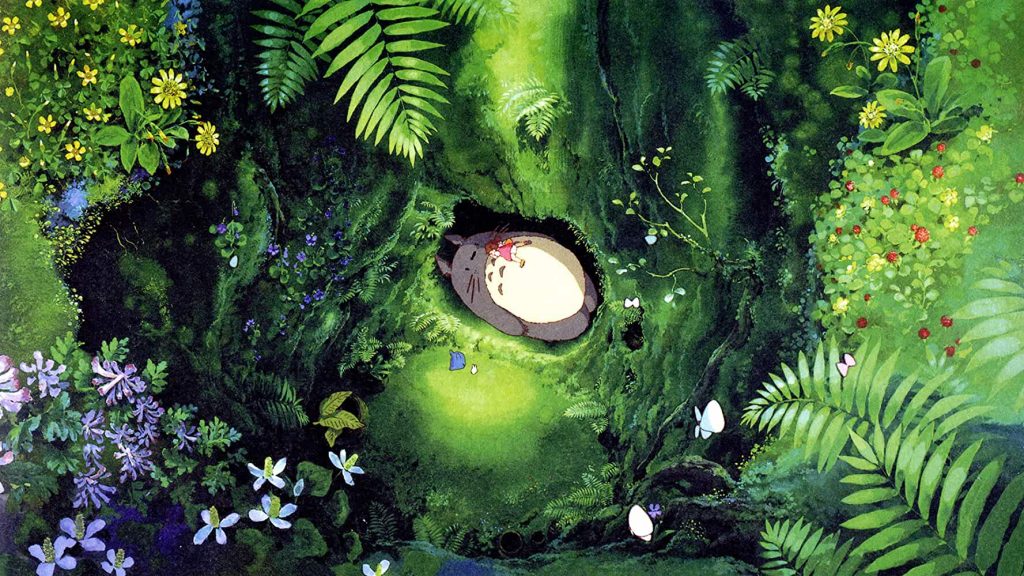
Totoro is a furry giant animal, with whiskers, big eyes, and a bigger smile. He lives in the huge camphor tree in the forest neighbouring Satsuki and Mei’s house.
While the little Totoros collect acorns, the giant one helps it to grow; together they play the ocarina like music instruments at night, sitting high on a branch, guarding the forest, and all the beings living in it.
Totoro in some ways is like a Kami – a spirit in Japanese religion of Shinto – which can be anything, from forces of nature to spirits of an honoured dead person like a King. Possessing both positive and negative qualities, these spirits are to be worshipped and thanked for their blessings and support.
Kami cannot be seen by everyone, but the one whom it chooses to reveal itself to. Being aware of the powers of Kami means being aware of the powers of nature, respecting it, and also showing gratitude for what it grants.
After Mei’s first encounter with Totoro, their father takes both the girls to a nearby Shinto shrine to thank the Kami for looking after Mei and asking it to continue looking after all of them. The shrine is next to the giant camphor tree which Mei happily recognises, but doesn’t find the way to Totoro’s den as she did the last time.
Two Little sisters, Mei and Satsuki
As children look at the world with the hope to see a miracle every second and love as if it is all theirs, it is only Mei and Satsuki who get to meet Totoro. It all starts with Mei, she sees the soot gremlins twice and then the three Totoros. Little Mei’s world, it seems, is still more magical than Satsuki.
When Mei tells Satsuki about Totoro, she tells her father that she too wants to meet Totoro, but on one occasion when Mei accompanies her to the school and draws Totoro’s image on a sheet, Satsuki feels embarrassed amongst her giggling friends, typical of a growing-up kid.
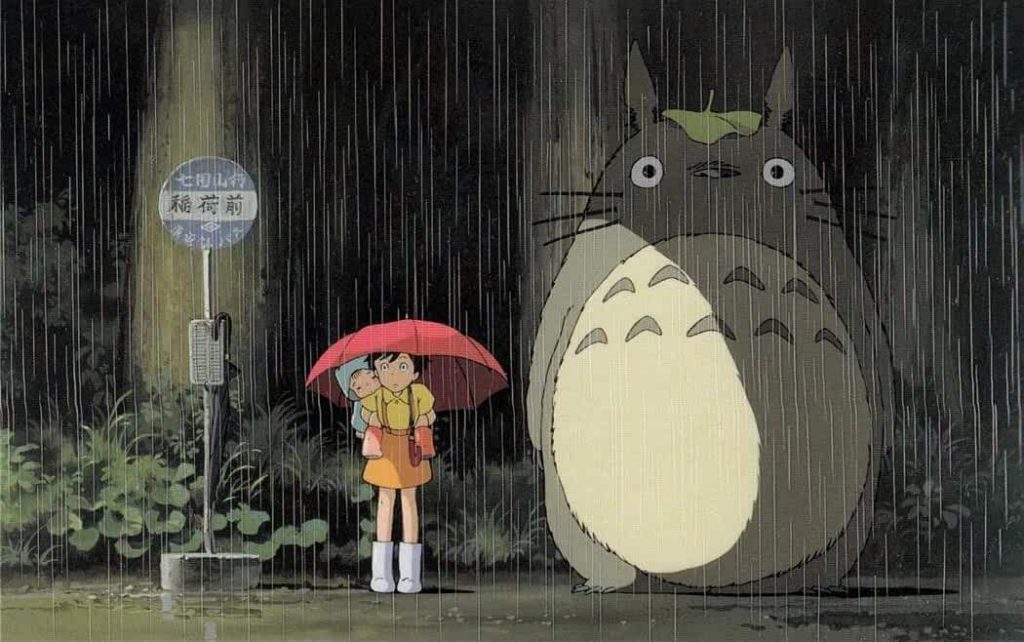
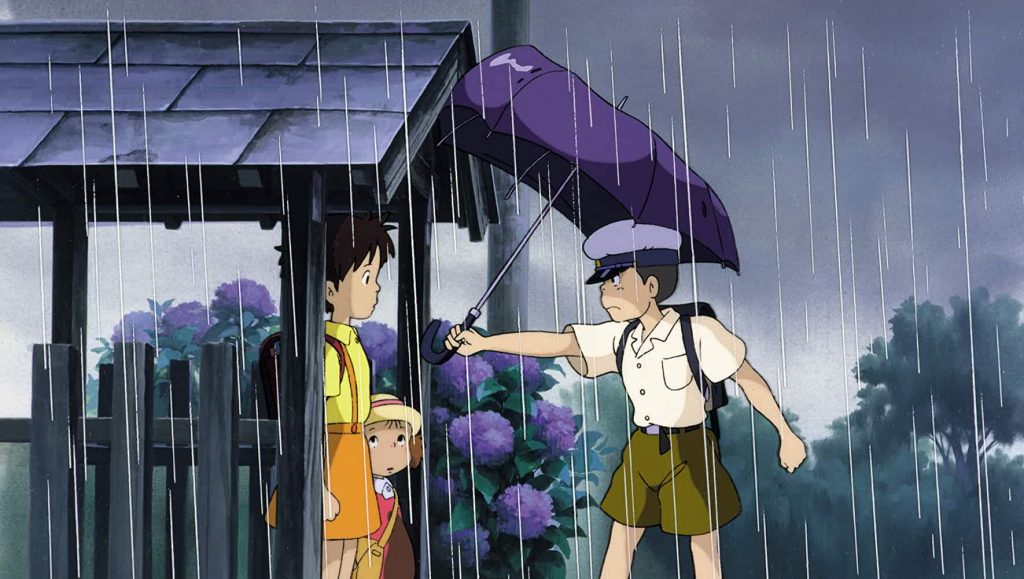
On a rainy late evening, Satsuki and Mei go to the bus stop to receive their father who had not taken an umbrella, there Totoro joins them. Satsuki is elated to see him but stays still. She then gives him the spare umbrella and shows him how to use it.
With a sleepy Mei on her back, Satsuki is surprised to know that Totoro is standing next to them. [Source – IMDB]
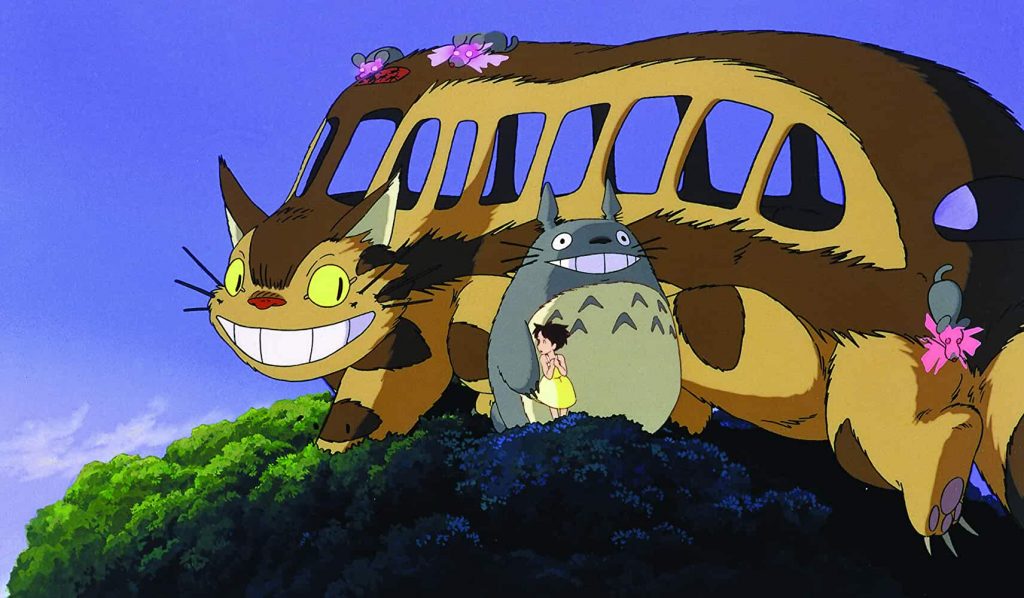
Raindrops falling on the umbrella from the branches above give Totoro the shivers which he enjoys; he jumps up and down and a heavy splash of raindrops fall on them and Totoro beams magnificently. The magic only multiplies then as a Cat Bus arrives there, Totoro climbs on it and leaves.
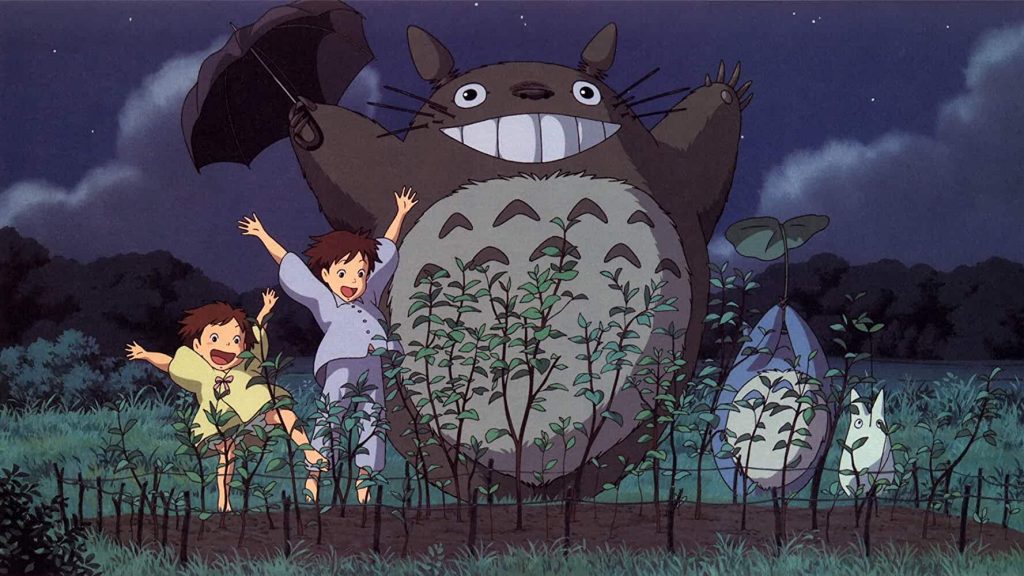
That same night, Totoro comes with his two little friends to silently perform a ritual in the yard where Mei and Satsuki have planted the acorns; the girls wake up and join the Totoros.
Their prayers are heard and the plants sprout magically to form a giant tree, just like the camphor tree, right before their eyes. Totoro then takes all of them to the top of the tree to sit on the branch and play the ocarina.
Next morning the girls find that the tree has vanished, but the seeds have indeed sprung; both of them then repeat the ritual ecstatically shouting “I thought it was a dream, but I was wrong.”
Mei repeats whatever Satsuki says, she gets excited when Satsuki is, dances along and follows her everywhere trying to match her speed, happy to be around her elder sister. But when she gets the news that their mother will not be returning soon as planned, she gets angry.
Both the sisters argue and Mei leaves for the hospital all by herself to give her mother an ear of corn that Granny had said would make her perfectly healthy.
In the evening when Satsuki realises that Mei is not at home, she, Granny, Kanta, and his family all start looking for her. Sure that Mei must have left for the hospital Satsuki takes to the road, running all the way and calling out Mei’s name, but she does not find her there.
Satsuki then goes to meet Totoro, praying to the camphor tree to allow her to meet him; she tells Totoro that Mei is missing and she cannot find her on her own.
Totoro smiles and immediately calls the Cat Bus, the destination indicator blinks Mei’s name, an awed Satsuki climbs on the bus and on its many legs the Cat Bus leaps from one farm to another, tiptoeing from one utility pole to another, finally stopping at the roadside where Mei was sitting and crying.
The Cat Bus then takes both of them to the hospital; there sitting on a treetop the little girls feel relieved to see their parents together and happy.
Both Mei and Satsuki come across as two real-life girls – their mannerism (in the first scene, sitting together in the small lorry, sharing candies), their reactions (when Mei sees the soot gremlins she freezes, holding her frock tightly), their silly arguments (when Satsuki teases Mei that she is afraid at night and that is why she cannot sleep alone), when happy (after meeting the Totoro for the first time Satsuki is overjoyed, she asks his father to hold both of them and they jump into his arms) when sad (both are disappointed to know that their mother will not be coming home soon), all these actions in totality make them appear like two actual kids.
Mama and Daddy Kusakabe
Tatsuo Kusakabe with his dear daughters.[Source – IMDB]
Both Tatsuo and Yasuko Kusakabe are loving, supporting, and open-minded accepting parents. They know that it is a tough time for the girls as they have been staying away from their mother and have shifted to a village for her sake, thus, they do not discourage them from any vibrant idea of theirs.
Whenever the girls talk about soot gremlins, Totoro and the Cat Bus, they both show excitement, honestly interested in their tales.
Tatsuo always listens to them and joins them in their fun activities. Yasuko misses both of them and worries for Satsuki as she knows she takes more responsibility than others do in her age.
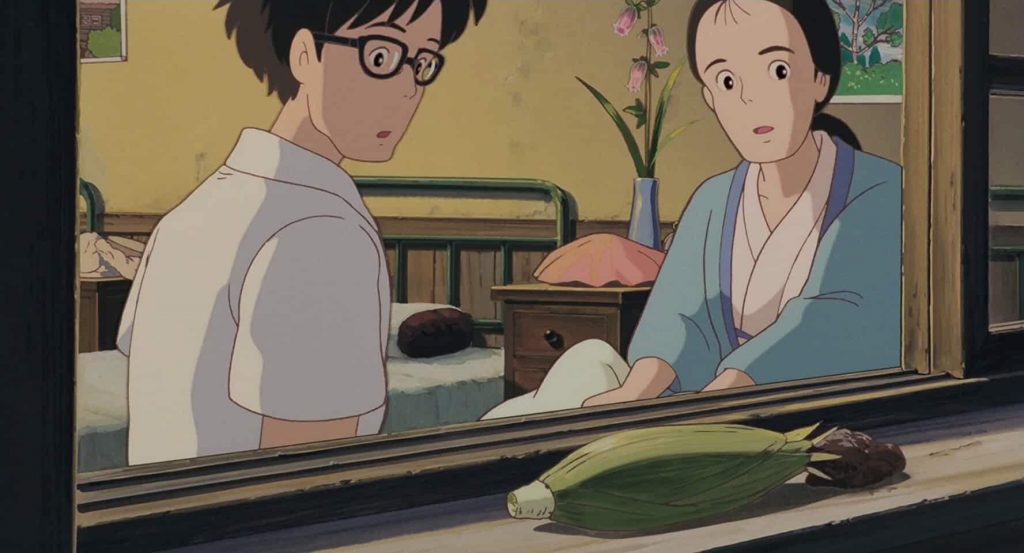
When Yasuko tells her husband that she thought she saw Mei and Satsuki sitting on the tree, smiling, Tatsuo, familiar with the Totoro story by then, picks up the corn with the inscription ‘for mama’ on it lying on the window-sill and says that they must have been here.
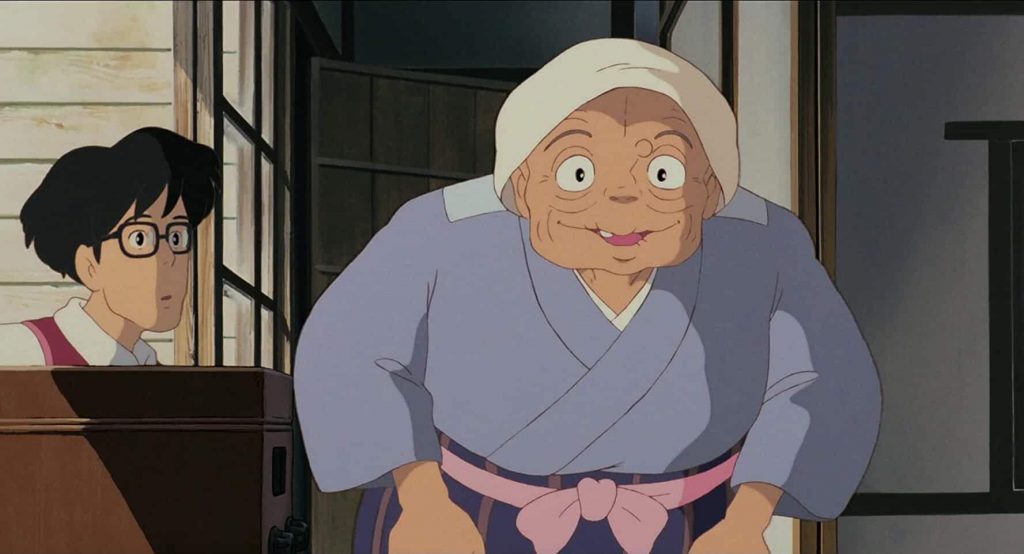
Granny and Kanta
Granny gets happy on knowing that the girls saw the soot gremlins. [Source – IMDB]
Mei and Satsuki’s neighbours, other than the Totoros, are Kanta’s family. While Granny is caring and full of warmth, Kanta hesitates even to talk to Satsuki.
On two occasions – delivering them lunch on their first day and giving his umbrella when it is pouring heavily – he simply hands over Satsuki the lunch box and the umbrella, grunting and without uttering a word.
As time passes by, they become like family to the Kusakabes; when Mei leaves for the hospital on her own, Granny gathers the whole village to look for Mei and Kanta goes to the hospital on a bicycle to check the way for her.
Granny hugs Mei when she returns with Satsuki. The four of them walk back home together as the cheerful closing track plays in the background.
The Charm of the Era
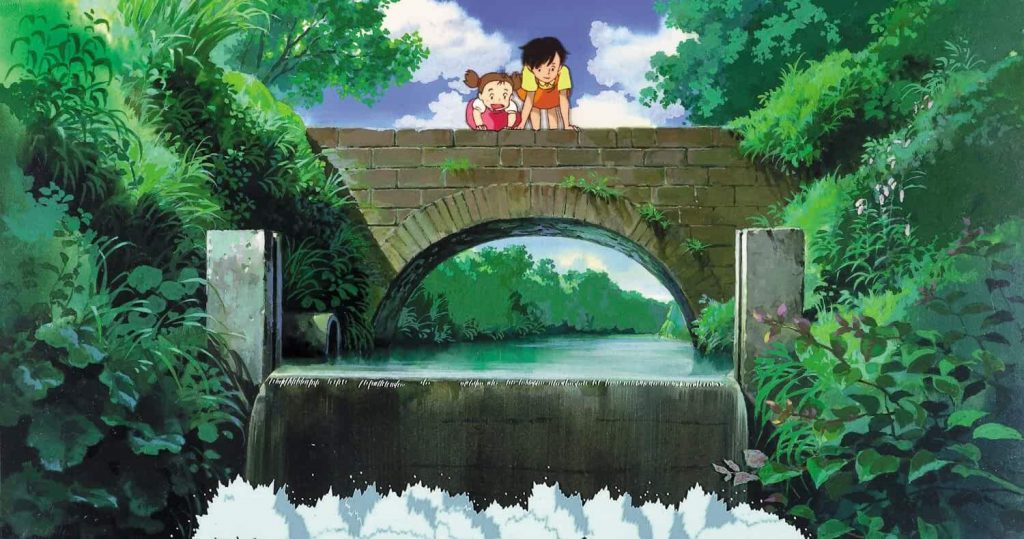
The film is set in the late 1950s Japan when life was simpler and the pace was kinder. On arriving at their new home, Mei and Satsuki get excited about seeing every new thing – the timeworn house (‘it could be haunted’, says Satsuki), the collapsing patio, the soot gremlins, the water pump, the small bridge that takes them to their house, the stream and of course, the giant camphor tree.
The melodious stream near Mei and Satsuki’s house.[Source – IMDB]
Raindrops falling in the rice paddies, the sudden downpour, the drizzles dripping from tree leaves, the puddles, all these scenes are beautifully captured in the film.
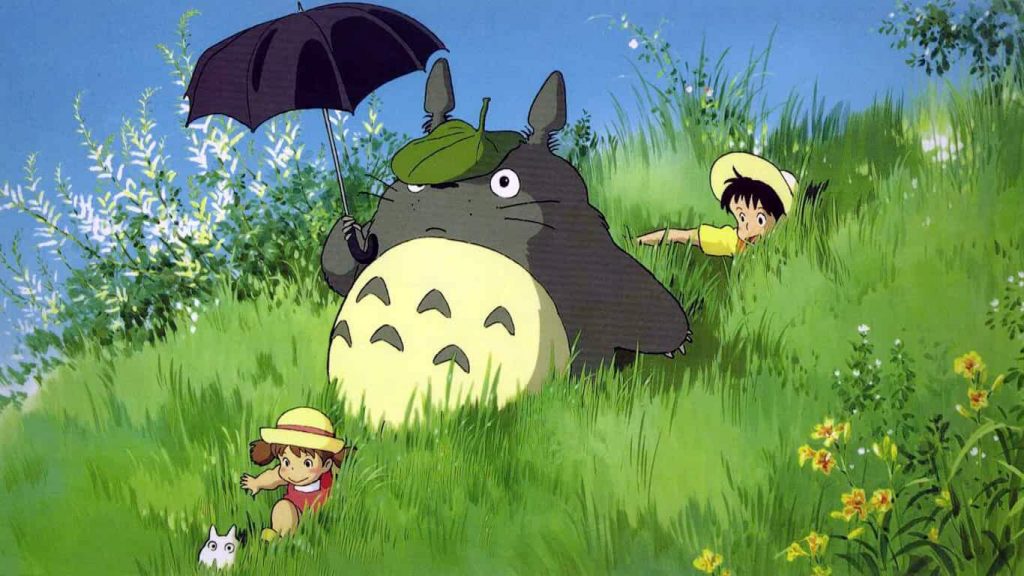
Totoro is overwhelmed with joy when raindrops fall on his umbrella which he is holding for the first time, this brings back memories of childhood.
Such simple happy actions become a habit unknowingly; whether it is raindrops falling on the umbrella for some or say, crushing the dry autumn leaves for others, it always gives us a sudden boost of cheerful energy.
Imagery & Music
The wonderful work done by Hayao Miyazaki and Kazuo Oga, the art director, makes the anime world truly alive.
The cushiony clouds, the rapturous scenery, the quiet stream, and every rock and leaf complement each other, aiding in and not shying from embracing the modernity.
When Mei, Satsuki, and their father visit the shrine for the first time, the ambience and even the cool moistness of the hidden place catches us and we are struck by the glory of the huge camphor tree.
And what gives the imagery this soothing life-like quality is the music in the film. The excellent soundtrack, composed by Joe Hisaishi, gives the film a mythical tone as if opening a door to a magical dream world while keeping it firmly grounded in its times.
Especially the score titled “The Huge Tree in the Tsukamori Forest”, which plays whenever we see the camphor tree in its glory, has become analogous to the spirit of the film. It is an uplifting majestic tune that marks the listener’s entry into a secret world.
The Credits Roll
The story goes on as the credits roll at the end. We see Mei and Satsuki spending time with their mother – taking baths together, reading storybooks – as they had been hoping to for a long time.
The girls continue living in the same region, making new friends, bonding with the old ones, making a snow Totoro in winters, and enjoying their childhood days.
Totoro’s home is one of the best places in the world.[Source – IMDB]
My Neighbour Totoro is considered to be, both by the critics and the masses, one of the best Anime fantasy films of all time. Totoro has become a cultural icon and the film has a worldwide cult following.
Apart from being the company logo and appearing in Studio Ghibli’s other productions, Totoro has also appeared in Disney Pixar’s Toy Story 3.
Such is the love for the film that an asteroid discovered in 1994 and a velvet worm species discovered in Vietnam in 2013 were named after Totoro.
A smiley giant, guardian of the forest, Totoro does not have a dialogue in the film; apart from speaking his name out loud to Mei, he only beams, roars, flies, plays the ocarina, eats and sleeps.
His simplicity makes him a more welcomed, accepted, and believable character by one and all. Mei and Satsuki’s neighbour, the guardian of the forest, Totoro is a true friend, yours as well as mine.
Written and Directed by – Hayao Miyazaki; Production company – Studio Ghibli; Music by – Joe Hisaishi; Cinematography by – Hisao Shirai; Edited by – Takeshi Seyama
Here is a children’s film made for the world we should live in, rather than the one we occupy. A film with no villains. No fight scenes. No evil adults. No fighting between the two kids. No scary monsters. No darkness before the dawn. A world that is benign. A world where if you meet a strange towering creature in the forest, you curl up on its tummy and have a nap.
Roger Ebert, the film critic. Read his review of My Neighbour Totorohere.
The unknown labourer in the outskirts of Kolkata. Photograph by Jagriti Rumi
*
Excerpts from the report
#First entry; Day 1
It landed lightly right behind the unknown labourer who was sweating his day off, certain of his actions and in complete focus, busy in a simple yet, arduous task.
#Fifth entry; Day 1
The flying golden-grass machine runs on a magic engine. A high maintenance product, if not frequently checked, leaks pixie dust.
#Thirteenth entry; Day 1
On the way back from home, that evening, when you saw an aeroplane blinking red-blue lights in the sky, you had uttered something, do you remember it, mister?
You were just fourteen then and had a rather rough day and a broken slipper was not helping either.
You had wished to fly.
Of course, you meant in an aeroplane, but you know how things are in offices, what was spoken was noted down verbatim, it became a written record and a record is the most sacrosanct concept and is hailed throughout the universe.
#Third entry; Day 3
It may look a bit raggedy to you, but it is as good as new. After the service station gave it a nod and we made them sign a nine-paged document for the record, this is its first trip. We, sir, run a professional organisation here.
#Ninth entry; Day 5
Come on now, why don’t you give it a try. The sky awaits you, explore the world and be spellbound by its majesty.
Also, then you have to fill a bunch of forms and sign it, for record purposes.
#First entry; Day 9
Listen, we do apologise for being late. Don’t be upset, in fact, you would be pleased to know that this is also an award, you are one of the most efficient and disciplined people in this world, please accept your prize… and then sign this document here… just a formality.
#Eleventh entry; Day 21
A handful of resources and a handful of desires, how do you adjust to such a life so easily? Doesn’t the heat bother you… the flies, the stench and the failures?
Is life nothing but a cycle ride to you? Oh, remember the cycle rides from your childhood? I do, very clearly, we have it in the records.
With the wind in your hair, you rode it so swiftly, beating all your friends… I bet you can beat the flying golden-grass machine as well.
#First entry; Day 40
Ahm! Let me again ask for your forgiveness for the delay, our department is not the best, it is the 6th best, well 16th actually, but keep this off the record please.
Nevertheless, there is no fault of this machine. It is a good model; many have travelled to far off lands in this little light ride.
What is remarkable is that it is in so many ways just like you, mister.
It too works year long, dreaming of meeting new travellers, visiting different lands, stopping at pixie-dust-pump-stations, collecting visions silently.
#Fifteenth entry; Day 55
Yes, for the 100th time yes, this is a magical machine… and… oh, why don’t you understand… think of it this way, you have won a lottery… you are getting to travel the world, okay? Now, don’t waste time and sign this…
RECORDS
Entry: 90005070QPx∞
The unknown labourer, id no.00089∞, after two months of bewilderment, shock, anxiety, panic, anger and confusion, agreed to make use of the flying golden-grass machine.
The messenger, id no. ᶲᴥ჻֎, successfully delivered the award and got the awardee’s signatures on all the forms.
Please find attached here the detailed report of the awardee’s world tour.
The messenger took charge of the flying golden-grass machine once the tour ended; the awardee’s memory was altered as per the protocol; he will now remember it as a strange dream.
Please find attached here all the signed documents for your perusal.
I am joy running free/
freely flying, fluttering, soaring in a valley/
Of joy am running free.
Greetings!
A storyteller, following the ancient tradition of cave chroniclers, standing in vrikshasana (the tree pose) on a hill top (it is sunny, but windy), breathing in and out stories (relishing it all, but at times overwhelmed), declares animatedly that she will continue to – tell stories, share rare story gems, and connect with the pacy universe while also keeping the website ad-free.
Big thanks to my readers. Stay tuned!
Also, a humble request to the new subscribers to check the spam folder after subscribing. Silly (but necessary) confirmation emails often land there instead of the bright inboxes. Merci!
Ya-hoy!
Chiming Stories (formerly Home Chimes)
P.S – Supporting a storyteller is good for the world’s health (and undoubtedly, for the storyteller’s health as well). Shower some love by sharing, commenting and subscribing to the Weekly Newsletter.
Gabbeh, the 1996 film, is a simple tale of a gipsy girl, her clan and the way their life goes on. Unfolding beautifully just like an artist painting a canvas, Gabbeh quietly touches the grand questions.
Ranked as one of the greatest British films of all time, The Lavender Hill Mob confides in the audience, letting them see, feel, laugh and think without tickling persuasively with a joke here and a punch-line there.
Godard… Breathless and Alive
A Tribute to Jean-Luc Godard, the Film Philologist who Reinvented Cinema.
Yes fly! For walking on the second track is dull and usual, but dreaming high, high, high requires tools. Tools like the right pair of shoes, a chirpy, gritty soul that eats butter-jam dreams, a soul that drinks milky-milky creams.
Silver cascade shimmering the night sky, music to the waves and surreal beauty to the eyes, the Moon loves the art of discipline.
It may be difficult to believe for the Moon’s splendour defies time, it stupefies the clock, it follows the path of a dreamer, but how could this be possible if the Moon knew not discipline?
In this moment, I am a little bit of this and a little bit of that, I am complete and incomplete, I am pleased and uncertain, I wish for nothing and I know I have to wait.
Because the distance covered reminds me of the hurdles I have crossed and the ones I could not, it reminds me of a throbbing past and a dreamy future and it reminds me of how much time is left.
Meredith and the Green Lake
Illimitable Splendour
A joy so complete without any rise or fall, so free without any time corners, so real without true being false, false being true.