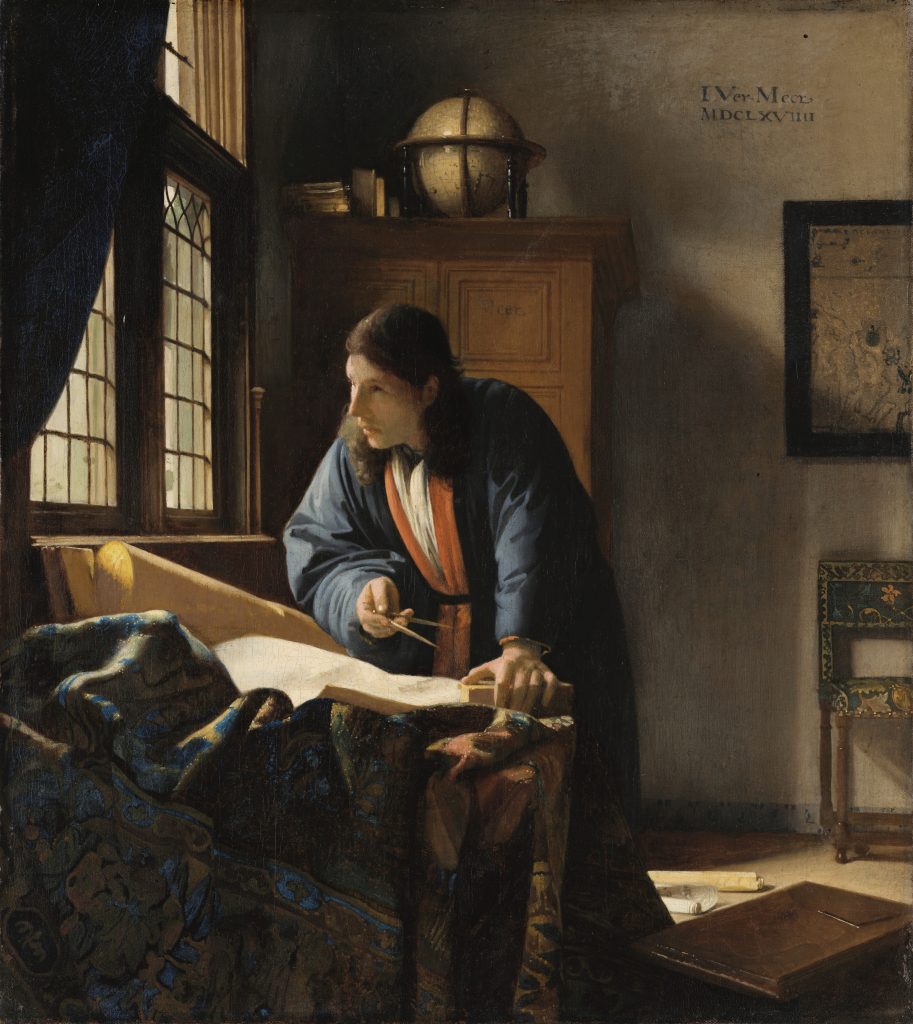
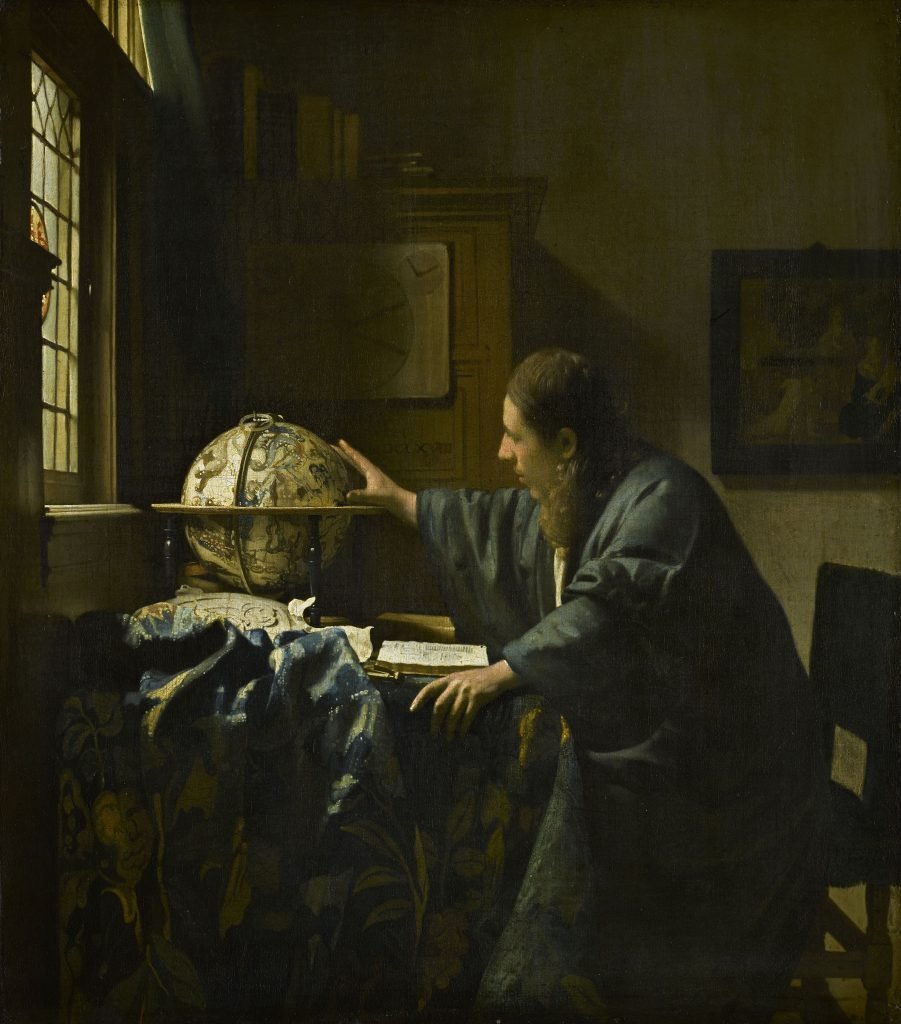
The Geographer and the Astronomer were in the same room as Vermeer for it is in the front room, on the second floor of a spacious house, Vermeer’s mother-in-law’s house, that he produced most of his work.
One good room and in this one good room, a window (usually on the left), a table, chair, cupboard, stool, curtains, draperies, tapestries and a picture-within-a-picture maintained a position, steady, jolly, known, homely, oozing warmth that allowed the artist to mix the pigments well.
And in these two paintings, the two silent globes – a celestial globe with its terrestrial pair for in the 17th century globes were sold in pairs as a direct, neat, calculable link between astronomy and geography was thoroughly entertained – appear in full support of the two sharp owners, a trust built on daily encounters in the same room.
The Japonsche rocken/ Japanese kimono worn by the two scholars here add to the room’s mood and colour; more like precious gifts for a selected few – back then these were not for sale, but presented in batches only to the merchants who were allowed to visit the Imperial Court in Edo (Tokyo) – the robes then feature seriousness, persistence and also recognition.
The ultramarine, cyan shade that colours the two robes, derived from natural lapis lazuli, very expensive, deep, quietly presents the two scientists caught wondering, imagining, getting inspired by a source.
*
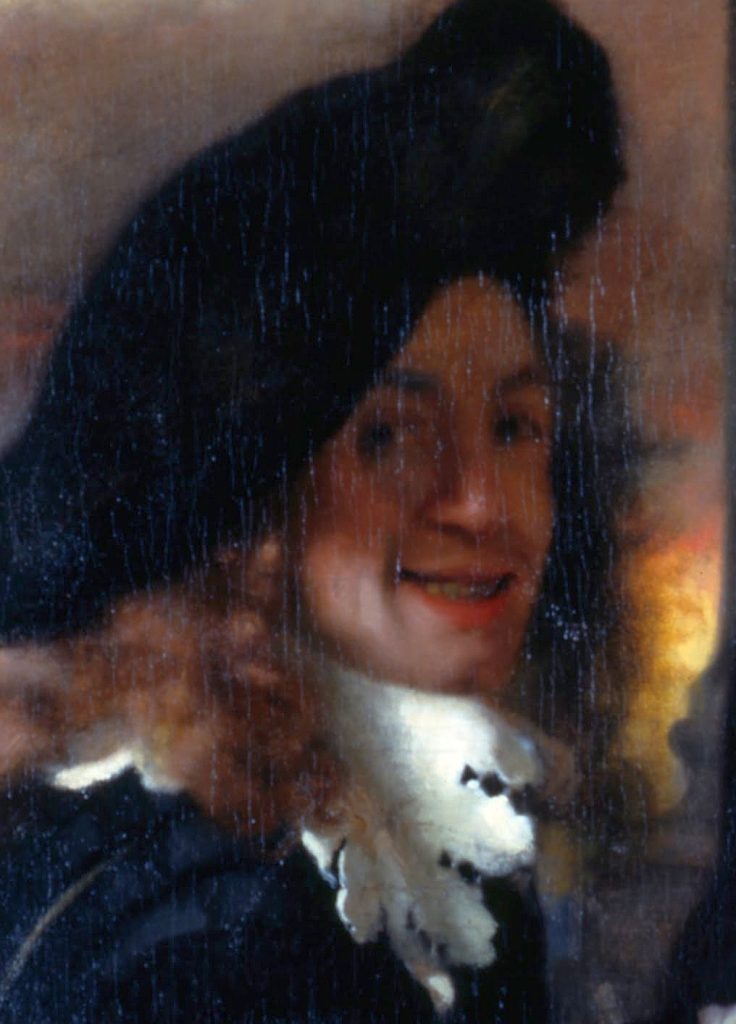
The only supposed portrait of Jan Vermeer van Delft. [Source – Wikipedia]
*
And the artist painstakingly fine-tunes the details, adds layers, swirls and golden dots, folds, peaks and dips, floral touches, tiny tiles and shadowy walls, and signs the painting, sometimes signs it twice.
And the room, sitting patiently absorbing in light and darkness, also signs.
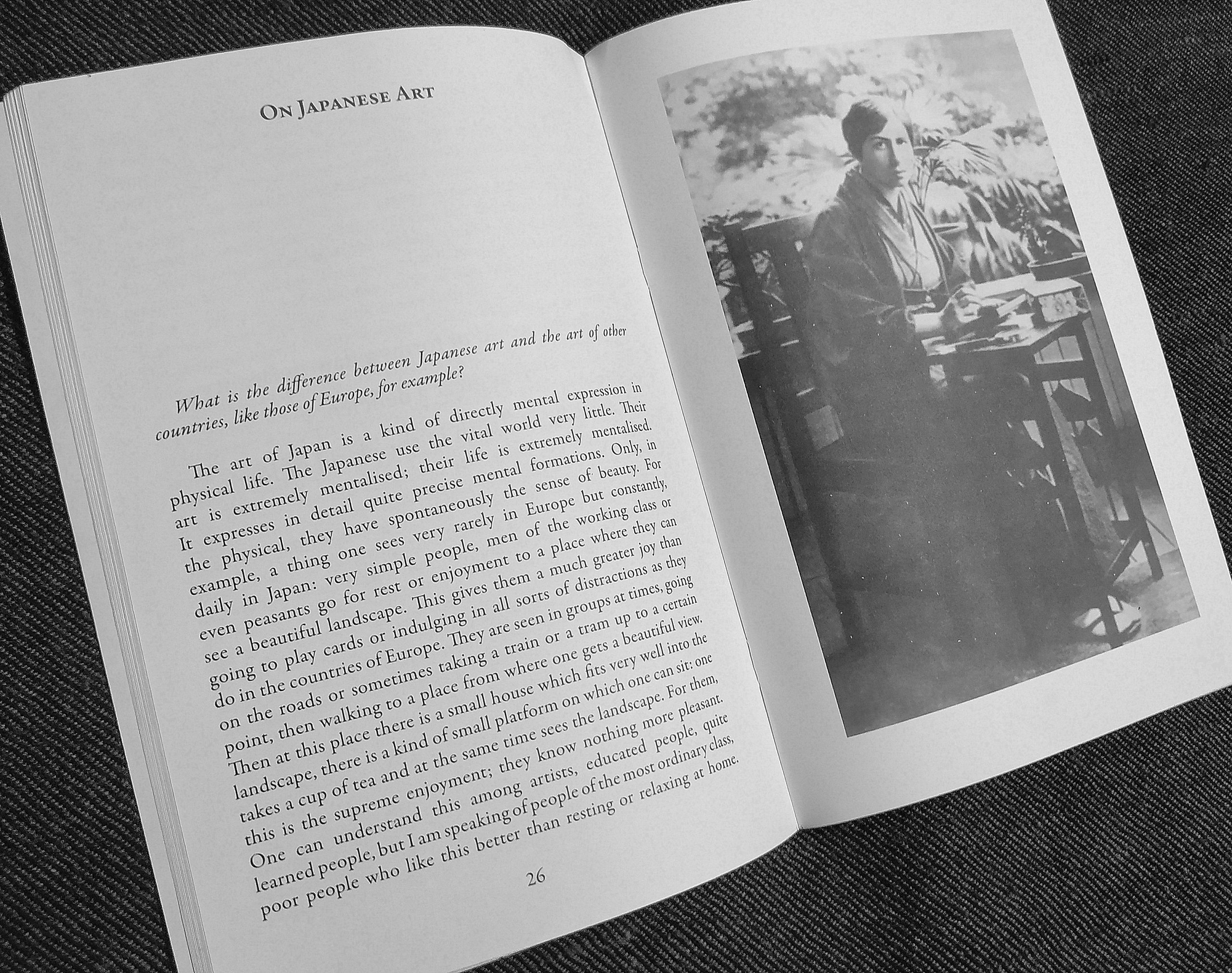
Seeing through a lens that sees things as it is, in its truest form, looking at a broken feather as a feather, not denying its reality, not giving it a quality, experiencing the moment quietly the Mother wrote about Japan. She wrote about its perfection/ beauty-loving people, the value given to nurturing kids, the dedicated women, the Japanese restrained-balanced-subtle art and the transient life.
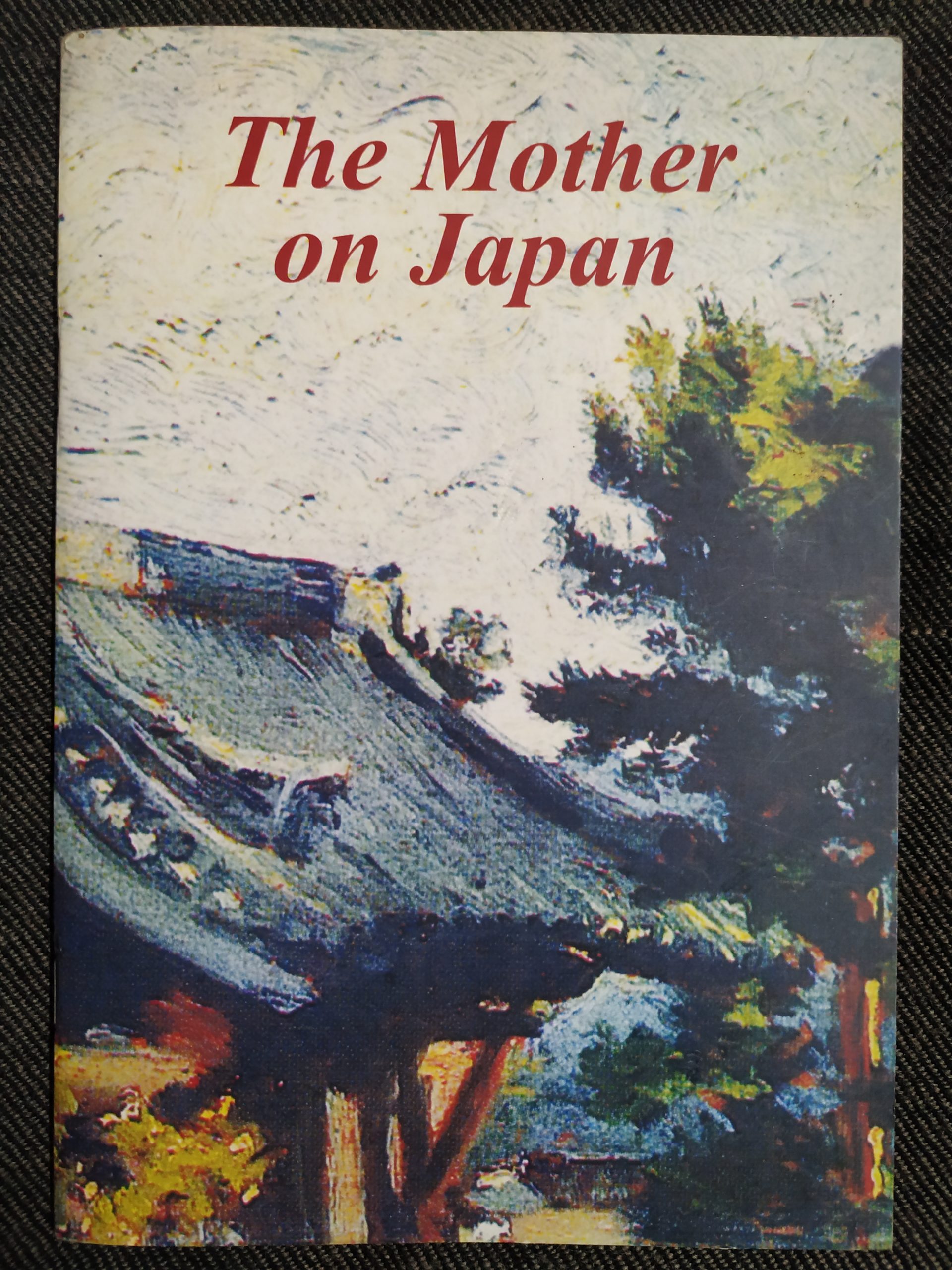
Roof of the Daiunji Temple in Kyoto, painting by the Mother. (Book cover) [Photo by Jagriti Rumi]
The Mother on Japan [Photo by Jagriti Rumi]
The Mother on Japan [Photo by Jagriti Rumi]
The Mother on Japan [Photo by Jagriti Rumi]
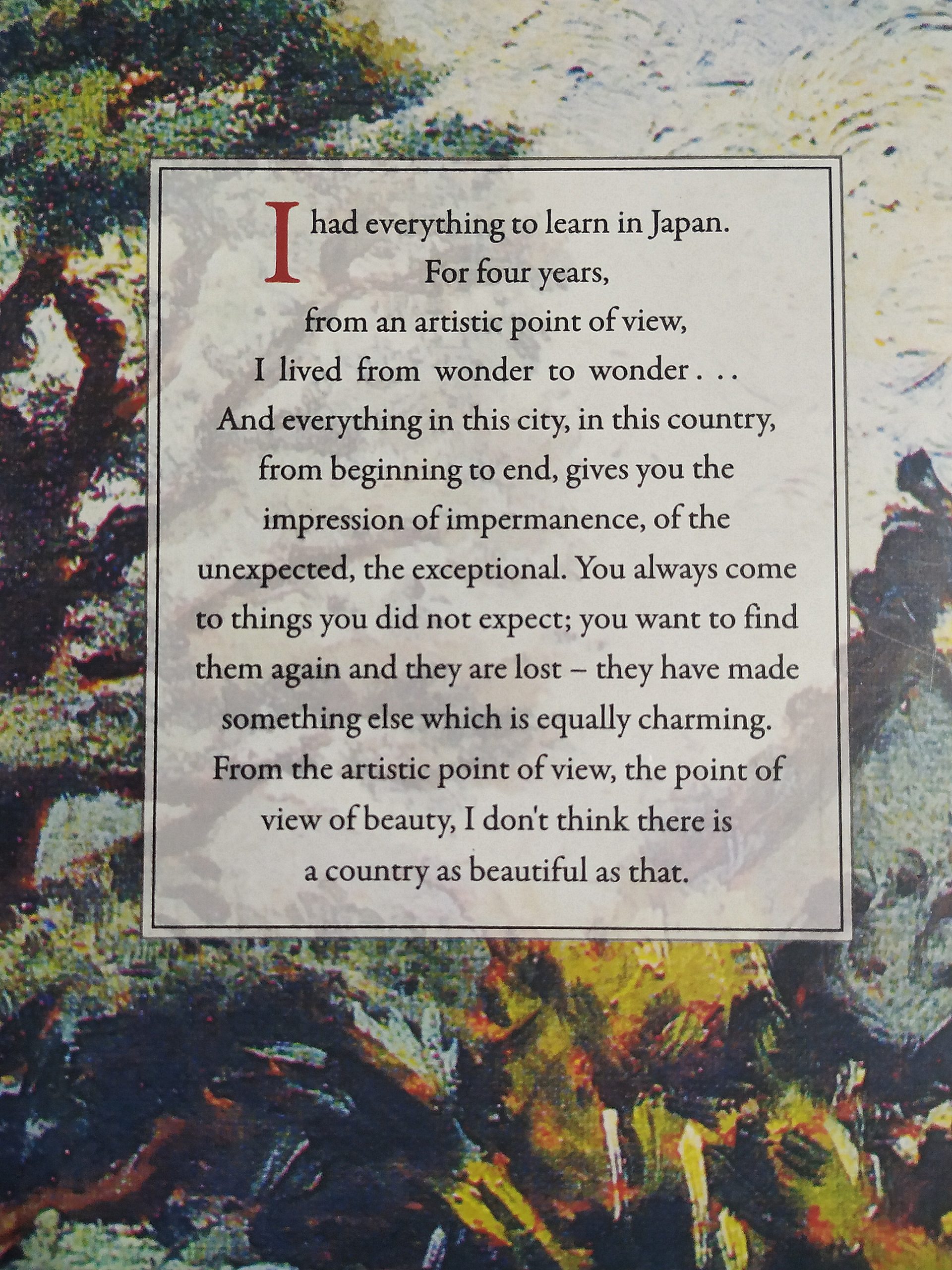
The Mother on Japan [Photo by Jagriti Rumi]
The people, she observed, not via reactions, but by silent selfless actions showed how much they cared for someone; happy to persevere they worked to fulfil the task at hand, devoted harmoniously and absolutely in the present moment, aware about nothing else.
*
Taking long walks to a garden in spring or autumns and spending time there or climbing the steep stairs to reach the monastery at the top of the hilltop, the people (of every and any class), she noticed, believed in beauty and peace.
*
“…very simple people, men of working class or even peasants go for rest or enjoyment to a place where they can see a beautiful landscape. This gives them a much greater joy than going to play cards or indulging in all sorts of distractions as they do in the countries of Europe. They are seen in groups at times, going on the roads or sometimes taking a train or a tram up to a certain point, then walking to a place from where one gets a beautiful view.”
“For instance, in autumn leaves become red; they have large numbers of maple-trees (the leaves of the maple turn into all the shades of the most vivid red in autumn, it is absolutely marvellous), so they arrange a place near temple, for instance, on the top of a hill, and the entire hill is covered with maples.”
“Well, an artist who goes there will experience an emotion of absolutely exceptional, marvellous beauty. But one sees very small children, families even, with a baby on the shoulder, going there in groups. In autumn they will go there. In springtime they will go elsewhere.”
The Mother (Questions and Answers, The Mother on Japan 12 April 1951)
Image of the Buddha, painting by the Mother. (The Mother, Paintings and Drawings, Sri Aurobindo Ashram Trust, 1992) [Photo by – Jagriti Rumi]
While reading about the 1919 flu and how the Mother fought back the negative, dark energy, one thinks about the present pandemic and hopes to win like the Mother in the end.
The glorious cherry-blossom trees in bloom – pink, white, vivid joyous pink – and the narrow paths that take one to wonderful places, with old Japanese houses on both sides, presented the Mother with a paradise puzzle…
*
“Then you go wandering around – always one wanders at random in that country – you go wandering and all of a sudden you turn the corner of a street and come to a kind of paradise: there are magnificent trees, a temple as beautiful as everything else, you see nothing of the city (Tokyo) any longer, no more traffic, no tramways; a corner, a corner of trees with magnificent colours, and it is beautiful, beautiful like everything else. You do not know how you have reached there, you seem to have come by luck. And then you turn, you seek your way, you wander off again and go elsewhere. And some days later you want to come back to this very place, but it is impossible, it is as though it had disappeared. And this is so frequent, this is so true that such stories are often told in Japan. Their literature is full of fairy-lore. They tell you a story in which the hero comes suddenly to an enchanted place: he sees fairies, he sees marvellous beings, he spends exquisite hours among flowers, music; all is splendid. The next day he is obliged to leave; it is the law of the place, he goes away. He tries to come back, but never does. He can no longer find the place: it was there, it has disappeared!… And everything in this city, in this country, from beginning to end, gives you the impression of impermanence, of the unexpected, the exceptional. You always come to things you did not expect; you want to find them again and they are lost – they have made something else which is equally charming. From the artistic point of view, the point of view of beauty, I don’t think there is a country as beautiful as that.”
The Mother (Questions and Answers, The Mother on Japan 12 April 1951)
“The enjoyment of art is an act of recreation, or rather of creation in the reverse direction, towards the source of intuition, i.e., an act of absorption, in which we lose our small self in the creative experience of a greater universe.”
Anagarika B. Govinda
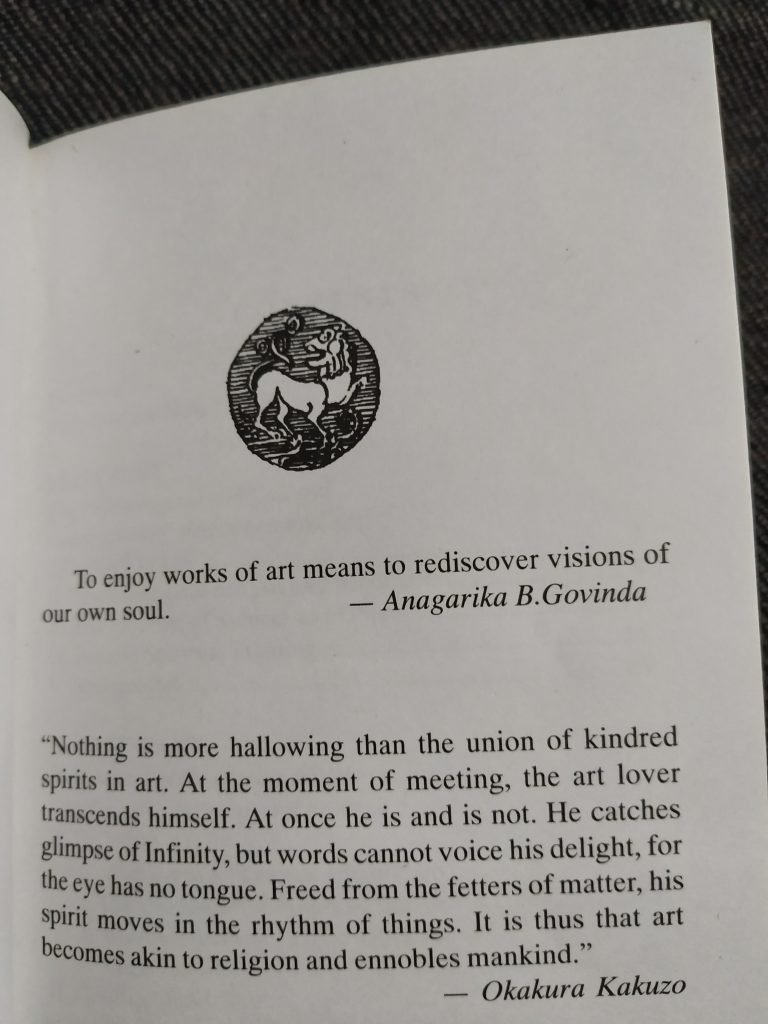
I happen to have a small sweet book titled Art & Meditation (actually a few years back I took it from my brother), written by Lama Anagarika B. Govinda – an artist, a Buddhist monk, traveller and writer.
Sharing his paintings, poems and thoughts with us, he talks about the ineffaceable, elusive yet real, sublimely beautiful link between art and meditation; how true art merges with true religion and vice-versa.
It is not digressive or sluggishly cumbersome, this thought, rather it is stimulating for the one who is not in a hurry.
The author wishes his essays and artwork to serve as koans i.e. ‘meditative problems’ for his readers that churn our thoughts and act as an impetus for continuing the search.
Photos by Jagriti Rumi.
I have gone through this insightful book twice now. What struck me this time was its size, how come Lama Anagarika Govinda’s lectures on art and meditation along with his artwork were capsuled in such a tiny book?
Of course, there must be other collections of his essays and pictures, surely in not-so-tiny a book.
But here I would intentionally turn this coincidence into a grand undertaking and happily say something ambitious.
This beautiful book holds, yes-yes it does, the secret to enlightenment and simply because of its humble, calm and forgiving nature, affordable price, elucidations of the artwork and colour schemes given and the profound ideas shared.
With these balmy thoughts, I will read this book again in the near future for then it will reveal a new secret to me.
Leaving you with an edifying thought –
“Art in itself is a sort of a paradox, a Koan in the deepest sense of the word, and that is why the followers of Zen prefer it to all other mediums of expression. For only the paradox escapes the dilemma of logical limitation, of partiality and one-sidedness. It cannot be bound down to principles or conceptual definitions, because it exaggerates or abstracts intentionally in such a way that it is impossible to take it literally: its meaning is beyond the incongruity of the words.”
Anagarika B. Govinda
Enlightenment, Pocketed- Calm mind beams Together with the heart.
I am joy running free/
freely flying, fluttering, soaring in a valley/
Of joy am running free.
Greetings!
A storyteller, following the ancient tradition of cave chroniclers, standing in vrikshasana (the tree pose) on a hill top (it is sunny, but windy), breathing in and out stories (relishing it all, but at times overwhelmed), declares animatedly that she will continue to – tell stories, share rare story gems, and connect with the pacy universe while also keeping the website ad-free.
Big thanks to my readers. Stay tuned!
Also, a humble request to the new subscribers to check the spam folder after subscribing. Silly (but necessary) confirmation emails often land there instead of the bright inboxes. Merci!
Ya-hoy!
Chiming Stories (formerly Home Chimes)
P.S – Supporting a storyteller is good for the world’s health (and undoubtedly, for the storyteller’s health as well). Shower some love by sharing, commenting and subscribing to the Weekly Newsletter.
Gabbeh, the 1996 film, is a simple tale of a gipsy girl, her clan and the way their life goes on. Unfolding beautifully just like an artist painting a canvas, Gabbeh quietly touches the grand questions.
Ranked as one of the greatest British films of all time, The Lavender Hill Mob confides in the audience, letting them see, feel, laugh and think without tickling persuasively with a joke here and a punch-line there.
Godard… Breathless and Alive
A Tribute to Jean-Luc Godard, the Film Philologist who Reinvented Cinema.
Yes fly! For walking on the second track is dull and usual, but dreaming high, high, high requires tools. Tools like the right pair of shoes, a chirpy, gritty soul that eats butter-jam dreams, a soul that drinks milky-milky creams.
Silver cascade shimmering the night sky, music to the waves and surreal beauty to the eyes, the Moon loves the art of discipline.
It may be difficult to believe for the Moon’s splendour defies time, it stupefies the clock, it follows the path of a dreamer, but how could this be possible if the Moon knew not discipline?
In this moment, I am a little bit of this and a little bit of that, I am complete and incomplete, I am pleased and uncertain, I wish for nothing and I know I have to wait.
Because the distance covered reminds me of the hurdles I have crossed and the ones I could not, it reminds me of a throbbing past and a dreamy future and it reminds me of how much time is left.
Meredith and the Green Lake
Illimitable Splendour
A joy so complete without any rise or fall, so free without any time corners, so real without true being false, false being true.