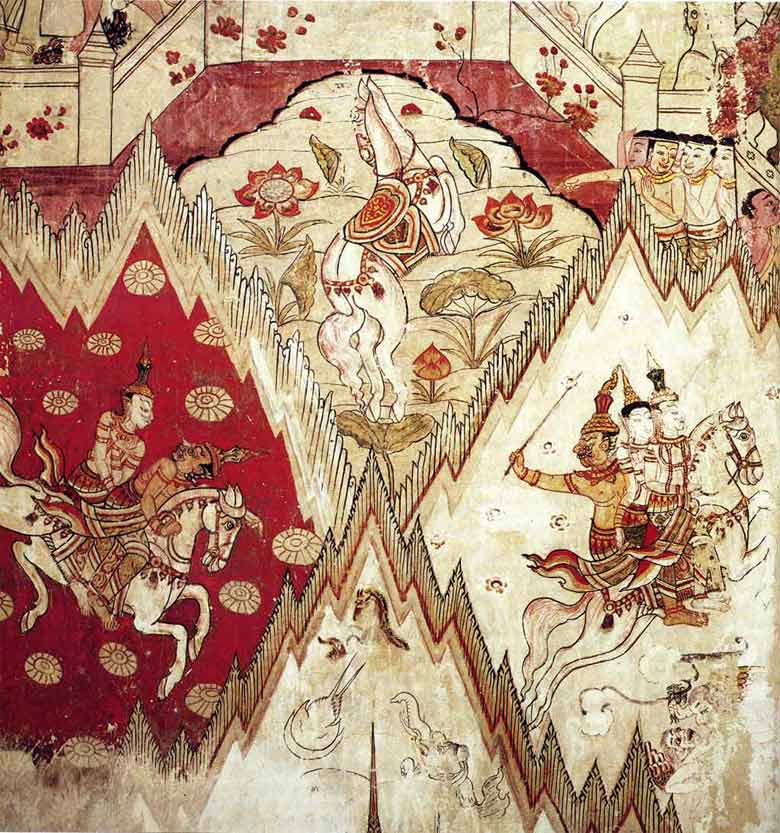
वह दूसरी ओर पीठ किए खड़ी थी। हमारी टैक्सी एकदम उसके पास ही आकर रुकी। वह हड़बड़ाकर मुड़ी और मेरा कलेजा मुँह को आ गया। उसके चारों ओर छोटी-मोटी भगवा पोटलियाँ बिखरी थी, पीठ पर मोटे रस्से में दो-तीन भारी कम्बल लदे थे। अपने खुरदुरे, तिब्बती लबादे को सम्हालती, वह एक कोने में सिमट गई।
She was standing with her back to the other side. Our taxi stopped right next to her. She turned around in a huff and my heart came to my mouth. Some small bundles were scattered around her, two or three heavy blankets were laden with thick ropes on her back. Holding on to her rough, Tibetan cloak, she huddled in a corner.
A known face, however time-wrought, when seen, catches the eyes and attention almost at once that you cannot resist thinking about it. She saw Kiki, her heart smiled and a surge of memories filled the world, stopping time effortlessly.
Kiki, a spirited girl, enamoured with every new idea, had the courage to not to conform, not too easily, blindly. As a maiden, when in love, then a married woman, a mother and again in love, she moulded her life and everyone she knew anew. Some cheered for her, others washed away her colours.
When her livid father cremated her without uncovering the shroud, once just to see Kiki’s face, she instantly got a new lease of life.
A new lease of life where she chose to become a bhikshuni; crestfallen, she took a turn to continue with this journey called life. How difficult it would have been?
To let go of the collection closely locked in the heart – the hurts, laughs, blessings, all of it. To begin afresh when old tidings try to tie one down, to let the old self know its place.
The bhikshuni was carrying a potali… what was in it, we know now.
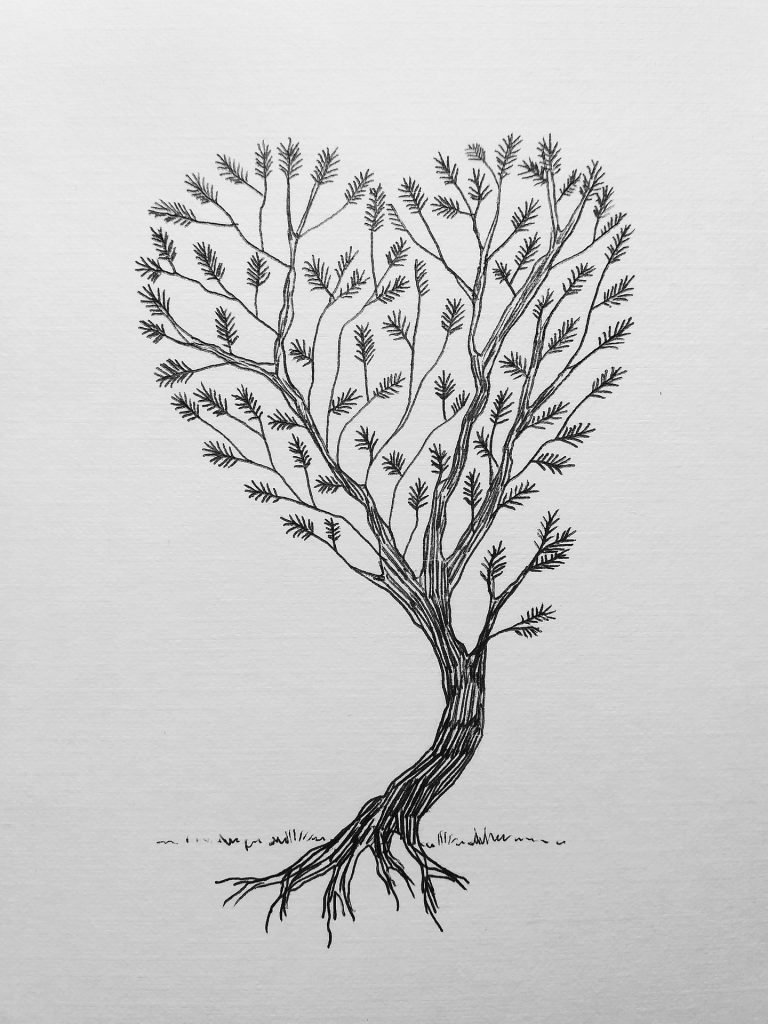
Standing next to the giant old tree, its static presence made Saami sombre, more and more.
He cried, “Saami is now one with the rigid, rough and-and dead, yes, dead and gruesome tree bark, Saami has turned into this tree bark… O, but why?”
Resting against the tree now, now hugging the tree and mumbling, Saami stared into nothingness blankly, quietly. He opened his fist – a flint stone chip, equally dead he thought – and started ripping off the bark once again.
“Saami sees it all, Saami knows the limits, Saami’s dungeon is different from theirs, but… it’s all the same”, he announced in pain.
The twittering yellow bird, the prancing butterflies, a distant lullaby, the pesky kung-fu crickets’ funny civil war and the red flowers’ bold stance, Saami turned a blind eye to it all.
Even the crickets stopped their civil war to enjoy the rain and the rainbow that day, but not Saami.
“Fools! Saami knows the pattern, Saami knows hope and destiny are always stuck in a traffic jam, and love…”, said Saami two hours ago.
“Love… love coloured Saami’s world black… black is the absence of all colours… black reflects no light… Saami lives in darkness”, he completed the sentence just when the fireflies lit the jungle.
Some rested on his head and hands, but Saami refused to greet them.
With a dry look, sullen eyes and tired limbs, Saami spoke for the last time, “dead, static tallness, this soulless tree bark hates Saami, this is the death penalty, and the most terrible because Saami is not tied, Saami can move, Saami knows, but not anymore, for Saami has become one with this giant numb stubborn treeeeeeeeeeeeeeee…”
Saami spoke for the last time because the lovely, joyous and calm tree’s branch took hold of Saami’s tired body and pulled him up-up-up… in a gushing blast of speed, suddenly music broke Saami’s heart-heart-heart… ta-rum-pup-pup-paa came the sound and immediately replaced it with a musical hub-dub sensation of a heart.
*
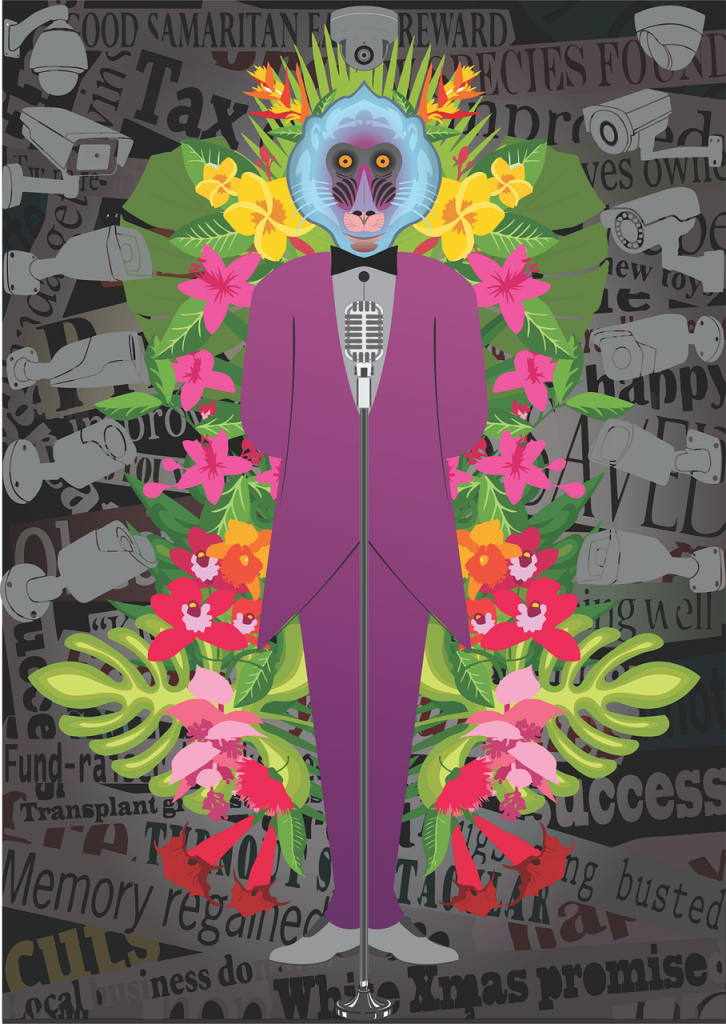
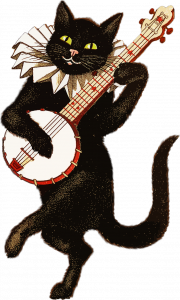
The lead singer-cum-dancer-cum-poser. [Image by Roy N from Pixabay]
From the top-most branch of the tall lovely tree, Saami could see melodic colours and no darkness, nothing was static for the entire jungle and the river and the wind and the sky and the stars and the moon and the sun (together) danced to the twee peppy tune – and equally soothing, thought Saami – that the animal orchestra was playing.
Every animal – jamming freely – sitting on the top of some tree just like Saami… Saami who started clapping, swaying along and tip-tap-toeing in the air.
The tall lovely tree finally spoke, “Saami, yoi-knowi-da-cosmic-i-dance-sO-‘ell”; Saami was seen blushing brightly before the curtain was drawn.
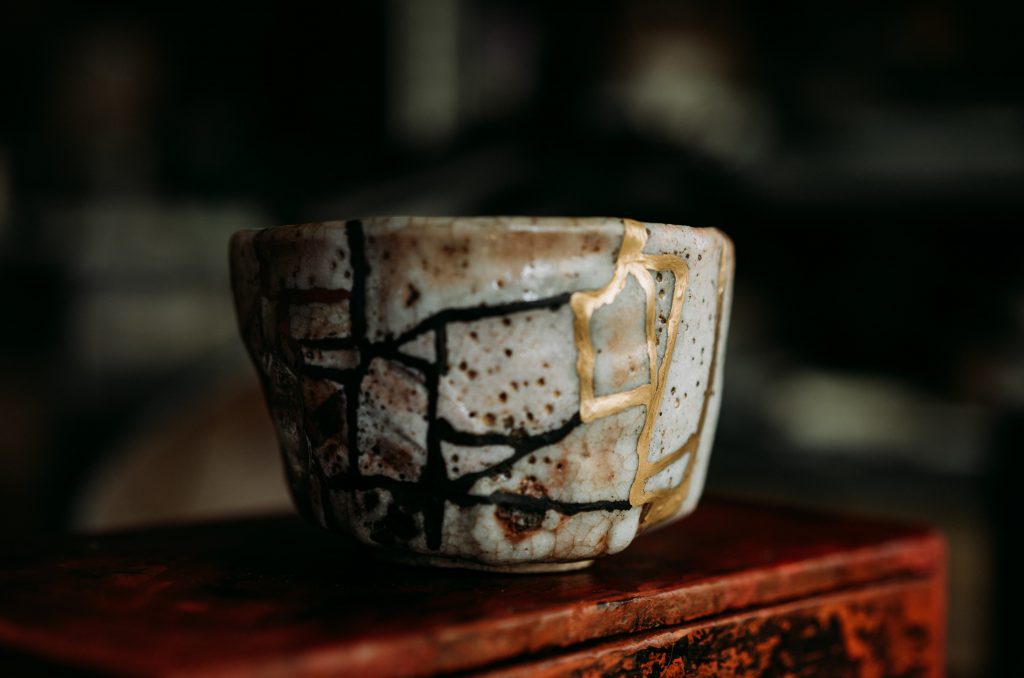
A happy piece! Kintsugi is the Japanese art of repairing broken pottery by mending the areas of breakage with lacquer dusted or mixed with powdered gold, silver, or platinum. – Wikipedia [Photo by Motoki Tonn on Unsplash]
*
For a better experience, listen to the wonderful, magical tracks before reading on –
*
Listen to Little Talks here –
*
‘Cause though the truth may vary This ship will carry our bodies safe to shore…
Little Talks, Of Monster and Men
And this journey forward that seems uncertain, unforgiving, perilous, and so lonely transforms into a key – a key that unlocks both the Pandora’s box of adversities and the heart’s orchestra.
String, woodwind, brass and percussion music, always on stand-by, ready to win-over the adversities melodiously, has given the heart’s orchestra a good name.
What if the monster charges with an army or is two-headed or many eyed or has tentacles? Hey-hey, hey-ho, the key that unlocks, also locks… it is all up to you and your heart’s orchestra performance.
Psst! Listen, all monsters aren’t evildoers, but they are music lovers for each one has a heart. Good luck!
Listen to King And Lionheart here –
*
And as the world comes to an end I’ll be here to hold your hand Cause you’re my king and I’m your lionheart
King and Lionheart, Of Monsters and Men
And this journey that seems to have ended with our destruction, our death, and yet alive, we silently stare, scar-faced and overwhelmed, at our sacrifice blooming at the right place, at the right time…
Tired steps befriend the trodden grass… and at last the haunting echoes fail… the Lionheart rises again.
Listen to Dirty Paws here –
*
The bees had declared a war The sky wasn’t big enough for them all The birds, they got help from below From dirty paws and the creatures of snow
Dirty Paws, Of Monsters and Men
And in the middle of a war, when you turn around to see and cannot distinguish between the mad faces, you become one with them and fight fiercely until you remember, you too are a creature that breathes.
Breathe, breathe, breathe and continue for that is the call…
Listen to Love Love Love here –
*
Oh, ’cause you love, love, love When you know I can’t love You love, love, love When you know I can’t love You love, love, love When you know I can’t love you
Love Love Love, Of Monsters and Men
And what hurts the most in this forgotten life of ours… unfulfilled love that can be fulfilled and yet…
When love love love turns you into a piece of Kintsugi pot, smile for now you have been repaired.
Listen to Mountain Soundhere –
*
Of Monsters and Men is an amazing indie rock band from Iceland. They have a knack for amalgamating folk stories, emotions, joy, pain and the magical into their songs that almost every time matches with the universe’s wavelength.
Listening to their music is like sitting around a bonfire on a bright winter night… and like playing with the breeze in the summers.
True! – NERVOUS – very, very dreadfully nervous I had been – and am; but why will you say that I am mad? The disease had sharpened my senses – not destroyed – not dulled them. Above all was the sense of hearing acute. I heard all things in the heaven and in the earth. I heard many things in hell. How, then, am I mad? Hearken! And observe how healthily – how calmly I can tell you the whole story.
A secret that punctures a heart, a heart that still beats, alive, yet unsure how, in a delirium reveals the secret to all. In Edgar Allan Poe’s short story, The Tell-Tale Heart, such a secret is shared with us.
Such a secret troubles the main character in the story and he begins simply by narrating it, gripping us first by raising our curiosity and later by force.
That is, a psychological force… for we are always free to get up and leave the old man’s dark room, but oh, we don’t. We hear and fear it as scene after scene unfolds.
Tension rises, our noble heart beats, not only because we suspect something horrible, truly tragic, but also because we recognise it…
We recognise the inexplicable rage, the feverish mind, the parched bond and the morbid thought that although residing in the backdrop knows well how to make itself heard.
Edgar Allan Poe’s poetry and prose often create a fantastical mysterious world where distinctly, incessantly the human mind tries to rein in something, something… where failure leads to a twist and success to a debacle.
His characters mock the world and oneself with equal fervour, pretending nothing at all, confessing the truth blatantly and leaving the readers with a secret.
I think it was his eye! yes, it was this! One of his eyes resembled that of a vulture – a pale blue eye, with a film over it. Whenever it fell upon me, my blood ran cold; and so by degrees – very gradually – I made up my mind to take the life of the old man, and thus rid myself of the eye for ever.
Charles Lamb, the romantic essayist of the 19th century, under the pseudonym Elia wrote informal, lyrical and personal essays – witty, humorous, funny – he wrote so that his heart won’t explode – and left the essays open-ended, putting the reader quietly in quandary, asking them to look for a definite answer, to construct the story circle complete and finish what he so melodiously had started.
And to finish this wistful melody the reader has to stay with Lamb’s thoughts for a while. What a victory for a writer!
Born in the year 1775, Charles Lamb’s ‘thinking heart’ wrote about his desires and imaginations, resentments and failures, the world he observed and the quaint world he read about, the sweet past and sweet melancholy, the civilised unsatisfied industrialised society, the forgetful lots and the few compassionate souls.
His evocative language interacted with the readers, urging them to participate and respond, digressing from the topic so often just like friends do while sharing an anecdote.
A friend to all, sharing his secrets honestly – for he thinks himself to be the only object he knows intimately – Lamb lived a lonely, troublesome life. He took care of his sister Marry Lamb – with whom he co-authored The Tales of Shakespeare (1807) for children – who suffered from mental illness and in a fit of madness had even killed their mother.
Standing by her side all his life, Charles Lamb continued to write.
His unrequited love story featured in many of his essays; Charles Lamb never stopped loving Ann Simmons. In his essay, Dream Children – A reverie, his two children sit next to him, eager to listen to stories of their ancestors, great uncles and aunts, people whom they will never meet and yet they would know so dearly via their tales.
He shares with them the stories of their great grandmother Mrs Field, the grand house where she lived as a caretaker, about their uncle John Lamb, his childhood days and the “idle diversions” (like watching little fish darting to and fro in the pond on a sunny winter day), and gently brings in the topic of death – how his brother passed away and how much he misses him, suddenly sad, the children ask him to tell them about their late mother (a reflection of Ann Simmons) – and just before he could look at his children a bit more, they fade away.
Awoke, Lamb finds himself sitting in his armchair, too far from the sweet-bitter-warm dream.
In a dream-like style, the essay catches that vague emotion of joy/loss/regret/fulfilment/affection/ loneliness all in one, that sweet emotion that colours the cheeks red, that makes one teary-eyed, that leads to a sigh, that reminds one of life…
Though Greek and Roman philosophers like Theophrastus and Plutarch, Cicero and Seneca wrote essays (when this genre was not yet coined), it was in the early 16th century that the French philosopher Michel de Montaigne popularised the essay as a literary genre.
Charles Lamb chose to follow Montaigne’s lead instead of following the well-known English essayists who predated Lamb like Francis Bacon, Addison, Steele, and Samuel Johnson.
Lamb’s essays, though personal in tone, never hesitated to critique the apathetic side of the society; not serious and didactic as Bacon, Lamb paid attention to creating an authentic picture of life.
In his essay, The Praise of Chimney Sweepers Lamb talks about the little kids who were made to work as chimney sweepers across London – snatching their childhood so brazenly.
*
A group of apprentice Chimney Sweeps. [Source – Caveat Bettor]
He shares anecdotes that paint the harsh reality in a straightforward manner – a tale within a tale – like how a soot-covered boy had laughed when Lamb tumbled down on a street one day, seeing his twinkling eyes made him smile too, how he describes the tea-like beverage that the chimney sweepers found appetizing, a cheap beverage that was made from the sweet wood of the sassafras tree, how his late friend James White used to throw a feast for the chimney sweepers at a local fair, offering them food and entertainment…
Without attacking the privileged class directly Charles Lamb presents an image that cannot be brushed off as easily as sometimes moral talks are brushed.
These imaginative, conversational style essays may not guide the reader like a classical essayist’s essays, it may not teach us the form, but what it does is nothing short of brilliance, it balms and befriends our aching heart and tells us frankly that it is alright, we are all in the same boat…
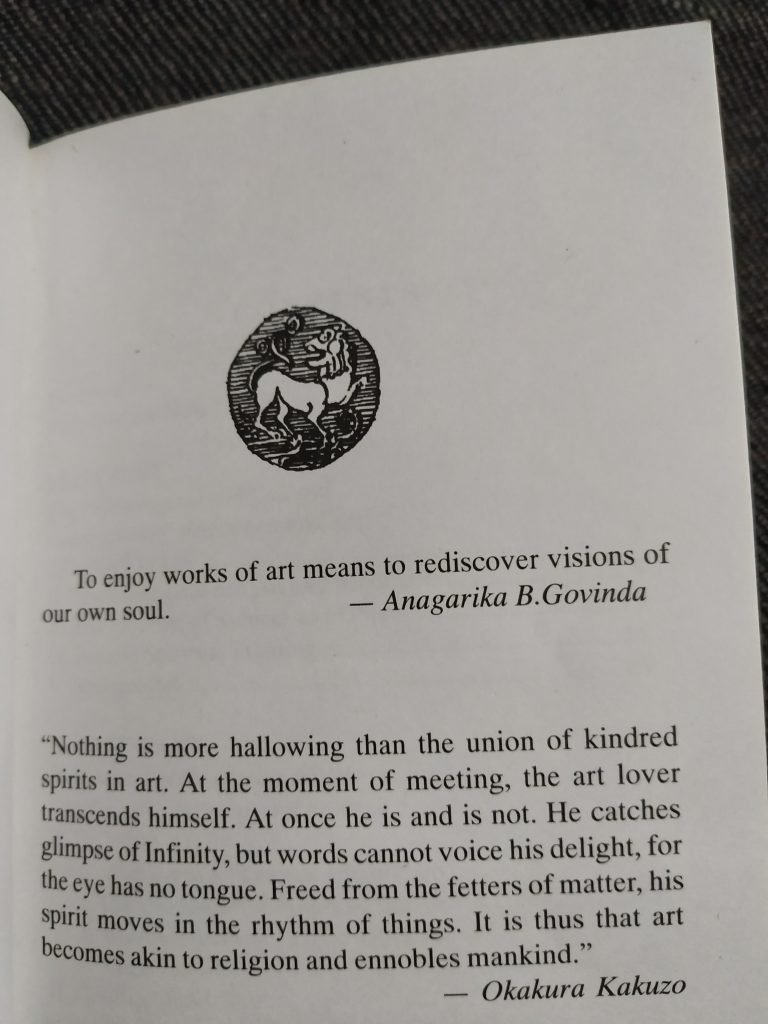
“The enjoyment of art is an act of recreation, or rather of creation in the reverse direction, towards the source of intuition, i.e., an act of absorption, in which we lose our small self in the creative experience of a greater universe.”
Anagarika B. Govinda
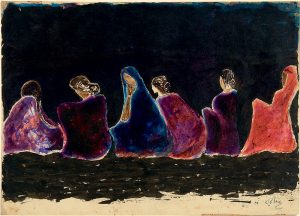
I happen to have a small sweet book titled Art & Meditation (actually a few years back I took it from my brother), written by Lama Anagarika B. Govinda – an artist, a Buddhist monk, traveller and writer.
Sharing his paintings, poems and thoughts with us, he talks about the ineffaceable, elusive yet real, sublimely beautiful link between art and meditation; how true art merges with true religion and vice-versa.
It is not digressive or sluggishly cumbersome, this thought, rather it is stimulating for the one who is not in a hurry.
The author wishes his essays and artwork to serve as koans i.e. ‘meditative problems’ for his readers that churn our thoughts and act as an impetus for continuing the search.
Photos by Jagriti Rumi.
I have gone through this insightful book twice now. What struck me this time was its size, how come Lama Anagarika Govinda’s lectures on art and meditation along with his artwork were capsuled in such a tiny book?
Of course, there must be other collections of his essays and pictures, surely in not-so-tiny a book.
But here I would intentionally turn this coincidence into a grand undertaking and happily say something ambitious.
This beautiful book holds, yes-yes it does, the secret to enlightenment and simply because of its humble, calm and forgiving nature, affordable price, elucidations of the artwork and colour schemes given and the profound ideas shared.
With these balmy thoughts, I will read this book again in the near future for then it will reveal a new secret to me.
Leaving you with an edifying thought –
“Art in itself is a sort of a paradox, a Koan in the deepest sense of the word, and that is why the followers of Zen prefer it to all other mediums of expression. For only the paradox escapes the dilemma of logical limitation, of partiality and one-sidedness. It cannot be bound down to principles or conceptual definitions, because it exaggerates or abstracts intentionally in such a way that it is impossible to take it literally: its meaning is beyond the incongruity of the words.”
Anagarika B. Govinda
Enlightenment, Pocketed- Calm mind beams Together with the heart.
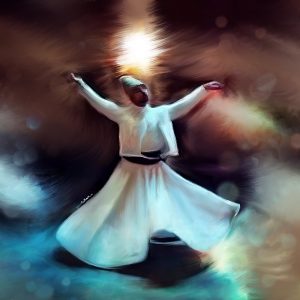
Playing the Raga Pranayama in my heart and soul I am sitting inside this quiet room for so many days now and slowly this world has stopped reeling.
The shrivelled old self shed off its glories and achievements and regrets all at once, it was painful and I did die a little. Then all I did was to look up and breathe, close my eyes and breathe again.
Now brighter, with no desire to compete with light or a sharper mind or the maestro musician, I sit simply playing the Raga Pranayama.
Yes, often my memory makes me feel overwhelmed, and yet something allows me to accept it all that too with a smile.
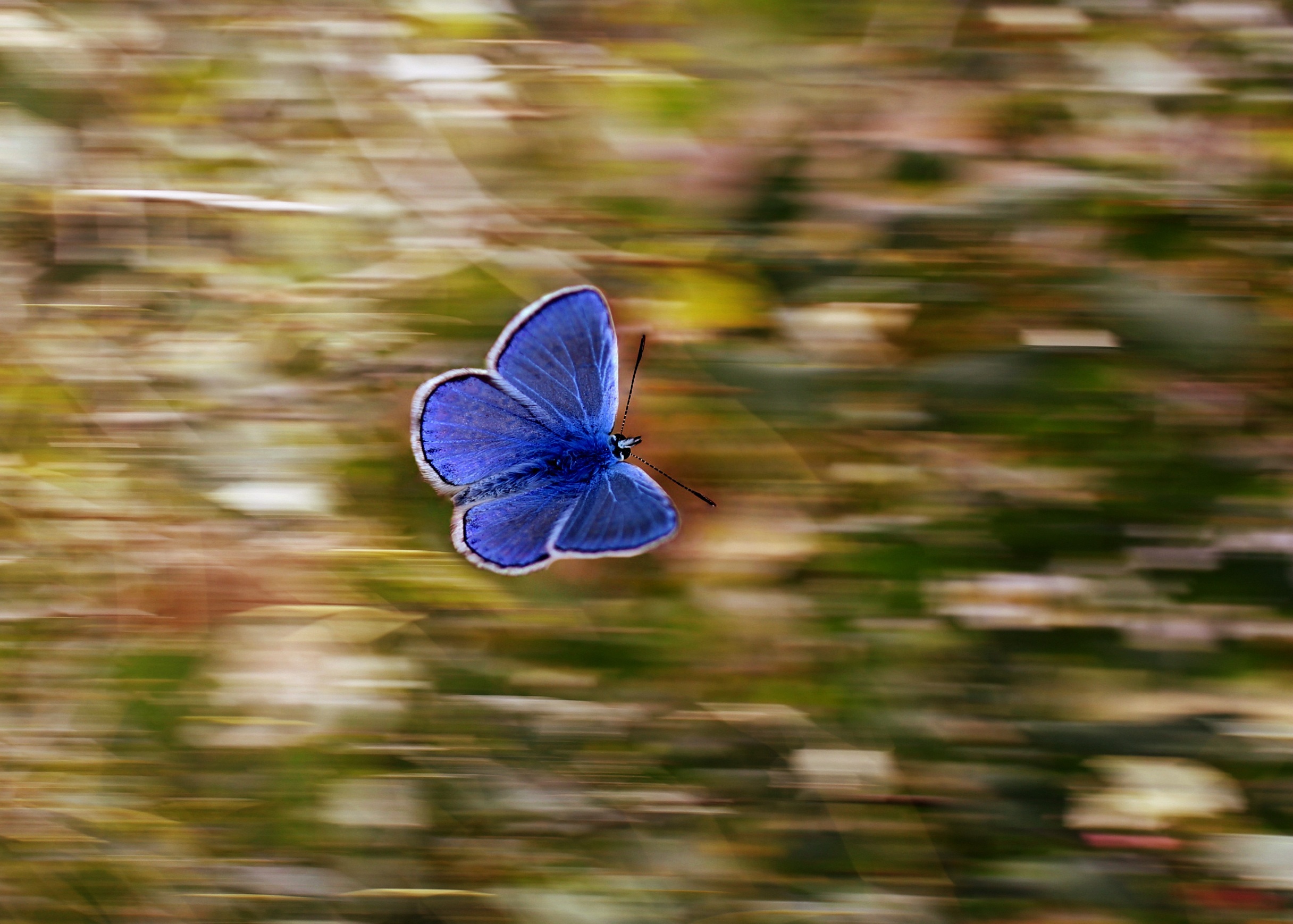
And softly the wind brings a message from the meadows that the dandelions are gushing with joy and beaming for one and all; that the butterflies are coming carrying colours for you and me; that the stream is singing, sparkling sibilantly, shy at first, vibrant then. Oh it is lovely!
It is a new beginning, I am sitting in my room and everything has changed as I play the Raga Pranayama.
Dispelling the emaciated fears that had spread and frolicked in my mind, dispelling with the truth of this life force running lightly within and without… the fears just succumbed in the end and this I will remember, always, so that I too can share and struck a happy peaceful note.
Voices together, singing this happy note, playing the Raga Pranayama will eventually rise above the gloomy cry of this malady.
Together we will rise and break that wall which was once built greedily by us. Hold on, hold on for it will pass.
Play with me the Raga Pranayama in your heart and soul and let the life energy guide you.
That hazy glow you see when you close your eyes and breathe, that dot, it is the one that surmounts, it has and it will, sometimes with and sometimes without the shell.
Raga (Sanskrit for “colour” or “passion”) is a melodic framework for improvisation and composition in Indian classical music. Read more here.
Pranayama (prana, Sanskrit for “life force” or “vital energy” and yama, Sanskrit for “restraint” or “control”), is a set of meditative practices designed to control pranawithin the human body by means of various breathing techniques. Read more here.
Also, listen to the magnificent Ragas that inspired me to write this post – Raga Rasia by Pandit Ravi Shankar
Raga Brindabani Sarang by Pandit Hariprasad Chaurasia
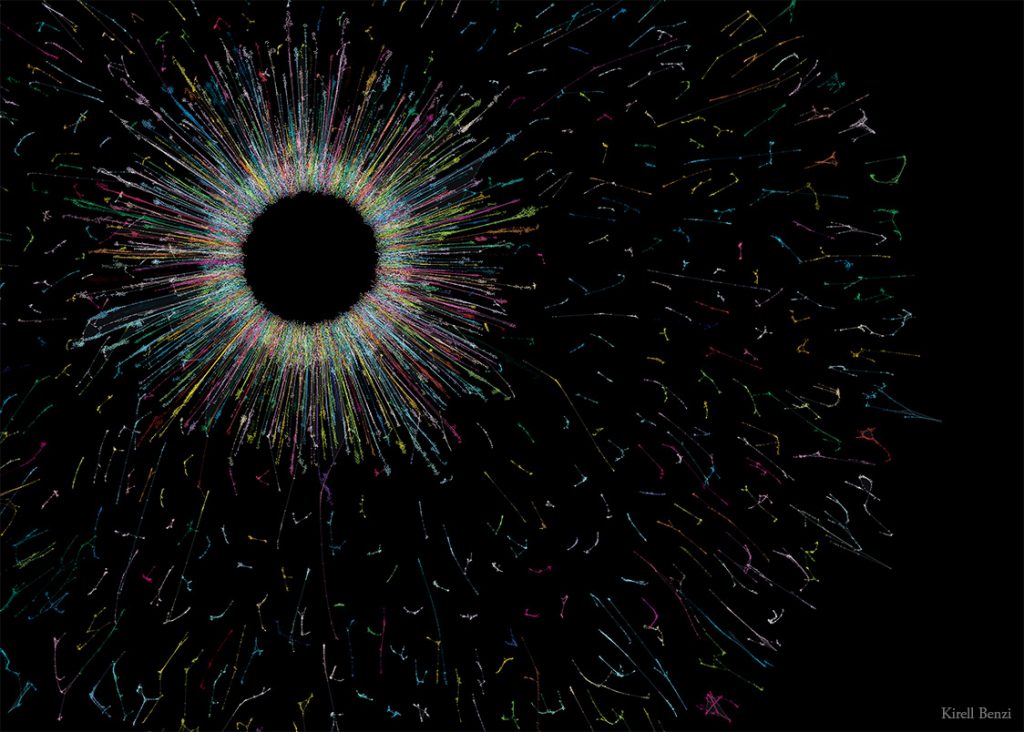
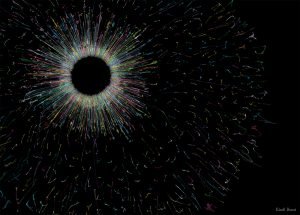
Learn more about Data Art by the fantastic Dr. Kirell Benzi, click here.
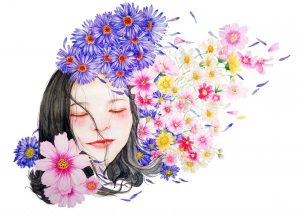
What the heart knows it reveals without any second thoughts for it does not weigh its words. The heart never babbles, it speaks passionately for it speaks the truth.
The heart speaks to a calm mind, to an honest voice, to a confident cry. The heart speaks fluently and soulfully.
Powerful enough to move mountains, the heart often uses poems to express, to highlight, to show what the eyes cannot see, to declare and vanquish weaklings who betray humanity.
I am thinking of you and your skylark song, cor cordium, you listened to your heart then and we are listening to you since.
Cor Cordium is Latin for ‘Heart of Hearts’; it is the inscription written on Percy Bysshe Shelley’s grave to whom I dedicate this piece.
Running lines, zigzag running lines fuel the mind often. Like lost in a busy city, burning with shiny lights, where no one knows whether it is day or night, I am lost walking, running, gliding on a zigzag path.
Neither snow white wintry nor swoony soft summery winds can be heard here, who knows why.
All I can hear is the hub-dub of my heart.
Trapped in this maze, facing dead ends and memory monsters, I solemnly walk ahead. And after an endless time passes by, I walk out of the maze. Exhausted, yes, but hopeful, why, for I kept walking.
Looking back from the mountain top I can see a cloud of zigzag lines, an imprint of time, a link between battles and victories, between a structured confusion and a messy exuberance. Ah! It goes on and on.
My heart is eager and my mind alert for the future to reveal itself.
I am not afraid anymore for the zigzag lines are transparent and always in a rush.
I am joy running free/
freely flying, fluttering, soaring in a valley/
Of joy am running free.
Greetings!
A storyteller, following the ancient tradition of cave chroniclers, standing in vrikshasana (the tree pose) on a hill top (it is sunny, but windy), breathing in and out stories (relishing it all, but at times overwhelmed), declares animatedly that she will continue to – tell stories, share rare story gems, and connect with the pacy universe while also keeping the website ad-free.
Big thanks to my readers. Stay tuned!
Also, a humble request to the new subscribers to check the spam folder after subscribing. Silly (but necessary) confirmation emails often land there instead of the bright inboxes. Merci!
Ya-hoy!
Chiming Stories (formerly Home Chimes)
P.S – Supporting a storyteller is good for the world’s health (and undoubtedly, for the storyteller’s health as well). Shower some love by sharing, commenting and subscribing to the Weekly Newsletter.
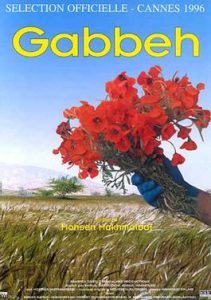
Gabbeh, the 1996 film, is a simple tale of a gipsy girl, her clan and the way their life goes on. Unfolding beautifully just like an artist painting a canvas, Gabbeh quietly touches the grand questions.
Ranked as one of the greatest British films of all time, The Lavender Hill Mob confides in the audience, letting them see, feel, laugh and think without tickling persuasively with a joke here and a punch-line there.
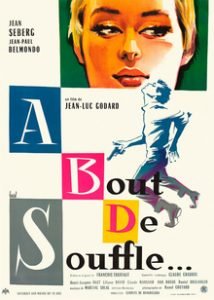
Godard… Breathless and Alive
A Tribute to Jean-Luc Godard, the Film Philologist who Reinvented Cinema.
Yes fly! For walking on the second track is dull and usual, but dreaming high, high, high requires tools. Tools like the right pair of shoes, a chirpy, gritty soul that eats butter-jam dreams, a soul that drinks milky-milky creams.
Silver cascade shimmering the night sky, music to the waves and surreal beauty to the eyes, the Moon loves the art of discipline.
It may be difficult to believe for the Moon’s splendour defies time, it stupefies the clock, it follows the path of a dreamer, but how could this be possible if the Moon knew not discipline?
In this moment, I am a little bit of this and a little bit of that, I am complete and incomplete, I am pleased and uncertain, I wish for nothing and I know I have to wait.
Because the distance covered reminds me of the hurdles I have crossed and the ones I could not, it reminds me of a throbbing past and a dreamy future and it reminds me of how much time is left.
Meredith and the Green Lake
Illimitable Splendour
A joy so complete without any rise or fall, so free without any time corners, so real without true being false, false being true.