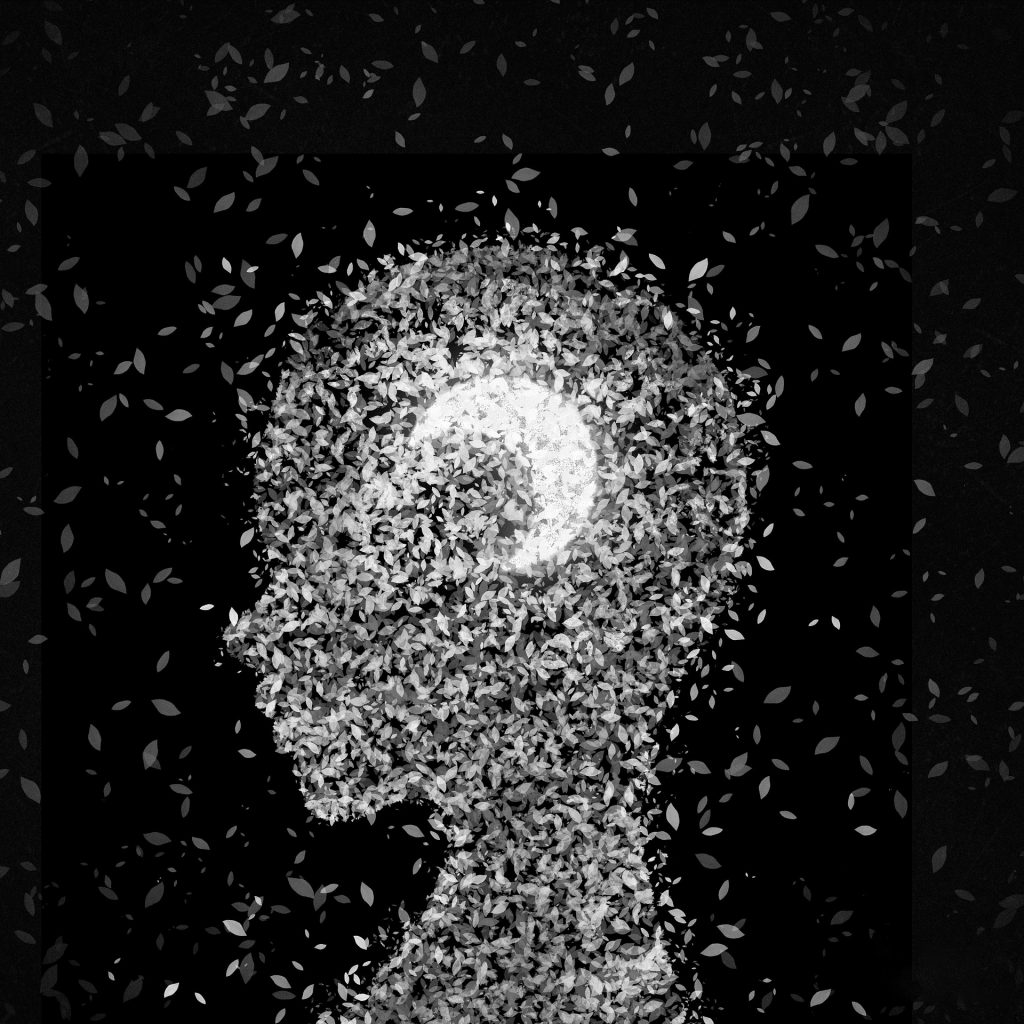
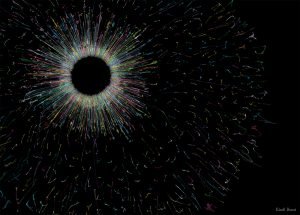
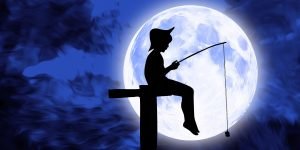
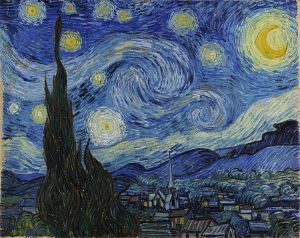
Now a clear dot… now hazy… mixing with the clouds through and through, then beaming alone gloriously. Splattering moony clay, then rubbing it, greasing with it the deep dark sky.
Mirroring all the romantics and dream-talkers, the moony clay moulds itself to fit into the beholder’s eyes and patient hearts. It listens, nods and registers its reply with the artist.
Moony clay – an assiduous storyteller, slowly moving away – happily builds the wavy waves and like a sand clock shows the slipping time its way.
Singing joyously, dancing leisurely, the moony clay creates and fills the heart with hope, lost in splendour.
See how it re-shapes, re-writes its journey, certain of uncertainty in knowing… in knowing it all.
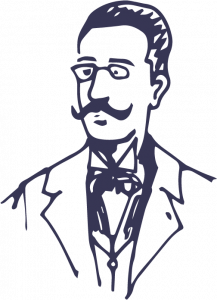
Charles Lamb, the romantic essayist of the 19th century, under the pseudonym Elia wrote informal, lyrical and personal essays – witty, humorous, funny – he wrote so that his heart won’t explode – and left the essays open-ended, putting the reader quietly in quandary, asking them to look for a definite answer, to construct the story circle complete and finish what he so melodiously had started.
And to finish this wistful melody the reader has to stay with Lamb’s thoughts for a while. What a victory for a writer!
Born in the year 1775, Charles Lamb’s ‘thinking heart’ wrote about his desires and imaginations, resentments and failures, the world he observed and the quaint world he read about, the sweet past and sweet melancholy, the civilised unsatisfied industrialised society, the forgetful lots and the few compassionate souls.
His evocative language interacted with the readers, urging them to participate and respond, digressing from the topic so often just like friends do while sharing an anecdote.
A friend to all, sharing his secrets honestly – for he thinks himself to be the only object he knows intimately – Lamb lived a lonely, troublesome life. He took care of his sister Marry Lamb – with whom he co-authored The Tales of Shakespeare (1807) for children – who suffered from mental illness and in a fit of madness had even killed their mother.
Standing by her side all his life, Charles Lamb continued to write.
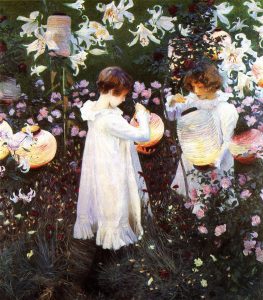
His unrequited love story featured in many of his essays; Charles Lamb never stopped loving Ann Simmons. In his essay, Dream Children – A reverie, his two children sit next to him, eager to listen to stories of their ancestors, great uncles and aunts, people whom they will never meet and yet they would know so dearly via their tales.
He shares with them the stories of their great grandmother Mrs Field, the grand house where she lived as a caretaker, about their uncle John Lamb, his childhood days and the “idle diversions” (like watching little fish darting to and fro in the pond on a sunny winter day), and gently brings in the topic of death – how his brother passed away and how much he misses him, suddenly sad, the children ask him to tell them about their late mother (a reflection of Ann Simmons) – and just before he could look at his children a bit more, they fade away.
Awoke, Lamb finds himself sitting in his armchair, too far from the sweet-bitter-warm dream.
In a dream-like style, the essay catches that vague emotion of joy/loss/regret/fulfilment/affection/ loneliness all in one, that sweet emotion that colours the cheeks red, that makes one teary-eyed, that leads to a sigh, that reminds one of life…
Though Greek and Roman philosophers like Theophrastus and Plutarch, Cicero and Seneca wrote essays (when this genre was not yet coined), it was in the early 16th century that the French philosopher Michel de Montaigne popularised the essay as a literary genre.
Charles Lamb chose to follow Montaigne’s lead instead of following the well-known English essayists who predated Lamb like Francis Bacon, Addison, Steele, and Samuel Johnson.
Lamb’s essays, though personal in tone, never hesitated to critique the apathetic side of the society; not serious and didactic as Bacon, Lamb paid attention to creating an authentic picture of life.
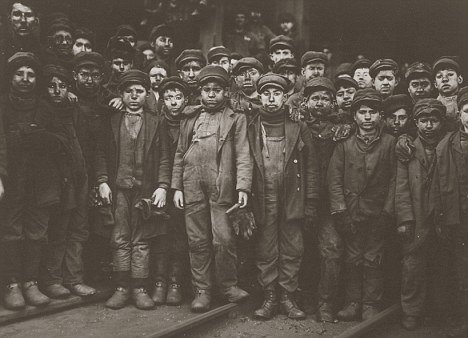
In his essay, The Praise of Chimney Sweepers Lamb talks about the little kids who were made to work as chimney sweepers across London – snatching their childhood so brazenly.
*
A group of apprentice Chimney Sweeps. [Source – Caveat Bettor]
He shares anecdotes that paint the harsh reality in a straightforward manner – a tale within a tale – like how a soot-covered boy had laughed when Lamb tumbled down on a street one day, seeing his twinkling eyes made him smile too, how he describes the tea-like beverage that the chimney sweepers found appetizing, a cheap beverage that was made from the sweet wood of the sassafras tree, how his late friend James White used to throw a feast for the chimney sweepers at a local fair, offering them food and entertainment…
Without attacking the privileged class directly Charles Lamb presents an image that cannot be brushed off as easily as sometimes moral talks are brushed.
These imaginative, conversational style essays may not guide the reader like a classical essayist’s essays, it may not teach us the form, but what it does is nothing short of brilliance, it balms and befriends our aching heart and tells us frankly that it is alright, we are all in the same boat…
The wheel of Time moves ceasing for none, winning over oceans, mountains, the sky, the wind and the fire.
People crowd to clench forms and beliefs, together they build and destroy. They wait to gauge for more and what is better.
Look now, how they shine, bright like fireflies, honest to the core; look now, how they lure, how they trick the tricksters, how they slay a man’s soul.
Speak not, for they are at work, cross-legged monks, meditating on what is less; speak not, for you will fail to express how chaotic is the chaos.
Rising high is the music of unity and harmony; falling face down is the corrupt, fake cry of every rigid mind.
Knowing the beginning, waiting for the end, it walks, it lingers, we walk, and we linger.
Tala Pattachitra, Palm Leaf Painting – Odisha’s ancient art form. [Source – ethnicpaintings.com]
Second eye says that it is all absolute bliss.
There is no Space or Time and it binds none; the ultimate end and the ultimate start merges with the absolute existence.
Flowing in a silent music, dancing always, the ripple reaches the centre.
The Brahman breathes; formless, it is of the colour peace.
Lord Jagannath’s eyes are the universe we see and the universe we can’t see. The happy devotee who bows, who worships, who sings, who gazes gets mesmerized by one of the universes, and by Lord Jagannath’s smile.
Our million eyes find a million revelations in Lord Jagannath’s eyes.
*
Lord Jagannath, Lord of the Universe. [Source – harekrsna.de]
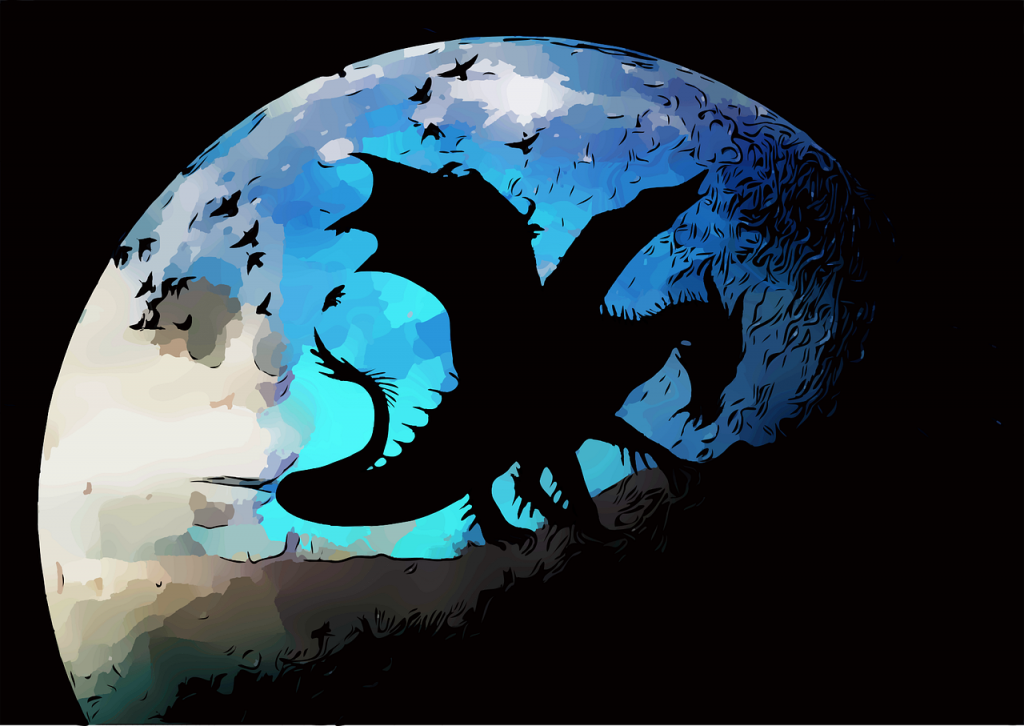
Eyes gaze at the grandiose being, follows its path, amazed and overwhelmed by the unbelievable. What is so grand in the way dragons fly? It is just in its element, it is its utmost self.
The dragons are awed by every mind that is familiar with its stories. Fire breathing, winged, snake like, four legged, cave dwellers, treasure keepers, proud and wise.
Flying high above the clouds, quasi-free from bondage, they come back on the ground to quench their thirst. They don’t kill for joy, they understand the laws of nature.
Mythical or not, dragons are glorious creatures. I say mythical or not for a storytellers’ imagination is an entity in itself, very much alive, though in thoughts, formless and fluid, but true.
Found in a story, the dragons thrive in this other realm.
Storytellers gave something more than just a pair of wings to the dragons, that something is splendour and beauty. Thus, right in the thought there was magnanimity and ferocity. What else is a dragon if not a magnanimous lovable beast?
Ah, here is what sprinkles magic in a dragon’s story, they are lovable beasts. Our storyteller friends didn’t suffer, at least, and I thank every heaven, from poverty of mind; they dared to imagine and realized that nothing is more powerful than true love, not even a dragon.
So rhythmically every dragon’s story is about love; a hero either fights back or fights along the dragon and wins back her love/ life and is showered with unheard grandeur.
Always a talk of antiquity, dragons are, but worth noticing is not the ‘antiquity’ bit, it is the ‘always’ bit. Always remembered, locked in the heart.
But what is so grand in the way dragons fly? It is just in its element, it is its utmost self.
Exactly, it is its utmost self. Like the storyteller who thought of it with utmost concentration, power, passion and love. Maybe just for a few minutes the storyteller was in her element, she was her utmost self, and thus, she gave birth to the dragon.
These legendary creatures ruled the sky once upon a time, and they still do, just travel to their realm and witness how majestically they fly.
Ocean eyes, an illusion or a reality… [Image by 愚木混株 Cdd20 from Pixabay]
All that you see, all that is in your mind, all that you have experienced, all that which breathes within you, exists only because you are.
The inevitable change assures gently that illusion is reality and the rest a seeming.
The carousel of life goes on; from the darkest night to the brightest morning, from black and white to the rich spectrum, you pass by. Humming a single note, you pass by.
The end, the beginning. Remember?
You created the rainbow as you saw it, you replied to the mountain when you echoed, you walked ahead to make it happen, you looked behind to say goodbye, you stopped to realise and what was beyond came to you with an epiphany.
Illusion is a friend. Fathomable, it is the reality.
Tenzin Achi’s magical! [Image by Tri Le from Pixabay]
*
Tenzin Achi for the first time was going to reveal the hidden treasure of her green old trunk. She knew we children were very keen and would do anything just to even take a peek inside. Especially after Lo’s encounter with an alien creature who guaranteed Lo that he came via the green old trunk.
When Tenzin Achi was approached to confirm this incident, she had just laughed and said, “Ask the green trunk.” No one ever dared to do that of course.
And today Tenzin Achi has agreed, astonishingly, at such a low bid – one chocolate and five cookies – to introduce us to the mysterious dwelling of the trunk.
“Oi… not letting you see inside”, said Tenzin Achi, “I’ll show you all myself, stay back.” I knew it, we are duped… she wouldn’t have let our curiosity die so soon.
But you know what, we all were prepared for it. Tenzin Achi is famous as canny granny.
Behold, she announced and took out a pair of silver tinned wire loops, which a talking dragon gifted her. Then came out five stones – red, indigo, yellow, green and white; she collected them from a planet she visited, named Kakuraa, and were extremely precious stones.
Seeing none of us impressed, she challenged us to visit planet Kakuraa and ask anyone about the credibility of the stones. Silence prevailed and when someone yawned, Tenzin Achi was seen sweating.
She then took out a tiny copper ball. Now this appealed to all us children and Tenzin Achi beamed.
There was a message engraved on the tiny copper ball and “only a warrior could read it” said Tenzin Achi. Dramatically she said some words in her dialect and we understood zilch of it, but we stayed hooked.
We all gasped in chorus as she twisted and opened the tiny copper ball. She first made all of us swear with our hands on our heart, “don’t pass my secret to anyone – I am a warrior of Phui clan.” We obeyed as we were clueless and eager to know what’s hidden in the copper ball.
Veil uncovered, Tenzin Achi took out a small piece of crumpled cloth from the copper ball, red-white pattern knitted, it looked extremely ordinary, but the story attached to it wasn’t.
She told us about Zumuh (that piece of cloth had a name). When the Kakuraa dynasty decided to leave for another world, they left on this planet, bits of Zumuh. These magical pieces worked as a Genie and it wasn’t easy to get one. Only who believed in magic and showed reverence to the Kakuraa dynasty could find it. Umpteenth times, she said proudly, Zumuh had helped her. Magic lived in her heart and pocket.
Pazo then said harshly, ‘Tenzin Achi is trying to fool us… this Zumuh can’t be used even as a hanky.’ Laughter filled Tenzin Achi’s old wooden room, but she stayed quiet, like me and Lo. Were there tears in her eyes?
I don’t know, but I stood up and told everyone “I too have a Zumuh, it saved my life thrice from a dog.”
They knew it was true, Kaalu had bitten Pazo and even Lo, but I managed to save my pajamas and myself somehow. I took out a round and rotted plastic but alive key ring from my pocket; with red-white pattern on it, I presented my Zumuh.
I told them that a great traveller gave it to me near the hilltop and then vanished. Surprisingly Lo agreed, adding that he too saw that great traveller vanish into thin air.
Pazo asked me to demonstrate the power of the Zumuh. Tenzin Achi had something else in her eyes then – spark of magic.
I stretched my hand, holding the key-ring and shouted, ‘Zumuh show your power, I believe in you.’
‘I also believe in you O Zumuh, let the magic shine’, said Tenzin Achi as she copied me and looked towards the roof, as if it was magical and we could see through it. Lo, who was without any Zumuh, also got up and screeched ‘I also believe.’
Many eyes were glued to the Zumuh and I was actually hoping for a magical blast.
Thunder!!!!!! We all literally jumped on our places. The sky replied and immediately it started to snow.
Although it was winter, it wasn’t the time of the year for the clouds to shower snow. I yelped, ‘Thank you Zumuh.’
We all rock and rolled and tried to copy Tenzin Achi’s funny one-leg-in-the-air-dance, singing ‘zumuh, kakuraa, o zumuh, kakuraa!!’
*
Lightning dances along with them. [Source – Pixabay]
I am joy running free/
freely flying, fluttering, soaring in a valley/
Of joy am running free.
Greetings!
A storyteller, following the ancient tradition of cave chroniclers, standing in vrikshasana (the tree pose) on a hill top (it is sunny, but windy), breathing in and out stories (relishing it all, but at times overwhelmed), declares animatedly that she will continue to – tell stories, share rare story gems, and connect with the pacy universe while also keeping the website ad-free.
Big thanks to my readers. Stay tuned!
Also, a humble request to the new subscribers to check the spam folder after subscribing. Silly (but necessary) confirmation emails often land there instead of the bright inboxes. Merci!
Ya-hoy!
Chiming Stories (formerly Home Chimes)
P.S – Supporting a storyteller is good for the world’s health (and undoubtedly, for the storyteller’s health as well). Shower some love by sharing, commenting and subscribing to the Weekly Newsletter.
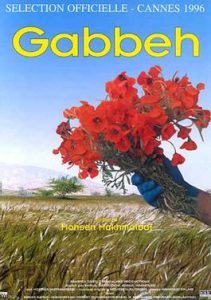
Gabbeh, the 1996 film, is a simple tale of a gipsy girl, her clan and the way their life goes on. Unfolding beautifully just like an artist painting a canvas, Gabbeh quietly touches the grand questions.
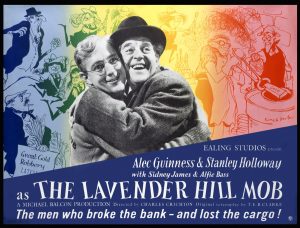
Ranked as one of the greatest British films of all time, The Lavender Hill Mob confides in the audience, letting them see, feel, laugh and think without tickling persuasively with a joke here and a punch-line there.
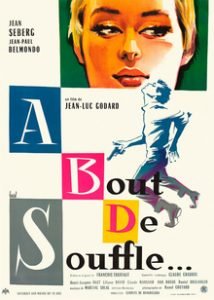
Godard… Breathless and Alive
A Tribute to Jean-Luc Godard, the Film Philologist who Reinvented Cinema.
Yes fly! For walking on the second track is dull and usual, but dreaming high, high, high requires tools. Tools like the right pair of shoes, a chirpy, gritty soul that eats butter-jam dreams, a soul that drinks milky-milky creams.
Silver cascade shimmering the night sky, music to the waves and surreal beauty to the eyes, the Moon loves the art of discipline.
It may be difficult to believe for the Moon’s splendour defies time, it stupefies the clock, it follows the path of a dreamer, but how could this be possible if the Moon knew not discipline?
In this moment, I am a little bit of this and a little bit of that, I am complete and incomplete, I am pleased and uncertain, I wish for nothing and I know I have to wait.
Because the distance covered reminds me of the hurdles I have crossed and the ones I could not, it reminds me of a throbbing past and a dreamy future and it reminds me of how much time is left.
Meredith and the Green Lake
Illimitable Splendour
A joy so complete without any rise or fall, so free without any time corners, so real without true being false, false being true.