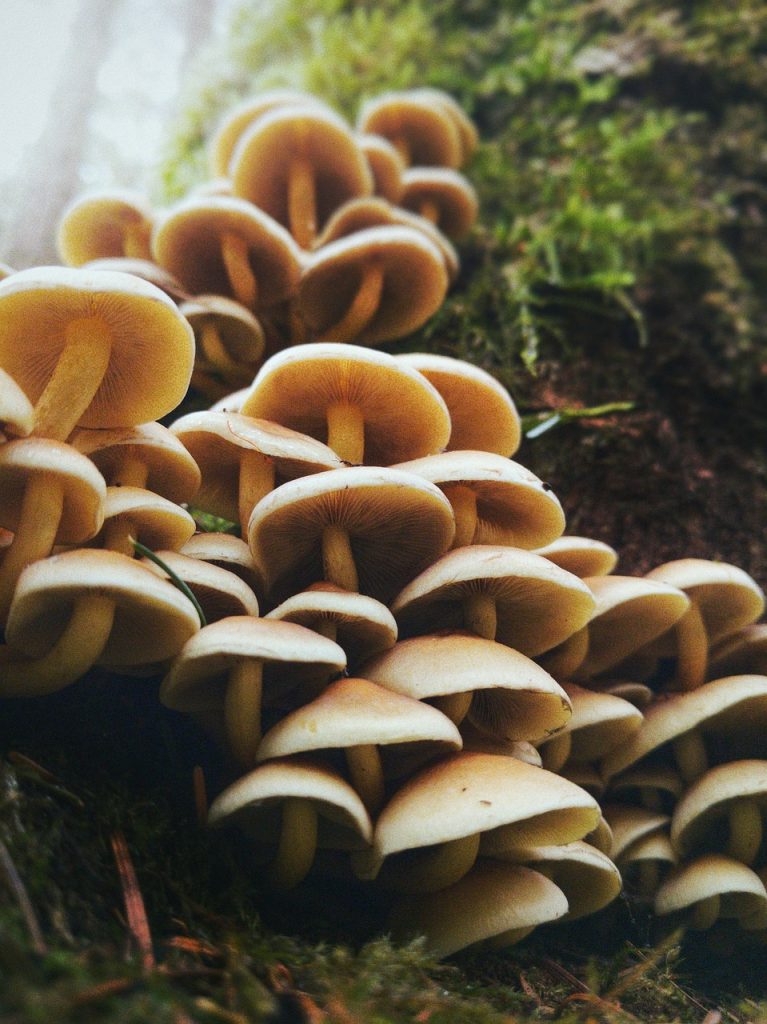
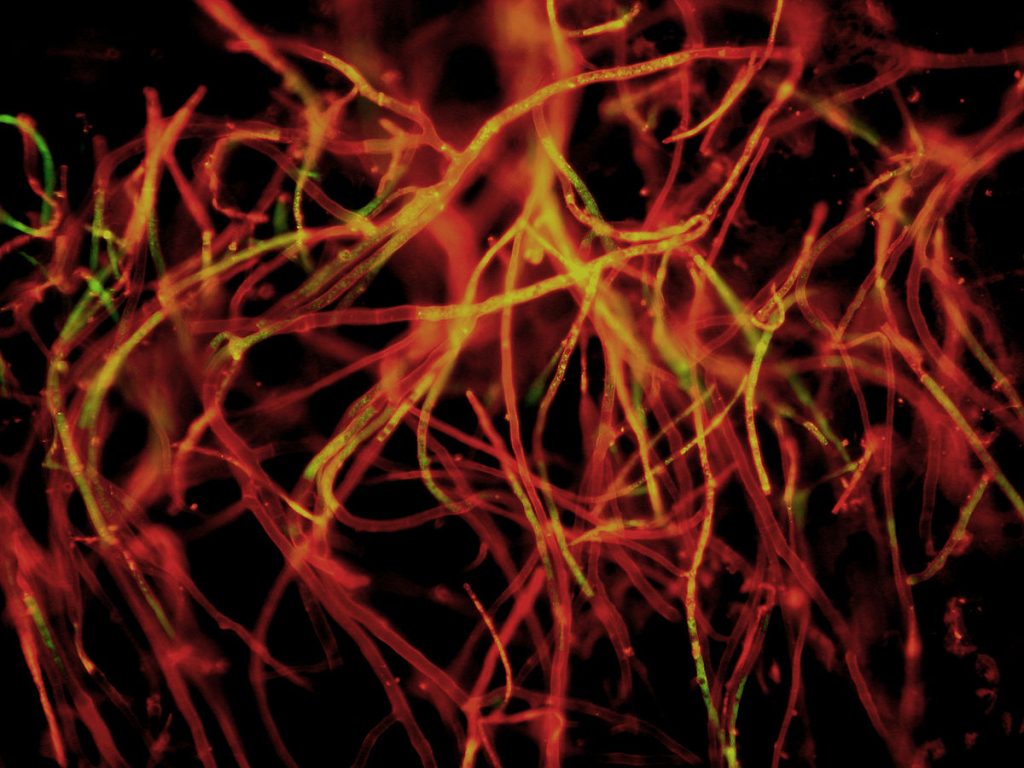
Oyster mushroom mycelium growing in a petri dish on coffee grounds. [Source – Wikimedia Commons]
Fungi marched onto land more than a billion years ago. Many fungi partnered with plants, which largely lacked these digestive juices. Mycologists believe that this alliance allowed plants to inhabit land around 700 million years ago. Many millions of years later, one evolutionary branch of fungi led to the development of animals.
A group of elongated cells (hyphae) from the filamentous fungus Podospora anserina. [Source – Wikimedia Commons]
I see the mycelium as the Earth’s natural Internet, a consciousness with which we might be able to communicate. Through cross-species interfacing, we may one day exchange information with these sentient cellular networks. Because these externalized neurological nets sense any impression upon them, from footsteps to falling tree branches, they could relay enormous amounts of data regarding the movements of all organisms through the landscape.
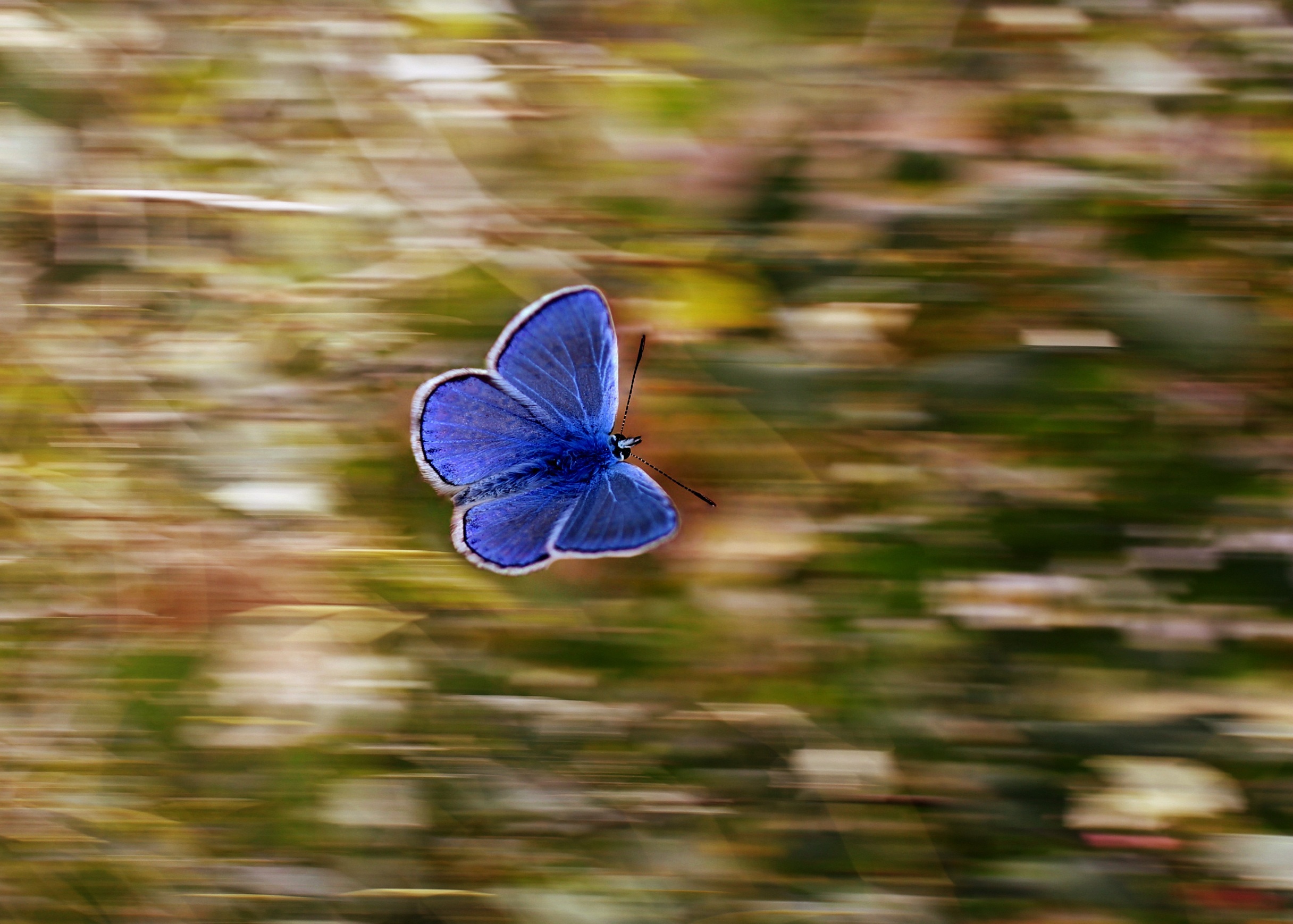
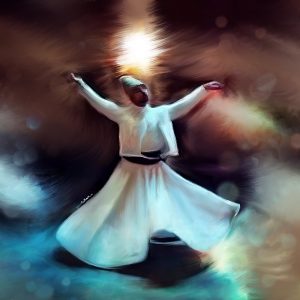
I am joy running free/
freely flying, fluttering, soaring in a valley/
Of joy am running free.
Greetings!
A storyteller, following the ancient tradition of cave chroniclers, standing in vrikshasana (the tree pose) on a hill top (it is sunny, but windy), breathing in and out stories (relishing it all, but at times overwhelmed), declares animatedly that she will continue to – tell stories, share rare story gems, and connect with the pacy universe while also keeping the website ad-free.
Big thanks to my readers. Stay tuned!
Also, a humble request to the new subscribers to check the spam folder after subscribing. Silly (but necessary) confirmation emails often land there instead of the bright inboxes. Merci!
Ya-hoy!
Chiming Stories (formerly Home Chimes)
P.S – Supporting a storyteller is good for the world’s health (and undoubtedly, for the storyteller’s health as well). Shower some love by sharing, commenting and subscribing to the Weekly Newsletter.
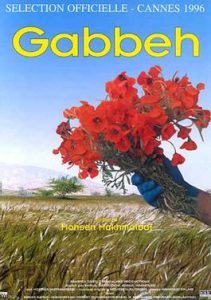
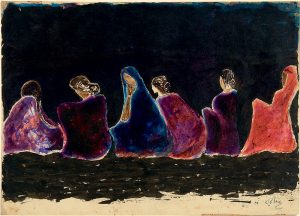
Gabbeh, the 1996 film, is a simple tale of a gipsy girl, her clan and the way their life goes on. Unfolding beautifully just like an artist painting a canvas, Gabbeh quietly touches the grand questions.
Ranked as one of the greatest British films of all time, The Lavender Hill Mob confides in the audience, letting them see, feel, laugh and think without tickling persuasively with a joke here and a punch-line there.
Godard… Breathless and Alive
A Tribute to Jean-Luc Godard, the Film Philologist who Reinvented Cinema.
Yes fly! For walking on the second track is dull and usual, but dreaming high, high, high requires tools. Tools like the right pair of shoes, a chirpy, gritty soul that eats butter-jam dreams, a soul that drinks milky-milky creams.
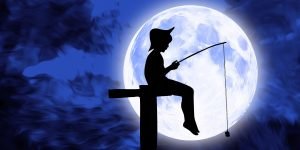
Silver cascade shimmering the night sky, music to the waves and surreal beauty to the eyes, the Moon loves the art of discipline.
It may be difficult to believe for the Moon’s splendour defies time, it stupefies the clock, it follows the path of a dreamer, but how could this be possible if the Moon knew not discipline?
In this moment, I am a little bit of this and a little bit of that, I am complete and incomplete, I am pleased and uncertain, I wish for nothing and I know I have to wait.
Because the distance covered reminds me of the hurdles I have crossed and the ones I could not, it reminds me of a throbbing past and a dreamy future and it reminds me of how much time is left.
Meredith and the Green Lake
Illimitable Splendour
A joy so complete without any rise or fall, so free without any time corners, so real without true being false, false being true.