In Conversation
It is not a humble, gentle quest they all set for, but a challenge that they take up passionately, blindly, gladly to find out the meaning of love. And while it sounded, and was, a glorious and grand task like a celebration, they were tricked by the challenge itself. Nevertheless, this push and pull continued and filled the space with the aroma of first, passion and daring, then, possibilities and impossibilities and finally, it filled the room with love.
The rather quick journey that took the form of a grand challenge unfolds here melodiously, in the form of a Qawwali and forms the climax in the romantic musical film Barsat Ki Ek Raat (One Rainy Night, 1960).
*
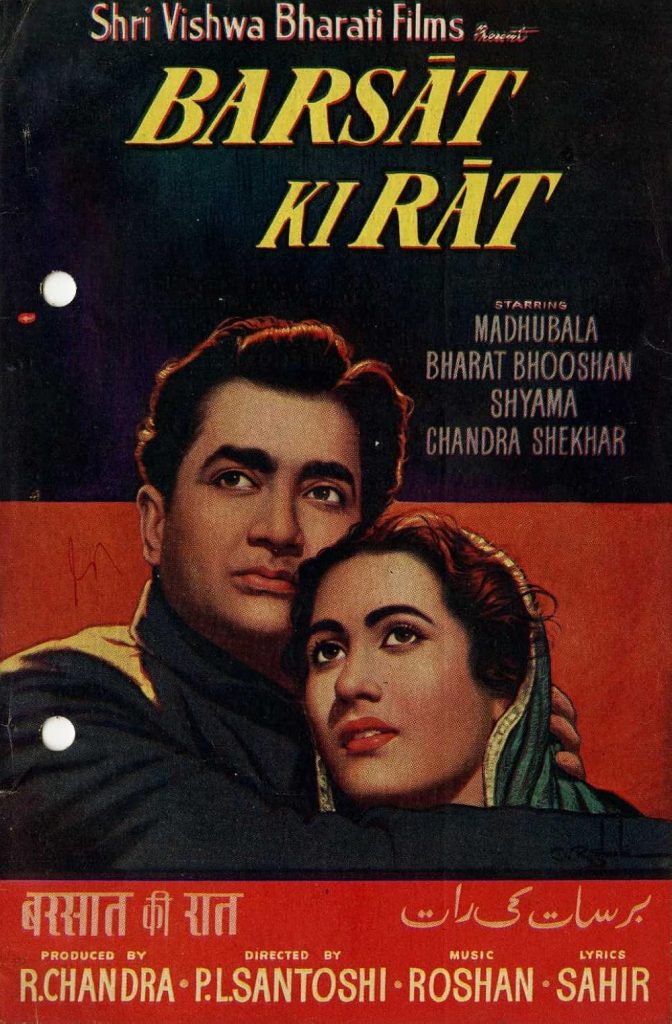
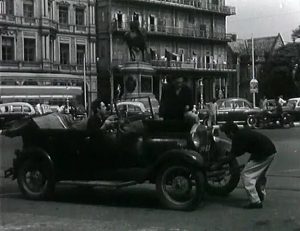
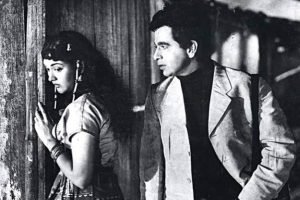
Barsat Ki Ek Raat (1960) directed by P. L Santoshi, story by Rafi Ajmeri, starring Madhubala, Bharat Bhushan and Shyama.
Na to Karwaan ki Talash hai… Qawwali by Sahir Ludhianvi. [Source – IMDB]
*
Words may never be able to capture what love is, but here Sahir Ludhianvi’s lyrics gallops any and every gap so beautifully that it presents the careful listener with tales, promises, whispers of love, pain, joy, tears, bliss, death and the sublime. The lyrics burn away the duality and confusion, the conflict and rigidness with so much love that your eyes well up.
Melos (song or music in Greek) and drama (drame in French) combine to form melodrama. A fantastic tool used to present all that is life in just a few minutes and hours on stage and screen.
*
Listen to mesmerising qawwali as you read ahead –
The music creates the mood, it is a jugalbandi (jam session) between the musicians, it rises and falls, it promises nothing and everything and then it stops letting the singers and words to take the centre stage… charismatically.
Male Singer –
Na to caaravaan ki talaash hai
I am not in search of a caravan
Na to humsafar ki talaash hai
I am not in search of a fellow traveler
Mere shauq-e-khaana kharaab ko teri rehguzar ki talaash hai
That ruined place of my desire searches for the path that leads to you
Team One presents a challenge via their craft, for it is a matter of love, they know the stakes are high, they challenge the other team as well as declare that they, who know love very well, know how to manoeuvre in this space. They talk about the lover who is content in their loneliness and doesn’t need any support from fellow travellers – another strong perspective – they are talking about someone who is already walking alone in this maze of a world, and that it is a choice because all this person desires is to find the way to their beloved.
Female Singer –
Mere naamuraad junoon ka hai ilaaj koi to maut hai
If there is any cure for my unfortunate obsession, then it is death
Jo davaa ke naam pe zehar de
Give me that medicine whose name is poison
Usi chaaraagar ki talaash hai
I am in search of such a healer
Team Two keeps forth a situation less as a reply and more as a fact as the singer is deeply in love with someone who loves another, it starts with and stays in a personal space for her. This lovesickness of hers, an obsession for those who don’t understand her, has only one cure and that is death. She raises the stakes further hinting at her looming death.
The words like obsession, cure, death, medicine, poison, healer, beautifully amplify the intensity of the entire song so early on; but after all, dying, loving and living aren’t separate. The singer is also surrendering, though not giving up, rather she is ready to give up on her life. She is surrendering it all with love.
Male Singer –
Tera ishq hai meri aarzoo,
Your love is my desire
Tera ishq hai meri aabroo,
Your love is my honor
Dil ishq, jism ishq hai, aur jaan ishq hai
My heart is love, my body is love, and my life is love
Imaan ki jo poochho to imaan ishq hai
If you ask for faith, then that is love too
Tera ishq main kaise Chhod doon?
How could I ever leave your love?
Meri umr bhar ki talaash hai
That love is what I have been searching for all my life
Team One doesn’t believe in surrendering, they are only too invested in winning the competition. They’re eager to charm the audience too and thus, they announce, that for them the beloved’s love is their desire, honour, heart, body and whole life and in fact, even their FAITH. Whatever is on a pedestal in their lives, they have already kept it at the feet of their beloved and after struggling so much how can they let go of their love, it has been a life time’ search and now they cannot abandon it, they cannot surrender.
This grand announcement receives applause. Continuing the search for love is what the majority does and so the majority claps; those in deep love, watch with love.
The song gallops as it has promised to do so and the tempo changes.
Male Singer –
Yeh ishq ishq hai, ishq ishq, yeh ishq ishq hai, ishq ishq
This is love, this is love, this is love
Jaan-soz ki haalat ko jaan-soz hi samjhegaa
Only one in torment can understand the condition of a fellow sufferer
Main shamaa se kehta hoon mehfil se nahiin kehta
I am speaking to the flame, not to the company gathered here
Kyonki yeh ishq ishq hai, ishq ishq, yeh ishq ishq hai, ishq ishq
For this is love, this is love, this is love
Team One enjoying the mood, the vibrancy and lead, takes a rather cheap shot at the opponent that isn’t recognised by all. Showing concern for the wounded lover he says he understands that pain and that is why now he is speaking with the flame directly and not the audience members. While on one level, he seems to be talking about the moth and flame metaphor that represents a self-destructive devotion, yet on another level, he is talking to the lead singer from Team Two, her name being Shama which means flame.
Female Singer –
Sahar tak sab ka hai anjaam jal kar khaak ho jaana
By dawn, everything will burn and be reduced to ashes
Bhari mehfil mein koi shamaa yaa parvaana ho jaaye
Everyone in this gathering shall became either flame or moth
Kyon ki yeh ishq ishq hai, ishq ishq, yeh ishq ishq hai, ishq ishq
For this is love, this is love, this is love
Seeing that the lead singer is in tears, the second singer from Team Two replies instead and that too sharply. She carries the moth and flame metaphor to its finality, declaring that by dawn, everyone present there may very well die because it is possible for them to turn into either the flame or moth – one will die-out and other will burn to death.
Hero –
Vehshat-e-dil rasn-o-daar se roki na gayi
Love is not stopped by the madness of the heart or ropes and the gallows
Kisi khanjar, kisi talvaar se roki na gayi
It is not stopped by any dagger, by any sword
Ishq Majnu ki woh aavaz hai jiske aage koi Laila kisi deewaar se roki na gayi,
Love is that voice of Majnu’s which Laila followed and which no barrier could stop
Kyon ki yeh ishq ishq hai, ishq ishq, yeh ishq ishq hai, ishq ishq
For this is love, this is love, this is love
Team Two is joined by the Hero (of the film) who is sitting in the audience, who knows them very well and can see Shama is hurt, he understands her more than anyone for he himself is pining for his beloved; he pitches in so that the enquiry into what is love goes on.
He gets enough aural space to match the rhythm.
Addressing the audience more than the opposition, he says that you are talking about flames here, while love cannot be stopped by anything, be it swords, ropes, gallows, walls or even your own heart. Referring to the celebrated but tragic love story of Laila and Majnu, he says that nothing can stop any Laila once she hears the voice of her Majnu. Indirectly, also saying that there were and will always be people who would choose death over separation from their beloved.
Male Singer –
Woh hanske agar maangen to hum jaan bhi deden,
If she laughs and asks, then I would even give my life
Haan yeh jaan to kya cheez hai? Imaan bhi deden!
Yes, after all what is this life? I would even give up my faith!
Kyon ki yeh ishq ishq hai, ishq ishq, yeh ishq ishq hai, ishq ishq
For this is love, this is love, this is love
Team One also talk about life and death, reiterating what they had said earlier. They say that we are ready to die, if that is our beloved’s wish; in fact, not only life, but we can let go of our FAITH too. What was there a need to reiterate at all? What happened to their sharp gift of repartee?
Hero –
Naaz-o-andaaz se kehte hain ki jeena hoga,
I am told that I must live with my fate gracefully
Zehar bhi dete hain to kehte hain Ki peena hoga
They give me poison, and say I must drink
Jab main peetaa hoon to kehte hain ki marta bhi nahiin,
But when I drink it, then they say I won’t die
Jab main martaa hoon to kehte hain ki jeenaa hogaa
When I am dying, they say I must live
Yeh ishq ishq hai, ishq ishq, yeh ishq ishq hai, ishq ishq
For this is love, this is love, this is love
Hero’s witticism is filled with love. His voice and words are imbued with the freshness of love. Thus, he counters Team One simply by not countering, he has crossed and reached another level, he speaks directly to his beloved who is listening to his voice somewhere for sure. He knows it, and so does the viewer.
He shows what a paradox romantic love often becomes, where one inadvertently ends up torturing the other, all the while hoping to heal and rise and unite. “You’re asking me to live and die at the same time. Ah love! Tell me how is it possible? Only in love?”
Male Singer –
Mazhab-e-ishq ki har rasm kadi hoti hai,
The laws and customs of love are very strict
Har qadam par koi deewaar khadi hoti hai
At every step, there is a barrier standing
With the sudden change in position, Team One falls down without any noise. They themselves seem unaware of this that from opposing team in a competition they have taken a stance that is somehow opposing lovers. They now talk about the “complicated” laws and customs of love that often places a wall in front of the lovers. They seem to be enjoying restrictions and in doing so they restrict themselves from moving further.
Hero –
Ishq aazad hai, Hindu Na Musalmaan hai ishq,
Love is free, love is neither Hindu nor Muslim
Aap hii dharm hai aur aap hii imaan hai ishq
Your own duty and your own faith alone is love
Jis se aage nahiin shekh-o-Brahaman donon,
Both Hindu and Muslim religious men cannot surpass this
Us haqeeqat ka garajtaa hua ailaan hai ishq
The reality of that thundering proclamation is love
What started as a jugalbandi (jam session), now moves towards a solo performance, a solo voice taking the lead and love, having shed the superficial flimsy faces attached to it, begins to spread in the air like perfume. Love is freedom and freedom love, and it is that which can liberate. Love, the hero says, has nothing to do with the man-made ideas at all. He proclaims that nothing can surpass love. And this truly makes him the hero.
Female singer –
Ishq na puchhe deen dharm nu, ishq na puchhe jaataan
Love does not ask your religion or creed, love does not ask your social class or caste,
Ishq de haathon garam lahu vich doobiyaan laakh baraataan ke
Love has drowned thousands of wedding revelers in its fiery blood
Yeh ishq ishq hai, ishq ishq, yeh ishq ishq hai, ishq ishq
This is love, this is love, this is love
The second singer from Team Two, sings in Punjabi, maybe because it needed to be said in this language, maybe because it doesn’t matter which language you speak, when it comes to love, the essence remains the same. It is yet another passionate declaration – Love doesn’t discriminate. Love also becomes something that vividly is alive, for it consists of “fiery blood”. From abstraction it enters a known realm.
Male Singer –
Raah ulfat ki kathin hai ise aasaan na samajh
The path of love is dangerous, do not think it easy
Yeh ishq ishq hai, ishq ishq, yeh ishq ishq hai, ishq ishq
This is love, this is love, this is love
Team One tries to fill the lovers with doubt and thus, they use fear instead to rise in front of love.
Female Singer –
Bahut kathin hai Dagar panghat ki
The path to the riverside is very dangerous
Ab kya bhar luaun main Jamuna se matki?
Now how can I fill my jug with water from the banks of the Jamuna River?
Main jo chali jal jamuna bharan ko dekho sakhi ji main jo chali jal jamuna bharan ko
As I was on my way to fill my jug with water from the Jamuna,
Nand kishor mohe roke jhaadon to
The young boy of Nanda [Krishna] stopped me
Kya bhar luaun main Jamuna se matki?
So how can I fill my jug with water from the banks of the Jamuna River?
Bringing in cultural reference, talking about the majestic couple – Krishna and Radha, the female singer from Team Two sets-up the stage for the Hero to take over. The reference also brings us closer to the hero and the heroine of the film, that they too are like Krishna and Radha, their love too is divine and that they’re united in their love for each other, even if separated by distance.
Male Singer –
Haan, kya bhar luaun main Jamuna se matki?
So how can I fill my jug with water from the banks of the Jamuna River?
Ab laaj raakho more ghoonghat pat ki
Now protect my honor, this veil of mine
Ab laaj raakho more ghoonghat pat ki
Now protect my honor, this veil of mine
Team One talks about honour and we wonder what about the love which is above honour and which they were talking about earlier? This is their last remark, though they do continue to show their craft, failing nevertheless. They humbly recognise this at the very end.
Hero –
Jab jab Krishn ki bansi baaji,
When Krishna played his flute
Nikali Raadhaa saj ke
Radha emerged, dressed up
Jaan ajaan ka dhyaan bhulaa ke,
Forgetting all she was taught
Lok laaj ko taj ke
She left the honor of society
Haaye ban ban Doli Janak dulaari,
The darling child of King Janak [Sita] swayed into the forest
Pehenke prem ki maalaa
And wore a garland of love
Darshan jal ki pyaasi Meera
Meera thirsty for her a glimpse of her Lord
Pii gayii vishh ka pyaalaa aur phir araj kari ke
Drank a glass of poison and then pleaded
Laaj raakho raakho raakho, laaj raakho dekho dekho,
Protect my honor, protect my honor, protect my honor
Yeh ishq ishq hai, ishq ishq, yeh ishq ishq hai, ishq ishq
This is love, this is love, this is love
In the story, the heroine following the voice of the hero, reaches the venue, showing by her mere presence how love triumphs, how love liberates, and it happens instantly. And Shama, the lead singer, is troubled, she loves the hero, but knows he cannot be hers; she salutes the heroine and almost loses her consciousness, she is taken away.
The hero, meanwhile, as if in trance, begins to touch the pinnacle, rising from mundane to the sublime; from romantic love to sacrifice to total devotion to complete surrender to union. It is all love, all life is love.
Hero –
Allah rasool ka farmaan ishq hai
The commands of God and Mohammed are love
Yaanii Hadith ishq hai, Quraan ishq hai
The teachings of Mohammed are love, the Quraan is love
Gautam kaa aur Maseehaa kaa armaan ishq hai
The wishes of Buddha and Christ are love
Yeh kaayanaat jism hai aur jaan ishq hai
This material existence and this life are love
Ishq sarmad, ishq hii mansoor hai
Love is everlasting, love alone is victorious
Ishq Moosa, ishq Koh-e-Toor hai
Love is Moses, love is Mt. Sinai
Khaaq ko but, aur but ko devtaa karta hai ishq
Love turns clay into idols, and idols into Gods
Intahaa yeh hai ke bande ko khuda karta hai ishq
The pinnacle is that love has the power to turn a man into a revered God
Haan.N yeh ishq ishq hai, ishq ishq, yeh ishq ishq hai, ishq ishq
Yes, this is love, this is love, this is love
Playing with fire called love, the hero lets everyone feel its warmth, holding the elixir in his hands, he lets everyone see their reflection in it, surrendering with love, he rises in love.
And he manages to do this because he is united with his lover, though he still doesn’t know she is there.
He shows how beautifully all the religions converge when they go deep enough in exploring this life, undoubtedly finding love as its source. Something divine yet purely simple.
Love is everlasting, it is the universe. Love is truth and it is everywhere.
*
Weekly Newsletter
Recent Posts