Flowers are made of stories, every colour a different genre, every form a different journey.
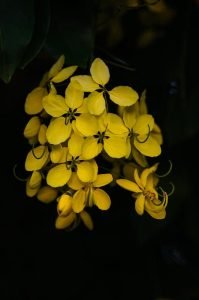
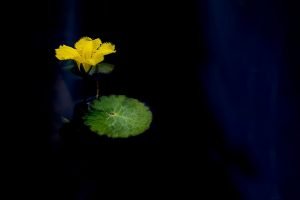
A yellow flower lived high on a tree; it sang and danced along with the wind. One day the yellow flower fell on a passerby who looked up at the tree, then down at the flower, smiled and left. The passerby loved its story.
Flowers are the best storytellers, just a glance and the job is done, allowing the story to unfold, to bloom within the seeker slowly.
A lotus once told me an epic and a night jasmine a love story and a marigold a fairy-tale saga.
Flowers are made of stories which the mind forgets but the heart remembers.
Georgina was walking towards her home, by the same old path. With grocery bags in both her hands she could not straighten her hat or pull her hair back. She blew her hair when it tickled her nose.
It was a hot summer day, everything around her glistened in heat. Then she heard something, she could feel a vibration and as she turned her head right, she saw a wave, higher than the surrounding trees and the sweet hillocks. Georgina, dumbstruck, could not move, she kept on gazing at the giant wave devouring the trees, the hillocks and rushing towards her. ‘This can’t be true’, exclaimed Georgina. The wave hit her.
She twisted and swirled, the grocery bags somehow managed the wet blow and so did her hat. Georgina could breathe; she was not hurt rather she could swim without any effort. She looked all around with bewilderment, a school of Goldband forage fish crossed her; each one greeted her with a quick ‘hello’. Beaming, Georgina nodded and said ‘hello’; she tried to wave, but she could not, because of the grocery bags in her hands.
Georgina swam happily and was joined by two dolphins. They whistled a tune and said something that Georgina did not understand. Both the dolphins then nudged her hands and made her let go off the grocery bags. She felt light as she saw the bags sinking and touching the ‘sea bed’. Joyfully then she danced along with the dolphins. She threw her hat away and opened her hair; she swam, she swayed, she stretched her arms and flew away.
Late in the day she reached home soaking wet; grocery bags in her hands made a puddle in the kitchen and her hat added a tiny stream to it. Aghast, her mother finally managed to say ‘where in the world have you been?’ Georgina looked at her mom and with a glint in her eyes, smile on her face she said ‘the ocean’.
The wind is blowing and the wind chime is playing a melodious tune. It is a calm hour of the day.
Dozens of clouds are drifting by leisurely. And that group of birds is sailing high, their songs are falling along with the sun rays, it is a tune unheard.
What charm is it that is capturing this scene? Ruby does not know, and, yet she allows herself to let it seep within.
Standing against the railing, staring at the sky, Ruby feels free and happy. Those thoughts cannot grip her any more, those worries slip down her gleaming face.
Ruby realises then that there is nothing wrong with Time, if it is fleeting, it is also filling every second with a pearl like moment.
“Breathe it”, she tells herself. When she does, she feels at home.
Waterfall like grand, fresh as a rainbow, her inner self whispers something. Ruby smiles, she does not know why. She looks at the kites, red kites against the blue sky, hopes, wishes, dreams they are, flying high.
Humming is good for the soul, Ruby tells herself as she hummed an incomplete tune.
Why incomplete? Who will complete it? “Ruby-Ruby”, someone calls out her name and completes the tune.
Jane in her simple jade dress stood out in that mahogany room. The splendour surrounding her could not match the spark in her eyes, knowing this the chandelier, humbled, dimmed its light.
Jane in her efforts to live freely always broke barriers and always lived freely. The shackles, when not shown any fear of, never dared to grab the fire named Jane Eyre.
She walked towards the window and half opened it; the gushing wind reminded her of a folk tale, of the times when a princess stared at the moon through a half open window, shared a secret and smiled. Jane Eyre could not help but smile then.
*
Title page of the first Jane Eyre edition. [Source – Wikimedia Commons]
Charlotte Bronte’s Jane Eyre is a marvellous, striking Victorian novel which was originally published under a pseudonym ‘Currer Bell’. Many female writers in that era opted for a pen name, occasionally for anonymity, but mostly for their work to get a wider audience (if it is accepted for publication at all).
*
We do not know who ‘Currer Bell’ might be, but his name will stand very high in literature.
The Weekly Chronicle
While all the reviewers praised the powerful story and imagination of the author, no one expected it to be a woman.
*
Charlotte Bronte, portrait by George Richmond. [Source – Wikimedia Commons]
One great merit of the work unquestionably is its originality. The author deserves no slight credit for the ingenuity and success with which fact and fiction, reality and romance, have been intermingled and made to serve conjointly in maintaining deep and unflagging interest.
Morning Advertiser
*
Have you lived the life of Jane Eyre? If not, then you must.
A voice narrates – “7th September 1980, a party from Calcutta, a film troupe is going to a village for shooting. The name of the village is Hatui. The name of the film is Aakaler Shandhane.”
The opening credits roll as we, along with the film troupe in cars, enter the village lane noticing the green fields, blue sky, rough road, dirt and poor villagers who are in full contrast to the vivacity of the song sung by the troupe. This is highlighted by the very first dialogue of the film by a character, a random villager standing on the roadside –
“The gentlemen are here for taking snaps of the famine… but the famine has enveloped us all.”
*
A story within a story, Aakaler Shandhane (1982), is a poignant portrayal of reality and our perception of it. The director (played by Dhritiman Chatterjee) knows and believes in his story, he is determined, his research is complete, he has photographs of the Bengal famine of 1943, of a mini famine in 1959, of 1971 – he says, “remember the Bangladesh war”; he thinks that is what one needs to make a film on Bengal famine.
But the director is absolutely ignorant about 1980, the present time, his time, and so when the Hatui village reveals the crippling similarities between the famine year and the present, the director feels at his wits’ end. He does then what is suggested to him – to leave and complete the film in a studio – for the ‘famine-stricken’ village could no longer entertain any of them.
*
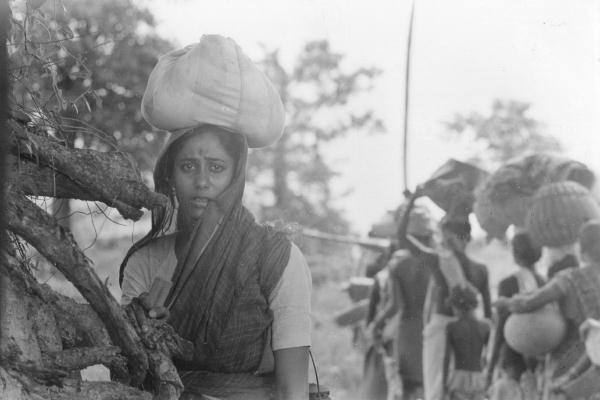
A still from the film; Smita Patil as a village woman. [Source – mrinalsen.org]
Smita Patil plays the role of a village woman, a wife married to a stubborn husband, who will die, but not bow down; this wife, for the sake of her little baby, accepts the famine, accepts exploitation, accepts filth and brings home a handful of rice and oil to prepare a meal in her dusty kitchen.
The husband goes mad with anger and picks up the little baby, ready to kill his own child for it unknowingly became the cause of bringing blasphemy to their household; Smita shouts and so does Durga. The director says “CUT”. Durga, a villager, standing in the crowd could not bear the pain, afraid for the child she shouted unaware of the camera and the art of acting. Every eye then stares at her, she hides her moist eyes and leaves.
*
Durga lives in the 80s, but finds a resemblance with Smita Patil’s character of the 40s – and why would not she, their lives resonate with gloom, caused by famine and its aftermath. Both are suffering, both have a child to feed, a husband to serve, a famine that torments and a society that reminds of it forever.
Quiet like a candle, Durga becomes a flambeau in the end; burning with rage she asks her incompetent husband what is wrong if the director offered her a role in the film, what is wrong if the role is of a prostitute. She tells him that when a lady, in those ugly famine days, can step out the confines of her house, why cannot she?
The old village schoolmaster asks the same question from all the respectable men of the village, reminding them about their ancestors who were as opportunistic as the film’s womanising contractor.
*
It becomes clear that the famine of 1943 was not just about starvation or five million deaths, it was also about what humans are and what humans can become in trying situations; and that hunger alone did not kill, corrupt minds and hollow traditions killed too… are still killing.
And the most affected were the poor, the weak… the females – they lost their children, their families, their lands and themselves. The director’s attempt to cast a villager for the role of a girl, who is forced to become a prostitute, creates chaos so profound that in no time the whole village starts detesting the entire troupe, no one comes to help, no fans, nothing. What else will a film dealing with the topic of famine bring, but cursed memories of the past? The villager who spoke the first dialogue of the film now comments –
“The gentlemen have created a famine after coming to make a film on famine.”
*
But what about the elite… they are now long extinct. The palace in which the film troupe settles is almost in ruins. There lives a couple – a lady and her bedridden husband – the relatives of the king. While the rest of the inhabitants have left the luxuries of this palace and shifted to the cities, the presence of this couple is also but a mere illusion of the past. When the bed-ridden husband dies, the lady aptly says that everything is over.
Twice there are talks about the photographs of the famine, on one occasion a game is played – one is to guess by looking at the pictures to which period it belongs. When Smita Patil shows a picture that is completely dark, a character says it is the photo of ‘load shedding… power crises’ and everyone laughs, then another gives it a poetic touch and calls it ‘darkness at noon’ and then finally Smita Patil gives it the title ‘past, present and future’; none of them thought that this darkness will eventually force them to abandon the film shoot and leave.
Into this darkness we see Durga fading away at the very end; the narrator tells us that her frail little child died after some time, her husband fled away and Durga was left all alone.
*
The story structure, which is subtly linear, seamlessly integrates the characters with the plot highlighting the contrast between the film troupe’s “idea of famine” and the actual impact of the many famines still reverberating in the village.
The First Plot Point and the Second Plot Point appear visually the same i.e. both are the scenes where the photographs of the famine are shown and talked about; the former is where the director, confident about his research, is showing his actors the photographs of 1943 famine and telling how while the World War II struck the rest of the world, in their land “people just starved and dropped dead”, in the latter scene, they play a guessing game – “to which famine does the photograph belong”. In both the scenes, the horridness of the famine photographs is seen in stark contrast to the amusement of the film troupe.
The story takes a turn, naturally so, after both these plot points, taking the troupe and the audience closer to the seriousness that the reality of famine holds. In the climax we see that the entire village opposes and loathes the film troupe, the main characters find themselves completely defeated, and neither the modern nor the rural people are able to do anything about the famine that stared at them.
The original brochure of the film. [Source – mrinalsen.org]
This masterpiece by Mirnal Sen won National Awards for Best Feature Film, Best Direction, Best Screenplay and Best Editing; it also won Silver Bear, Special Jury Award at 31st Berlin International Film Festival.
Aakaler Shandhane(In Search of Famine), searched for an answer, an answer that is still due.
The dark old lady walks like lightening devouring the night sky, she is swift, she is fast. Her dusty feet, darker than the broken black slippers, know exactly where it is to lead and where it is to stop. Draped in a saree lungi style, her slender figure boasts of agility and strength.
Amma, it is a cold tonight, and she covers her head, her ears with a towel. Does she look funny? Not at all, she looks as beautiful as that flower kept in that book. That flower, dark coloured, tells a story, pressed and noted neatly in that book, stored for a chance meeting.
Amma what time is it, nine thirty she says and at ten she has to go to a flat and clean the dishes, clear the kitchen counter, set the culinary world in order; often Amma plays music and her dear plates, cups and spoons dance on her tune. Amma beams then like she is beaming now – Amma’s toothless smile.
On her way back home, at night, embracing the darkness Amma moves briskly, but stops in front of a small house and asks Sunita bahin if she can get a water-can and take some fresh water; yes, at Amma’s place you won’t see a water-tap rather there are colourful canisters lined up – yellow, blue, faded red and dirty white.
Amma is stylish, her dark self knows what colours to wear – white and orange and green, mixture of all these and add some flowery designs, this completes her look. Do you also wear the colours of the road, the trees, the dark sky Amma? For you look as quiet and great as them.
And your eyes, that glance, killer! Amma your eyes are sharp, your eyes smile – your eyes are familiar with Time and that’s why you don’t mind, you don’t curse it, you don’t cherish it; you know how to live it. Whatever it may be, a raging tempest or a happy carnival or a visit to the temple, you get up the next day and leave for work on time.
I wonder if you have not spoken with everyone until now. Because you are alive, you know Time, you know the society, you know poverty and you smile with your eyes.
Amma cheers to your journey. The dark old lady waved a goodbye.
In that wonderful valley, some children are playing hide-and-seek. Their laughter, their complaints, their chit-chats echo. The Deodar trees and the wind, the birds and the flying-foxes give the background score. Joy is the dominant colour of this valley, even the passing clouds are pacing down to collect some.
Ah!
That is her memory, just a memory of the past days. The compact city life, the tick-tock march to the town centre, the race to the platform got sidelined somehow, and she took a memory, opened it up, read it happily.
She felt good, memories don’t truly fade. You can always read them. Always!
The wheel of Time moves ceasing for none, winning over oceans, mountains, the sky, the wind and the fire.
People crowd to clench forms and beliefs, together they build and destroy. They wait to gauge for more and what is better.
Look now, how they shine, bright like fireflies, honest to the core; look now, how they lure, how they trick the tricksters, how they slay a man’s soul.
Speak not, for they are at work, cross-legged monks, meditating on what is less; speak not, for you will fail to express how chaotic is the chaos.
Rising high is the music of unity and harmony; falling face down is the corrupt, fake cry of every rigid mind.
Knowing the beginning, waiting for the end, it walks, it lingers, we walk, and we linger.
Tala Pattachitra, Palm Leaf Painting – Odisha’s ancient art form. [Source – ethnicpaintings.com]
Second eye says that it is all absolute bliss.
There is no Space or Time and it binds none; the ultimate end and the ultimate start merges with the absolute existence.
Flowing in a silent music, dancing always, the ripple reaches the centre.
The Brahman breathes; formless, it is of the colour peace.
Lord Jagannath’s eyes are the universe we see and the universe we can’t see. The happy devotee who bows, who worships, who sings, who gazes gets mesmerized by one of the universes, and by Lord Jagannath’s smile.
Our million eyes find a million revelations in Lord Jagannath’s eyes.
*
Lord Jagannath, Lord of the Universe. [Source – harekrsna.de]
I am joy running free/
freely flying, fluttering, soaring in a valley/
Of joy am running free.
Greetings!
A storyteller, following the ancient tradition of cave chroniclers, standing in vrikshasana (the tree pose) on a hill top (it is sunny, but windy), breathing in and out stories (relishing it all, but at times overwhelmed), declares animatedly that she will continue to – tell stories, share rare story gems, and connect with the pacy universe while also keeping the website ad-free.
Big thanks to my readers. Stay tuned!
Also, a humble request to the new subscribers to check the spam folder after subscribing. Silly (but necessary) confirmation emails often land there instead of the bright inboxes. Merci!
Ya-hoy!
Chiming Stories (formerly Home Chimes)
P.S – Supporting a storyteller is good for the world’s health (and undoubtedly, for the storyteller’s health as well). Shower some love by sharing, commenting and subscribing to the Weekly Newsletter.
Gabbeh, the 1996 film, is a simple tale of a gipsy girl, her clan and the way their life goes on. Unfolding beautifully just like an artist painting a canvas, Gabbeh quietly touches the grand questions.
Ranked as one of the greatest British films of all time, The Lavender Hill Mob confides in the audience, letting them see, feel, laugh and think without tickling persuasively with a joke here and a punch-line there.
Godard… Breathless and Alive
A Tribute to Jean-Luc Godard, the Film Philologist who Reinvented Cinema.
Yes fly! For walking on the second track is dull and usual, but dreaming high, high, high requires tools. Tools like the right pair of shoes, a chirpy, gritty soul that eats butter-jam dreams, a soul that drinks milky-milky creams.
Silver cascade shimmering the night sky, music to the waves and surreal beauty to the eyes, the Moon loves the art of discipline.
It may be difficult to believe for the Moon’s splendour defies time, it stupefies the clock, it follows the path of a dreamer, but how could this be possible if the Moon knew not discipline?
In this moment, I am a little bit of this and a little bit of that, I am complete and incomplete, I am pleased and uncertain, I wish for nothing and I know I have to wait.
Because the distance covered reminds me of the hurdles I have crossed and the ones I could not, it reminds me of a throbbing past and a dreamy future and it reminds me of how much time is left.
Meredith and the Green Lake
Illimitable Splendour
A joy so complete without any rise or fall, so free without any time corners, so real without true being false, false being true.