Relationship with the world grows like grass and creepers; growing in every direction like the grass, growing criss-cross network like the creepers. The very many we don’t know, the very few we do, together shape our lives.
Meeting not the grass patch across the road, I stay happy/unhappy with my rocks, my stones, my pals, my weeds.
And in a shrinking world – our one big grass field, our one small landmass in the world of oceans upon oceans – the seasons may change, but the weather remains the same, it is the weather to form relationships, this weather is here to stay.
Hatred and discomfort in a relationship doesn’t require much effort, it easily springs to life, nurturing illusions in separation, measuring neatly, dividing by all, leaving the remains in decimals.
Compassion, love in a relationship is all that there is to it.
Then doing a chore becomes something more, like wild grass covering and fostering the soil exuberantly, turning into meadows, savannas, prairies, pastures, it grows, not knowing the difference it grows.
Moon loves the grass and listening to George Ezra. [Source – Pixabay]
*
The weather remains the same, it is the weather to form relationships, this weather is here to stay, that is why probably the weather forecast says, ‘Listen to George Ezra’.
His songs are about forming relationships – with friends, family, the beloved, the city, the village, Tiger Lily, the oldies goldies, heaven, hell, middle earth, nature, you and me and them all.
In baritone voice, his songs narrate a story of relations without conclusions so that you can freely listen and freely walk on the grass field.
His songs share secret messages that you get before you know you did.
Without an end, like a creeper stretching its hand, meeting a tree or a forest floor, the song meets you, takes you along.
Ezra’s songs speak not about ‘eventually’, for there is no ‘eventually’, but only the now, the present, this instant, not what is fleeting, nothing is, for you’re fleeting along.
Hold on, hold on dear world for we are moving together, divided we fall, we have fallen, fallen on the green grass that if we see, observe, will share a thing or two about relations.
This weather forecast won’t fail you, rather it’ll nudge you lovingly to make do, see through and say Take Two today.
Twisted, quirky and stubborn relationships, at times, may overpower, confuse, ridicule you, don’t give up then, but take this antidote; first get drenched in rain and thunder, be with the darkness inside, then simply ‘blame it on me’, only to switch to a soothing greenery, back to nature for a while.
*
Why Day – Did You Hear The Rain?
*
Eh Day – Blame it on me
*
Any Day – Barcelona
Weather forecast ‘ifs’ –
*
If you want a clear sky and the day to be bright and sunny or if it is too hot and you want a happy tiny cloud to follow you for shade then listen to George Ezra’s Morning Song.
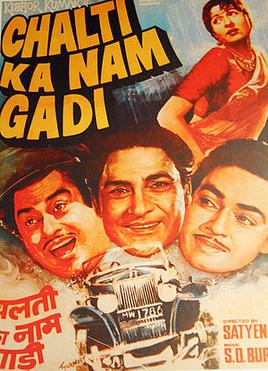
The theatre is jam-packed and noisy; as the lights go off, everyone becomes quiet. The film starts and the opening credits roll – in black & white animation we are introduced to the star cast, Ashok Kumar, Madhubala, Anoop Kumar and a yodelling-dancing Kishore Kumar – with a melodious announcement to get ready for a laughing riot titled Chalti Ka Naam Gaadi.
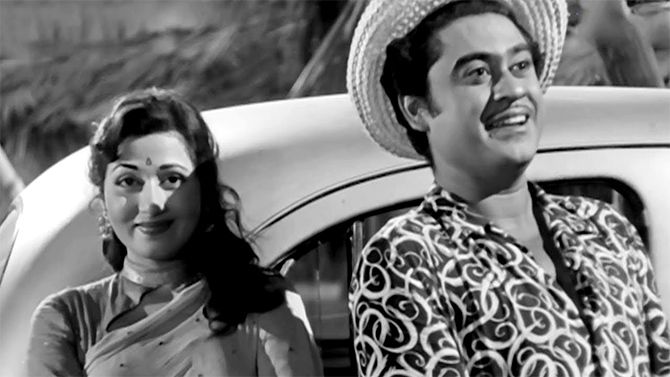
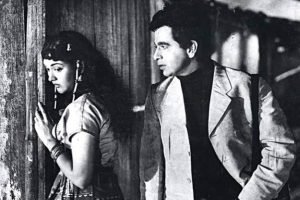
Madhubala and Kishore Kumar in Chalti Ka Naam Gaadi (Source – parrikar.org)
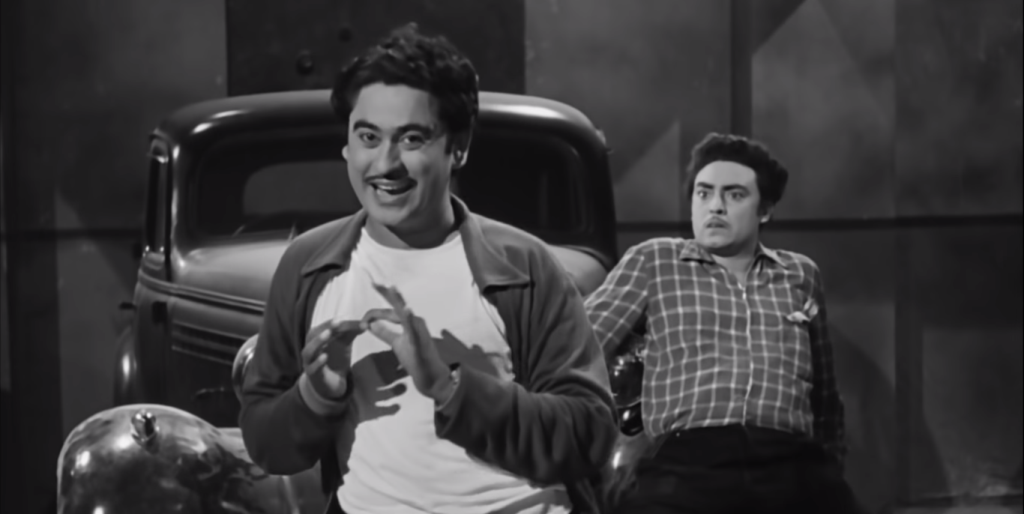
The Ganguly Brothers (Source – ShimlaTimes)
Laughing and falling in love. (Source – mubi.com)
(Source – kafaltree.com)
(Source – kafaltree.com)
(Source – kafaltree.com)
(Source – kafaltree.com)
(Source – Wikipedia)
One of the biggest hits of 1958, Chalti Ka Naam Gaadi, directed by Satyen Bose, is a classic comedy film which though is 173 minutes long and is more than 60 years old, is still a treat to watch. The appearance of the Ganguly Brothers together for the first time, the unforgettable music composed by S.D Burman and soulful, breezy lyrics by Majrooh Sultanpuri, all combined, led to its massive success.
While no writing credits, apart from dialogues (by Ramesh Pant and Gobind Moonis), are given in the film, it has a well-structured, strong screenplay. The plot twists and character quirks both intermingle harmoniously to create comedy.
Writing a Comedy
A genre of fiction writing, comedy intends to amuse the audience; the Ancient Greeks defined it as a narrative involving an odd character caught in a challenging situation that inadvertently after making a fool of himself triumphs in the end. With changing times, and different types of mediums, comedy writing has also evolved; slapstick, parody, spoof, satire, irony, sarcasm, farce and dark comedy, these different sub-categories all approach comedy distinctively.
For a comedy story, you would need a solid comic premise, complex, but relatable characters, a risky situation in which the protagonist is caught, a touch of drama, plenty of puns and enough space for character development. Comedies aim not only to amuse and entertain but also to subtly mock the stereotypical stagnant beliefs in the society.
Chalti Ka Naam Gaadi has these elements all in place. Three brothers, all afraid of even looking at women, as if predestined, meet up three lovely ladies who take the lead to bring their story to a happy ending.
Characters
Brijmohan, Jagmohan, Manmohan – The three brothers together run a garage; the two younger ones follow elder brother, Brijmohan’s dictum of not interacting with any woman at any cost (apart from when there is an emergency). They even have a mantra that they chant to shoo ladies away; in the very first scene when their car breaks down and they are unable to find any fault in the engine, they blame it on a beautiful young lady looking at them from a distance. Seeing three men chanting the mantra, finding them weird, the lady leaves; the car starts working then and this reconfirms their theory about women.
They are not anti-women, nor are they disrespectful towards them. For the younger brothers, it is all about following Brijmohan’s rules and for him it is a way to protect his brothers from emotional traumas, something that he had undergone when his lady love left him for a rich man.
Jagmohan aka Jaggu is a fickle-minded, often cunning, but timid guy; obedient and docile in front of Brijmohan, he becomes inquisitive and laid-back when given the charge of the garage and easily passes his chores to his younger brother.
Manmohan aka Mannu is the main lead; he is sincere, dexterous and funny by nature. One rainy night, when he is all alone in the garage, he is forced to repair the broken car of a young lady, Renu, who in a hurry forgets to pay him his due. Next morning he explains to his brothers that he had to entertain that lady as it was an emergency case. Brijmohan highlights it to them that she is a clever person as she intentionally did not pay him anything.
Thus, the story takes a turn as Mannu, in a quest to get his due (5 rupees and 12 annas) follows Renu everywhere, he even reaches her home late at night and when the watchman suspects him to be a thief, Renu helps him to run away, once again without the due amount; such incidents result into the inevitable conclusion, Mannu and Renu fall for each other.
Mannu hides his feelings from Renu as he battles with the unacceptable idea of falling for a woman. He can never disobey Brijmohan, but he cannot forget Renu as well.
Comedy elements never leave the screen space even while dealing with such dramatic dilemmas. Jaggu and Mannu love Brijmohan, they look upon him as a father figure and as their hero. In one scene, Brijmohan, a boxing champion, beats up a giant who was refusing to pay the servicing charges and Jaggu and Mannu both had unsuccessfully tried to tackle him.
Their scenes together are hilarious; whenever Renu calls at the garage, both Jaggu and Mannu start fumbling, telling Brijmohan that they don’t know who she is, when Renu tells Brijmohan to send someone to repair her car, both Jaggu and Mannu refuse to go, though wishing to leave immediately.
Renu – The absolutely stunning leading lady of the film is a modern woman in the truest sense – she is bold, independent, zealous, a bit strong-headed, but sensible enough to differentiate between a fake and an honest person. She likes to drive her car, no matter even if it is late in the night – a big deal in 1950s India. When running late to reach home after giving her dance performance at the theatre, Renu is worried not that her father will scold her for being late, but about the car breaking down in the middle of the road yet again.
There is no question about parity in the film, as the women are given equal screen space and story material; in fact, the women are responsible for taking the story forward. Renu is the one who openly expresses her interest in Mannu, visiting his garage and taking him along for outings. Brijmohan too is unable to refuse as Renu had found a lady’s photo in Brijmohan’s room, purposely she enquires about it in front of his two brothers; a dumbfounded Brijmohan avoids the scene by allowing Mannu to accompany Renu.
Later, when Brijmohan tells Renu upfront that she should stop meeting Mannu, she does not falter and expresses that she is serious about Mannu; impressed by her honest approach, he then approves of her.
Renu’s actions, along with Mannu, become the driving force in the film; through her straightforward, brazen and naïve behaviour, she also adds to the humour.
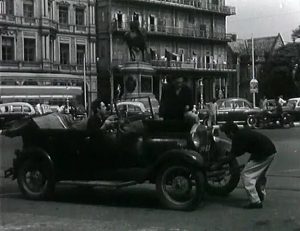
“Pom-pom-pom!” Driving the Champion on the streets of Bombay. (Source – bollyviewer)
‘Champion’ car, Model 1928 – This debuting car is more like a sidekick, an accomplice and a recurring motif in the film that talks about the ‘moving forward’ mantra, connects the plot points and even sponsors the happy ending scene. Apart from being the reason that steers Renu’s entry into Mannu’s life, it is given a special Chaplinesque sequence to enrich this comedy.
Mannu and the Champion car participate in a race, competing against many including the villain’s pawn; the start is a bit rocky, but they are determined to win, exchanging an opponent’s hat with a cockerel, throwing bananas at another and spraying water at the pawn, Mannu and the Champion car beat the others with great aplomb.
The car here is a metaphor for life; if the car is running and if you are able to fix it when it breaks down, you are all set, that is all you need to do.
Listen to the uplifting title track of Chalti Ka Naam Gaadi now.
Raja Hardayal Singh, the Antagonist – In his first scene, it is evident that his kindness, his beguiling demeanour and his aristocratic attitude is all too good to be true. A fraudster, who had long back managed to rob a rich businessman after marrying his only daughter (i.e. Brijmohan’s lady love, Kamini), Raja Hardayal Singh now has plans to make his pawn marry Renu so as to get all her property.
While his bass, confident and assured tone makes him a dangerous villain, his foolish men and their shortcomings make him appear as a goof. Then again when it is revealed that he keeps his so-called mad wife, Kamini, captive in an old bungalow, he takes his position back to being a ruthless man. But unlike in a novel when such a secret is revealed, the effect stays and changes the mood of the story, here the opposite happens. As it is a comedy, Kamini’s distress does not stay for long rather it triggers the climax and ensures her freedom.
Supporting Characters
These supporting characters, some half and some nicely baked, are a good study of how in a well-written comedy everything contributes to keeping the humour alive without it being overblown.
Maujiya – A junior mechanic cum helper, Maujiya is a happy-go-lucky kid who has very few scenes in the film, but whenever present he doubles the dose of comedy. He is an on-screen audience member who observes the three brothers, their eccentricities, always amused, but also alert of being caught.
Sheela – Renu’s best friend, smart and funny, Sheela is another bold beauty in the film. She falls for Jaggu and finds his buffoonery amusing. While chit-chatting once she happily tells Renu that she would choose a simpleton over a wise guy as she wants her husband to always listen to her; finding these qualities in Jaggu, she makes sure they become friends. Her frankness and wit mark her presence strongly in the film.
Renu’s Father – Like a puppet this character is placed to add humour in a scene or to bridge one twist with the other. A jovial, simple and sweet old man, Renu’s father takes everyone’s words at face value and thus, is shocked to know Raja Hardayal Singh’s reality. He trusts Renu and gives her freedom to choose her life partner.
Kamini – Though she appears later in the second half, she plays a distinct role in shaping the story from the beginning; Brijmohan thinks she betrayed him, but she and her rich father were fooled by Raja Hardayal Singh. Not afraid of anything, she decides to save Renu and Mannu’s life and becomes a catalyst for the climax.
Climax– Renu and Mannu are trapped, Raja Hardayal Singh is ready to marry Renu with his pawn; after a hurried reunion between Brijmohan and Kamini and a comic mime-style scene between Jaggu and Sheela, everyone reaches the same bungalow and a farcical fight sequence begins. Mannu, Renu, Jaggu, Maujiya, Renu’s Father and the half-witted goons create a mockery of a climactic sequence. It is only Brijmohan and Raja Hardayal Singh who behave seriously, fighting to end it for good and all. Sheela who was following Jaggu’s car, contacts police and arrives at the end to conclude the drama.
While in many black and white Hindi films of this era, the ending is usually badly shot as if the villain is in a rush to be jailed, but here the pace is much better. The police capture Raja Hardayal Singh and his team, and the three couples unite; sitting in the Champion car, Brijmohan, Jaggu and Mannu sing the title track of the film, while the three ladies in the front, Renu at the wheel, enjoy and laugh.
Songs – What added to the popularity of this film is its melodious, peppy soundtrack and catchy, honest lyrics. Iconic numbers like the title track “Babu Samjho Ishaare”, “Ek Ladki Bheegi Bhaagi Si”, “Hum The, Woh Thi Aur Sama Rangeen”, “Main Sitaron Ka Taraana”, “Haal Kaisa Hai Janaab Ka” are all timeless. Songs in Hindi films act as a medium of storytelling, usually sealing the romantic journey of the hero and the heroine, always lyrically taking the story ahead. Here a song, “Hum Tumhare Hain”, picturised on Helen and Minhaj Ansari, though not truly necessary for the plot of the film, is nevertheless a beautiful song. Great singers like Asha Bhosle, Manna Dey and Kishore Kumar create magic through their voices.
A melodious meet cute!
5 rupees and 12 annas, the amount that Mannu never got.
Conclusion
With a few flaws and goof-ups, this film is a pure comedy classic, and in fact, the flaws humorously add to its nature. The characters are crafted nicely and each complement’s the other; if the film is a musical instrument, then all the strings are perfectly tuned to produce a hilarious track. Characters perform comedy in pairs and that too, effortlessly; Renu and Mannu’s romantic track is sweet and entertaining, especially their short stint as detectives; Jaggu and Sheela are loudly funny, but not in a bad way; and the three brothers are like three jokers in a comical act. Also, whenever and whoever is paired with the Champion car, we are bound to get our laughter dose out of that scene.
Thus, with a strong and humorous story, quirky characters and crisp pace, this film continues to be a hit.
I am joy running free/
freely flying, fluttering, soaring in a valley/
Of joy am running free.
Greetings!
A storyteller, following the ancient tradition of cave chroniclers, standing in vrikshasana (the tree pose) on a hill top (it is sunny, but windy), breathing in and out stories (relishing it all, but at times overwhelmed), declares animatedly that she will continue to – tell stories, share rare story gems, and connect with the pacy universe while also keeping the website ad-free.
Big thanks to my readers. Stay tuned!
Also, a humble request to the new subscribers to check the spam folder after subscribing. Silly (but necessary) confirmation emails often land there instead of the bright inboxes. Merci!
Ya-hoy!
Chiming Stories (formerly Home Chimes)
P.S – Supporting a storyteller is good for the world’s health (and undoubtedly, for the storyteller’s health as well). Shower some love by sharing, commenting and subscribing to the Weekly Newsletter.
Gabbeh, the 1996 film, is a simple tale of a gipsy girl, her clan and the way their life goes on. Unfolding beautifully just like an artist painting a canvas, Gabbeh quietly touches the grand questions.
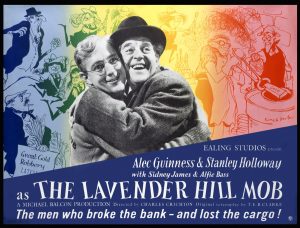
Ranked as one of the greatest British films of all time, The Lavender Hill Mob confides in the audience, letting them see, feel, laugh and think without tickling persuasively with a joke here and a punch-line there.
Godard… Breathless and Alive
A Tribute to Jean-Luc Godard, the Film Philologist who Reinvented Cinema.
Yes fly! For walking on the second track is dull and usual, but dreaming high, high, high requires tools. Tools like the right pair of shoes, a chirpy, gritty soul that eats butter-jam dreams, a soul that drinks milky-milky creams.
Silver cascade shimmering the night sky, music to the waves and surreal beauty to the eyes, the Moon loves the art of discipline.
It may be difficult to believe for the Moon’s splendour defies time, it stupefies the clock, it follows the path of a dreamer, but how could this be possible if the Moon knew not discipline?
In this moment, I am a little bit of this and a little bit of that, I am complete and incomplete, I am pleased and uncertain, I wish for nothing and I know I have to wait.
Because the distance covered reminds me of the hurdles I have crossed and the ones I could not, it reminds me of a throbbing past and a dreamy future and it reminds me of how much time is left.
Meredith and the Green Lake
Illimitable Splendour
A joy so complete without any rise or fall, so free without any time corners, so real without true being false, false being true.