Film Analysis
[Source – denofgeek.com]
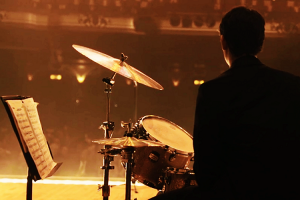
Drums can be heard in a long corridor, with several doors on both sides, that runs till the very end and opens into the last room where the drummer is playing… no, say practising, practising like Buddy Rich, practising until corrected, practising until mastered… this incredibly clever tune, ‘Whiplash’.
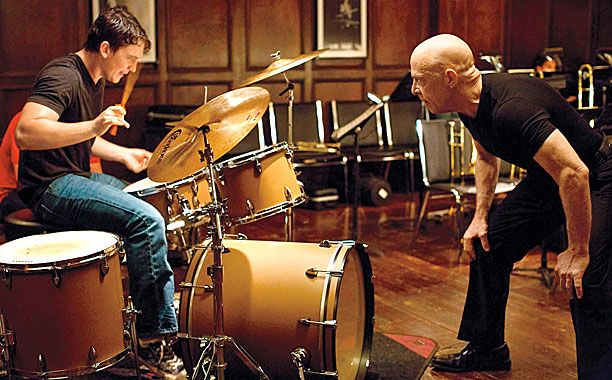
Damien Chazelle’s 2014 drama film Whiplash revolves around a passionate jazz drummer Andrew Neiman (played by Miles Teller) and his perfectionist jazz instructor (played by J. K Simmons); one dreams of becoming great, the other demands greatness; one is hopeful, the other is ruthless; when out-of-tune, they clash, when in sync, they dance.
At the still point of the turning world. Neither flesh nor fleshless;
Neither from nor towards; at the still point, there the dance is,
But neither arrest nor movement.
T.S Eliot (Four Quartets: Burnt Norton)
Here, T.S Eliot is talking about that state of mind where not so overwhelmed by it, we make peace with it; Whiplash the film is also about Andrew Neiman’s state of mind which when at peace, allows him to create magic, to dance, to play harmoniously perfect.
Whiplash highlights the protagonist’s internal journey beautifully, in fact, that is all we see – Andrew’s internal dilemmas, struggles, failures and the shining sudden victory. The writer-director very carefully places us within Andrew’s mind.
In the opening scene of the film, Andrew is playing the drums alone in a classroom when he notices that the best teacher in the music school – Terrance Fletcher – is watching him.
*
Andrew – (stops playing) I’m sorry…
Fletcher – No, stay…What’s your name?
Andrew – Andrew Neiman sir.
Fletcher – What year are you?
Andrew – I’m a… first year.
Fletcher – You know who I am.
Andrew – Yes sir.
Fletcher – So you know I’m looking for players.
Andrew – Yes sir.
Fletcher – Then why did you stop playing?
Andrew Neiman starts playing… then stops.
Fletcher – Did I ask you to start playing again?
Andrew – I am sorry…
Fletcher – I asked you why you stopped playing and your version of an answer was to turn into a wind-up monkey…
Andrew – Sir I thought…
Fletcher – Show me your rudiments.
Andrew – Yes, sir… (Starts playing… stops.)
Fletcher – Double-time swing… (Andrew starts playing) no, double-time… double it… faster… faster…
Andrew Neiman plays… in a few seconds he hears the door shut loudly. Andrew is disappointed… Right then Fletcher comes back inside.
Fletcher – Oopsy Daisy! I forgot my jacket. (Takes his jacket and leaves.)
*
Watch the opening scene here –
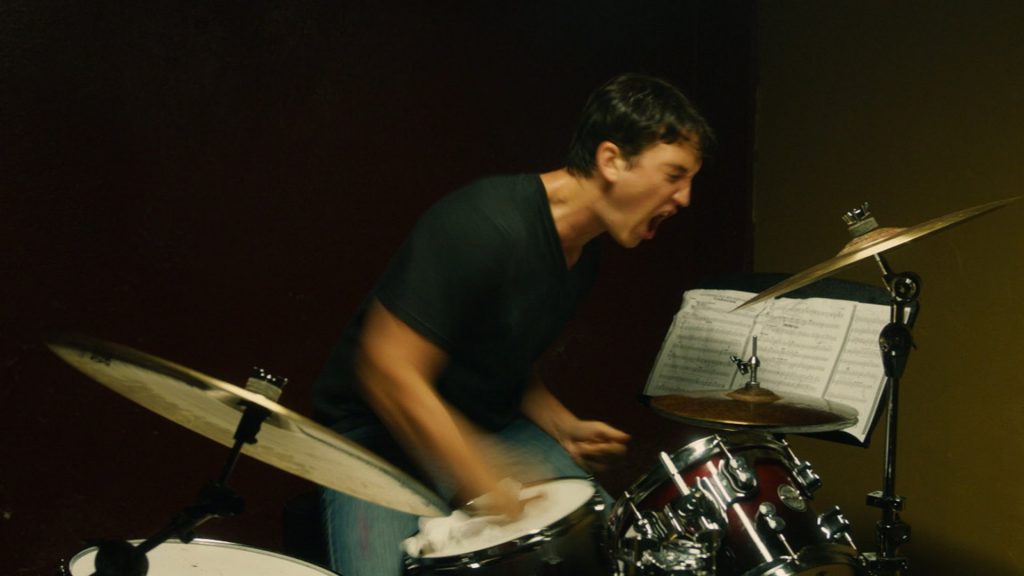
While the Andrew VS Fletcher drama unveils, Fletcher the perfectionist starts to appear more like Andrew’s inner critic especially in those scenes where he is practising; the setting, the lighting, the mood and the music makes it look like a void where either jazz or Fletcher’s authoritative voice plays dominantly.
“Don’t be harsh on yourself”, we often tell this to ourselves as sometimes our inner critic can harm us more than an outsider. The antagonist, Fletcher, is equally harsh and critical; a student when talking about Fletcher’s reputation mentions how he is known for making or ending one’ career.
So who wins here, Fletcher the antagonist or Fletcher, Andrew’s inner critic? The answer is both.
Like a pompous self that often praises itself, there are scenes when Fletcher praises Andrew; initially friendly, Fletcher encourages him to play well and tells him how Jo Jones threw a cymbal at Charlie Parker’s head, and how that incident made Parker work insanely hard; later on, like a strict-discipline-loving-freak-self, Fletcher, during a practice session, throws a chair at Andrew, warning him not to dare spoil his bands’ image.
*
[Source – highonfilms.com]
Fletcher personifies Andrew’s obsession to be a great drummer – he works hard, accepts Fletcher’s treatment even when he starts to resent him.
The internal journey of the protagonist overpowers the antagonist, but not in a negative way; it only boosts the antagonist’s authority over the protagonist; it feels like another side of Andrew is working hand in gloves with Fletcher.
The secondary characters too reflect the protagonist’s internal journey.
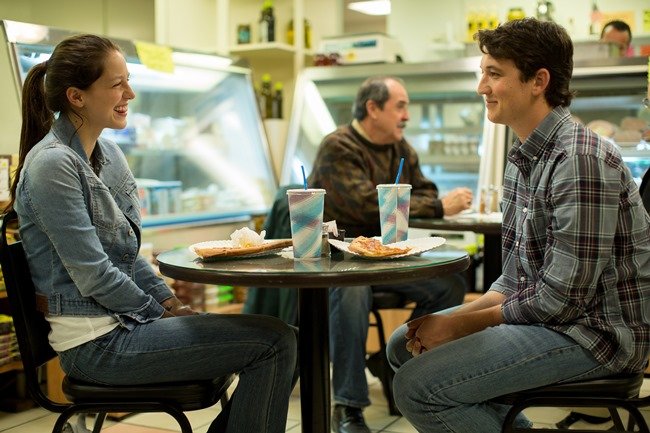
Andrew does not like his father’s mediocre mentality (Fletcher is the one to fan the flames by mentioning it repeatedly that his father is not a true “writer” and that is probably why Andrew’s mom left him), nor does he understands his girlfriend Nicole’s attitude towards life – how is it that she does not know what she wants in life – he loathes mediocrity and it is evident from his behaviour.
*
[Source – moviemaker.com]
In a scene where Andrew, his dad and some guests are having dinner, an argument breaks out where his father, talking about the musician Charlie Parker says –
“Andrew’s Father (Jim) – Dying broke and drunk and full of heroin at the age of 34 is not exactly my idea of success.
Andrew Neiman – I’d rather die drunk, broke at 34 and have people at a dinner table talk about me than live to be rich and sober at 90 and nobody remember who I was.”
*
Watch the dinner scene here –
Even though the secondary characters’ role is nominal, yet this does not weaken the story.
They do have a voice of their own though we do not hear it clearly and that is because the protagonist is not ready to accept their version of the life. Andrew’s obsession does not leave any choice for them but to only listen to him as the core of the film is about this very obsession; the subdued self of these secondary characters, thus, appears to be their actual state.
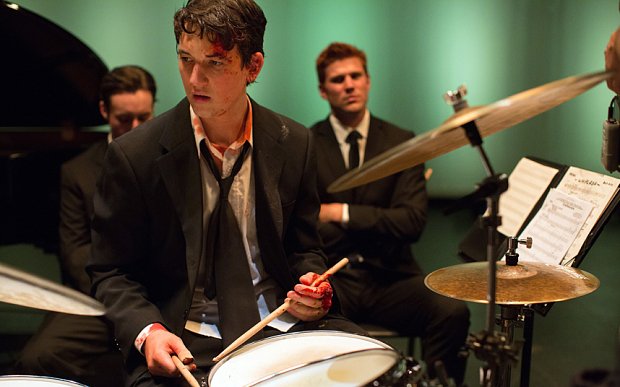
Andrew is obsessed with the thought of becoming the next great drummer so much so that he refuses to value the external life which consequently starts to fall apart – he has arguments with his father, he also breaks up with Nicole – and this then affects his internal life; he practices day in and out, but one single mistake and Fletcher replaces him with another drummer.
*
[Source – thetake.com]
Unable to thread the needle, Andrew first gets irritated with himself for not working hard enough and later on with Fletcher whom he literally attacks.
The result is that he is dismissed from the music school (the best in the country); devastated, he agrees with his dad and secretly files a complaint against Fletcher.
When awakened in the external world, Andrew internally goes into a hiatus. The setting shifts from the dark rooms to brighter ones and to open places.
The story approaches the climax and the internal journey, after the short hiatus, takes over once again. Climax scenes are about Andrew meeting Fletcher, who has been expelled from the music school and is now forming a freelance jazz band; he offers Andrew a position.
*
[Source – basementrejects.com]
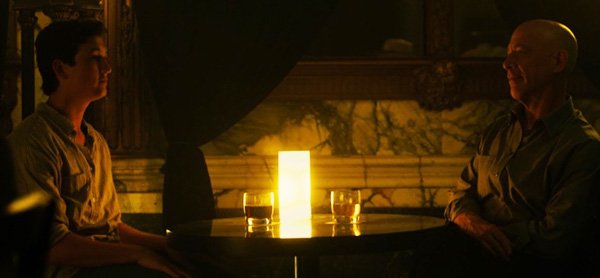
Now the internal journey resumes from the same point of tension where Andrew had left it – Fletcher hates Andrew and tells him that he knows it was he who framed him, but reveals it on the stage, just a few seconds before the performance, leaving Andrew utterly shocked.
Andrew is defeated by the antagonist, he plays the drums foolishly and finally gets up and goes backstage where his dad waits for him feeling sorry; but because Fletcher is not just an antagonist but also Andrew’s inner self, his obsession – it pulls Andrew back on the stage. He starts playing the drums not worrying about Fletcher’s threats.
*
Final performance part 1 and 2, watch here –
*
This transformation in Andrew may appear to be sudden but is not so; this is an internal transformation that forges gradually.
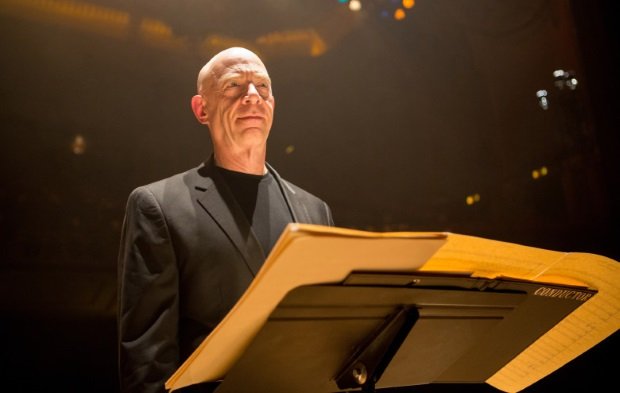
Andrew transforms in this last scene – he overpowers his fears – he plays flawlessly – so much so that Fletcher recognises his genius at this moment and joins him and together they play a fantastic jazz number (Caravan). As Fletcher reflects Andrew’s inner self, he does not object to this transformation in him and accepts Andrew’s victory quite happily.
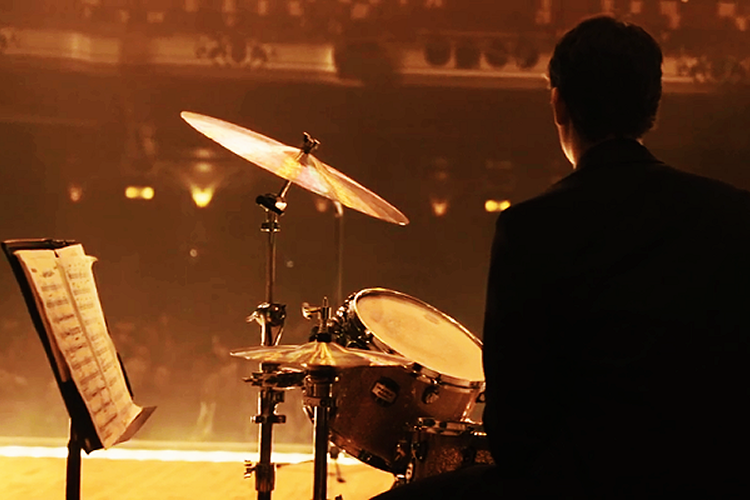
Drumming passionately, just like he did in the first scene of the film, Andrew’s story comes to a close; this time he just doesn’t play the tune, he lives it.
*
[Source – denofgeek.com]
*
Weekly Newsletter
Recent Posts