Short Film Analysis
*
*
The cinema’s characteristic forte is its ability to capture and communicate the intimacies of the human mind… The cinema is superbly equipped to trace the growth of a person or a situation.
Satyajit Ray
A child’s mind – impressionable, unbiased, bold, colourful and spirited – picks up the colours of this patterned and cemented world, crossing the maze, chasing dreams, breaking away, yet gradually getting engulfed by it wholly. How come? And Why?
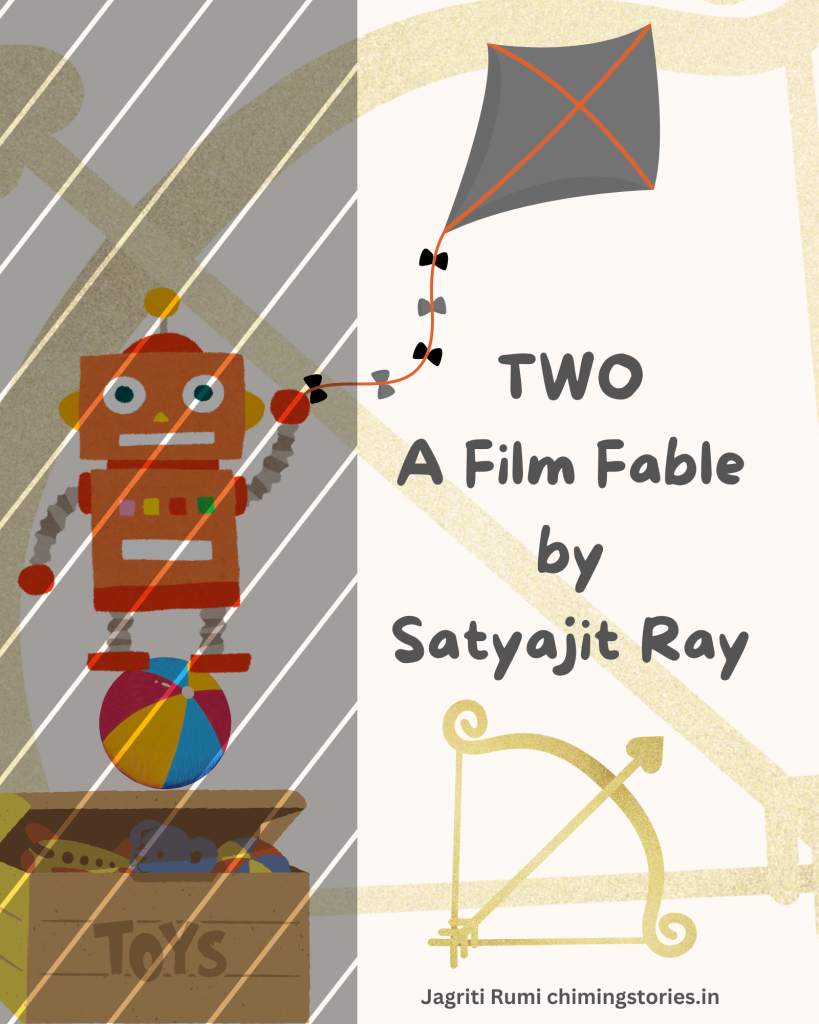
Ray’s short film – Two: A Film Fable (1964), twelve minutes long, black and white, without any dialogues – shows ‘how’, leaving the ‘why’ for the viewer to find out.
For a better understanding, watch the film before reading further –
Story
Fable, a short story that tells a moral truth, often using animals as characters, is given a twist by Satyajit Ray for here we aren’t told anything, just shown and we don’t see animals but toys that are class-conscious.
With two little kids as the protagonists and only people in the film, it makes a striking portrayal of the class difference in our societies that nurtures and feeds, without fail, every individual, even a child, with a prejudiced ideology.
The little kids in the film, one up in a mansion and the other outside his thatched hut, start a competition of showing off their toys to each other. Soon the privileged kid starts to overpower the poor kid by showing his latest toys one after the other; he proudly and pompously uses his air gun to shoot down the poor kid’s kite, defeating him in this invisible war-like game.
The rich kid turns to wonder what he should do next – his luxurious life acts heavily on him as he is hardly interested in playing anything, getting distracted every time to hop on the other toy train.
Though the rich kid thought he had won the game, he notices how the poor kid has gone back to his first toy – the bamboo flute. The rich kid in his big mansion with barred windows, ample toys and other luxuries feels confused in the end.
Analysis
A chance encounter between a rich and poor child that quickly moves from a childish display of their toys to a game of power politics, Ray’s fable presents a strong image of a divided and degraded society.
The film shows the truth of inequality – nurtured by greed, leading to decadence – revealing how the class that suffers the most is the one which invariably suffers to simply survive.
India in the 60s, apart from facing many internal problems, also fought wars with China (in 1962) and Pakistan (in 1965), thus, impacting the overall growth of the new nation. Two: A Film Fable highlights this stunted growth by showing the disparity between the two kids, reminding people about their responsibilities as a free citizen of a free nation.
The rich kid is not just rich, he is self-indulgent and hedonistic; home alone after attending his birthday party, he saunters around in the big empty home, drinking Coca-Cola, chewing bubble-gum, not sure which toy, out of the lot, he should play with. Meanwhile, the poor kid is playing his bamboo flute, walking round and round outside his hut, not minding the glaring sun.
Bamboo flute vs. toy trumpet, small drum vs. battery-powered monkey drummer toy, a mask, bow and arrow vs. couple of fancy masks, swords, spears and guns – both the kids don’t realise participating in power politics as they don’t understand it, but because they belong to such different classes, separated by a giant gap, their casual showing-off game inadvertently turns into power politics.
When the poor child comes back and quietly starts to fly a kite, the rich kid – who was till now looking down at the poor kid from his first-floor window – looks up at the sky, surprised to see the poor kid’s kite soaring high. Wondering, he gets his toy rifle and shoots down the kite. The rich kid is unabashedly happy about his actions here.
Satisfied now, the rich kid goes back to playing with his toys, switching every automatic toy on simultaneously, making a lot of noise, over which he soon hears the poor kid’s flute once again. While the poor kid calmly plays the flute, the rich kid stands still looking nonplussed.
In a very subtle manner Ray’s film criticises the class politics, the capitalist outlook and booming culture of consumerism by portraying how these ideologies sink in the society affecting one and all and especially instilling flawed values in the children.
*

[Source – Pixabay]
*
Today these two kids – who are still very much present as the disparity has only intensified – will not have such an encounter through the window anymore, thanks to the mobile phones and social media age.
The adults have joined too for they started the big game, everyone’s playing it, my toys vs your toys. And whosoever wins, not knowing what else to do, restarts the game.
And the fable continues…
*
Weekly Newsletter
Recent Posts