Today is boring, today is dull. How can I float up high without looking at the sky? Keener eyes not grounded, but in the middle of this and that, hers and mine, cries and sighs, laughs and jitters, cuckoo and balderdash, all this and a pinch more with a tinge of lustrous gold, confronts me every lethargic moment asking me to be agile and give an answer not a reply, one that is worthwhile.
Sham, it is a sham, I shout. The next moment I am out in the middle of that riddle, attacked badly by the crowd. Glares wicked or kind, I tell you are invincible.
Hush! Hush! Staying quiet is the key.
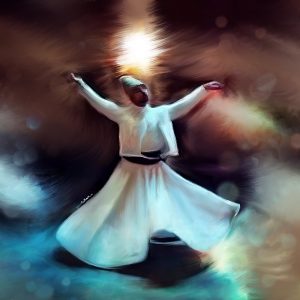
A fresh beginning, in between, for me as I get up to admire the quagmire that glows and shows me nothing. And what do I do? I hum a rhythm, I jig a little. Smoothly I begin dancing, hand movements and the twist and then the circle. Round and round and round.
I see an image in and around me crystallising, a translucent image, spreading like a wave, filling the ceiling, passing through the windows, leaving behind glorious dirt particles and a thin film of light.
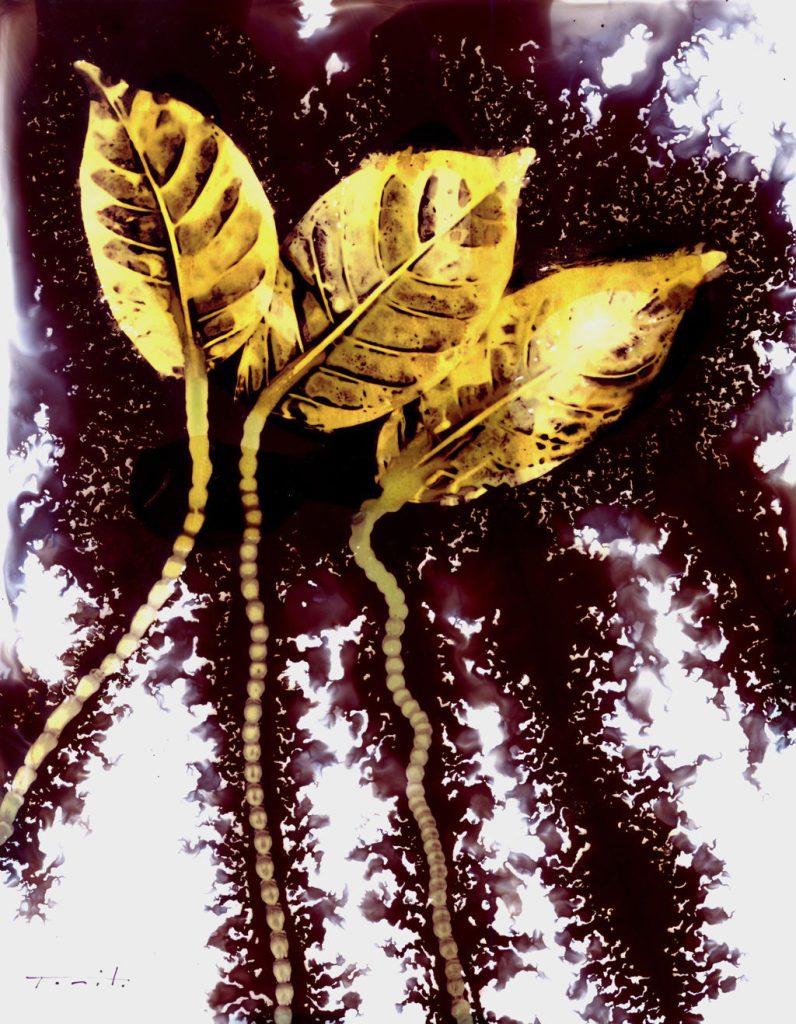
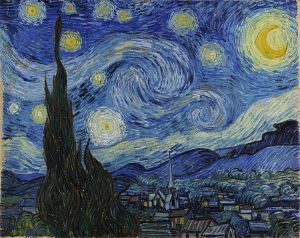
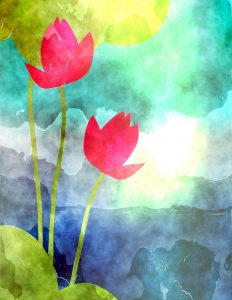
Golden Leaves Art. A painting by Jose Tonito. [Source – Deviantart]
*
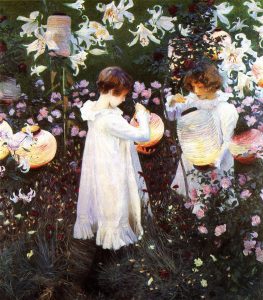
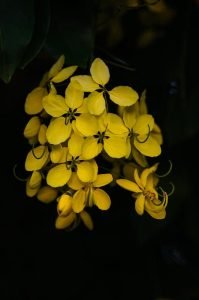
In this second when I think about the bluish green, maroon flower and the wavy lines, I am reminded of the golden thought full of bright light and a rush of sparkling trail which, if I follow, and I do follow, I reach a melodious moment, it is certainly true as I feel its charm and floating I land back, touching the soil I understand my presence and the leaves sing together a hymn of the past, I smile and feast on the warmth of this meaningless meaningful journey that quietly adores the skylark’s secret and freely shines, glad to be and not be, everything merging in this second.
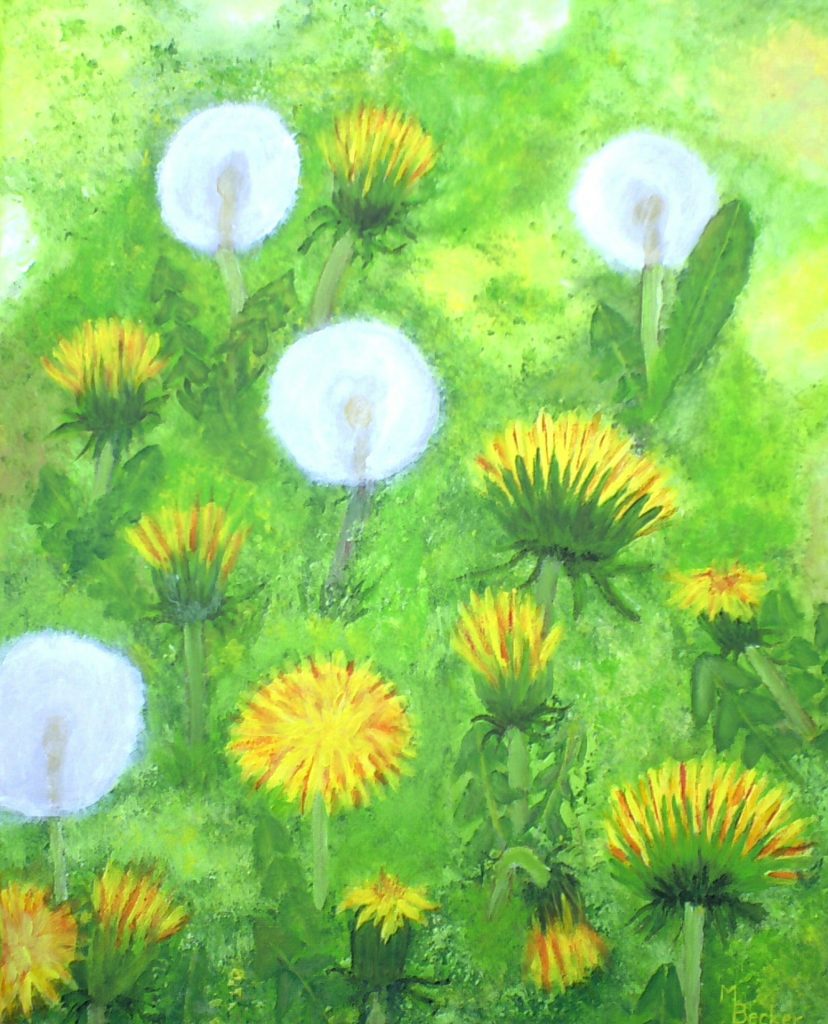
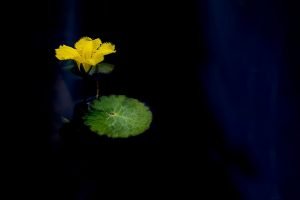
Happy dandelions with yellow friends in the sun. [Source – Pixabay]
This bright light that surrounds, that has soaked, that is soothing is one with me. This cottony soft memory is a truth. I breathe, I hear it.
A melodious tune played on the lyre flows in the air. We are all dancing to it.
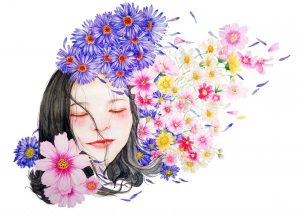
A sea of dandelions… Running as if I have wings, golden wings, I cross the sea. When did I start swirling? A gush of harmonious wind surprises me and I fall down, laughing loudly.
The dream continues every time I quietly see this bright light.
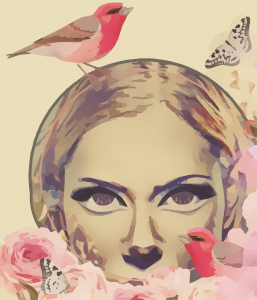
The unfinished book, a chapter in a story. Image – Pixabay.
*
Biting her nails, Ruby thought about the unfinished book. Drops on the windowpane and the cold coffee agreed that it was late. The passing crowd in the cafe didn’t bother her, she was rather pleased. Ruby forgot about time.
Sigh! Ruby looked outside the window and saw nothing, neither the woman with a red umbrella nor her brown guide dog. She was lost; god knows where her train of thought took her by then. Playing with her scarf, she picked her coffee and took a sip. Ugh! It was bad.
Time and space hit Ruby once again, she checked her watch and decided to leave, just then her eyes fell on the woman with a red umbrella; she recognised her and her brown guide dog. Ruby’s eyes revealed something.
As she watched that woman and her dog crossing the road, a part of her got up and left. Heavy eyed, Ruby saw herself through the window; she quickly crossed the road and stopped the woman. They talked animatedly for a while.
Ruby in the cafe looked longingly at the scene. The other Ruby started walking along with the woman and her guide dog. Shaking her head in disbelief, but still smiling, the Ruby in the cafe got up, paid the bill and went outside.
There she waited for a few minutes and then walked in the direction where that woman and a part of herself went.
*
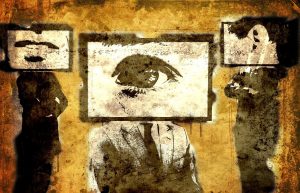
Another cup of coffee is ready, finish the unfinished book. Image – Pixabay.
Keiji comes running to his elder brother Ryoichi and tells him about the bullies. Ryoichi, a great son of a great father, stands up and assures his brother not to worry. Keiji trusts Ryoichi. They can handle the bullies, they are confident. The next morning their father walks with them half way to the school and then leaves for office. Keiji and Ryoichi, near the school gate, find the biggest boy amongst the bullies challenging them. They then look at each other, deciding with a nod what they should do. They run away and don’t attend the school that day.
Yasujiro Ozu’s ‘I Was Born But…’, a 1932 silent film, will remind you of your childhood, the challenges you faced as a child – winning some and losing some, the faith you had in someone great and the dream of becoming someone great. Children’s world comes in contact with the adult’s world. The innocent child doesn’t understand hierarchy or hypocrisy, though he understands power as he finds it in his world as well; power to not to be bullied, power to bully the bully, power to be the group leader.
How in the adult’s world dreams become unreal, fantasies die and realities are numbered, given a name, a social status and bit by bit life is compromised, is what we see in the film, but from the children’s point of view. Children are lively and so is the film. Its comical timing is fantastically perfect. Slowly with the shifts from this to that world, the tone changes, yet maintaining the rhythm throughout.
*
Keiji, Ryoichi and their father, Mr Yoshii. [Source – IMDB]
Understanding anything, anyone is a tough job, some fail to and some refuse to do it altogether. This film takes up this job and finishes it successfully, understanding the child’s dilemmas, beliefs, hopes and displeasure, understanding the adult’s demeanor and how they accept a denouement, understanding the familial ties and the need of tuning it, understanding the melodies of life and how it makes everyone laugh all the time.
An amazingly marvelous film, it must be watched by all those who want to feel the magic of cinema. ‘I Was Born But…’ is one of my favourite films of all time. It is introduced as ‘a picture book for grownups’ and rightly so. The fact that it’s a silent, black and white film doesn’t make it a difficult watch at any point rather this masterpiece flows so wonderfully that colour or sound seems redundant.
All you have to do now is to watch this film, appreciate and thank Yasujiro Ozu for making this superlative work of art.
Samira was walking briskly. Her thoughts followed her where ever she went, in shade and dust, amongst the crowd and throughout the dim alley with matted hoardings. Life in its minute detail, including the folded chit in a jeans pocket, spoke to Samira. Thoughts dappled with plaintive acceptances and mellowed retraces were highlighted.
Everything was perfectly normal when Samira turned in slow motion, her hair flying dramatically, her eyes looking for… Alas! There was nothing filmy to see, except something comic – pigeon droppings dropped on a man’s head. Samira grimaced as if she knew the pigeon or the man.
It started to drizzle. Samira smiled, almost chuckled, why, because she had an umbrella. And then came the moment – heavy, pouring rain made the pedestrians hide in shops, except a bunch of few who had an umbrella. Samira shined with a beautiful pink umbrella.
La la la laa laa, la-la la la laaaa! She was reminded of the grand music score from Chariots of fire.
But all this for a few minutes and she was back in shade and dust, amongst the crowd and on the rough road. She looked at the people around her and wondered about their life, sufferings, dreams and hopes. Gosh! In a puddle, Samira saw her gloomy face and noticed her laces. Now, just like the others, she looked for a corner and sat to tie her laces.
Umbrella on a side, down on her knees, Samira got drenched as a rusty, rickety roof pipe broke brazenly. Pedestrians saw it, ignored it and then saw it again. Sheepishly Samira got up, then acted brave till the road curved to the left. “It is over”, she said.
Samira walked, deep in conversation with herself when a little girl, a beggar, came running towards her and started to walk with her. She thought, now she will ask for some money, now she will beg, now. But the beggar smiled and said, “I just want to go till there”. Samira nodded and looked at her pink umbrella happily. The beggar giggled as her little brother joined them. Samira looked at both of them and saw the two most radiant smiles she had ever seen.
Gladly she walked with them, not thinking anything, quietly and happily. Giggles overpowered her thoughts.
Who what am I? My answer: I am the sum total of everything that went before me, of all I have been seen done, of everything done-to-me. I am everyone everything whose being-in-the-world affected was affected by mine. I am anything that happens after I’ve gone which would not have happened if I had not come. Nor am I particularly exceptional in this matter; each ‘I’, every one of the now-six-hundred-million-plus of us, contains a similar multitude. I repeat for the last time: to understand me, you’ll have to swallow a world.
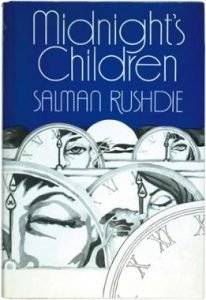
A deluge of emotions, of past eras, of destined ends, of old knots, of shared hopes, of what is remembered and forgotten, of the less and the more,Midnight’s Children is a fantastically chronicled piece of magnificent writing.
It’s indeed like swallowing a whole world, with all its shades very much alive, which then settles and dwells within.
Nothing is left unnoticed, not even the dust, which covers everything, every surface, smooth or quiet, elegant or wasted; a glance that speaks volumes in seconds, a sweet fragrance that reminds of childhood holidays, a dream that knows no boundaries, a feeling of connection with history, with past present and future, an immortal bond, no, nothing is missed out.
Or is there? If it is then this makes it nothing but more human. From the very beginning, it’s not a book, but Saleem Sinai, the person that you get to know closely, brazenly, truly.
Midnight’s Children is as magical as reality is and as real as history tells magic is and historical in a magically real manner that truly shows the reality as magically as possible keeping in mind and yet breaking the rules of history.
Indian folklore, the oral tradition allow one to fully believe in this midnight’s magical tale. Born in a momentous time period, Saleem’s future gets tied to his country, to history.
And right here, we get ready for, by default, a dramatic turn of events – it is all implausible, but nothing that our Mahabharata and Ramayana aware mind cannot follow. An epic journey heightened by allegorical twists and unprecedented turns is delightfully accepted by us.
Midnight’s Children is surely a unique experience that could be matched only if you meet Rani of Cooch Naheen holding a silver spittoon, inlaid with lapis lazuli, who then asks you to try the paan-eating and spittoon-hittery or if you get a chance to talk to any of the midnight’s children or if you hear Jamila Singer singing or of course, if lucky, you meet the Buddha.
I have a second-hand print of Midnight’s Children that my brother bought in Kolkata; it has the appearance of a lone traveller, with a green tin trunk, that now wants to tell the tale of its travels. I’ll keep returning to it, for it is magical.
With Midnight’s Children, the Booker of Bookers’ prize winner (1993), said the critic VS Pritchett in the New Yorker, “India has produced a great novelist… a master of perpetual storytelling.” Absolutely true!
On this Independence Day, I think of the magnificent Salman Rushdie and the wonderful Midnight’s Children and that why Salman Rushdie faced life threats and had to leave India and settle abroad…
For how long will the celebrations of Independence go on? After the freedom from British Raj, what about the freedom from inequality? Inequality, thanks to the establishment, has been established everywhere in the world – the black versus the white, the book versus the idol, the rich versus the poor with the middle ones playing seesaw – still it doesn’t mean that it should continue.
Respected Salman Rushdie Sir, you, writing in a foreign land is far better than you in India in doubt. The fantasy and macabre lovers that we earthlings are, stories will alone survive; it is definitely the most needed art form in every century.
Your stories, much-awaited, have and will cross boundaries that physically might not be possible for you.
Thank you in general. And if you happen to meet the Midnight’s Children anytime soon, please ask them to do some abracadabra.
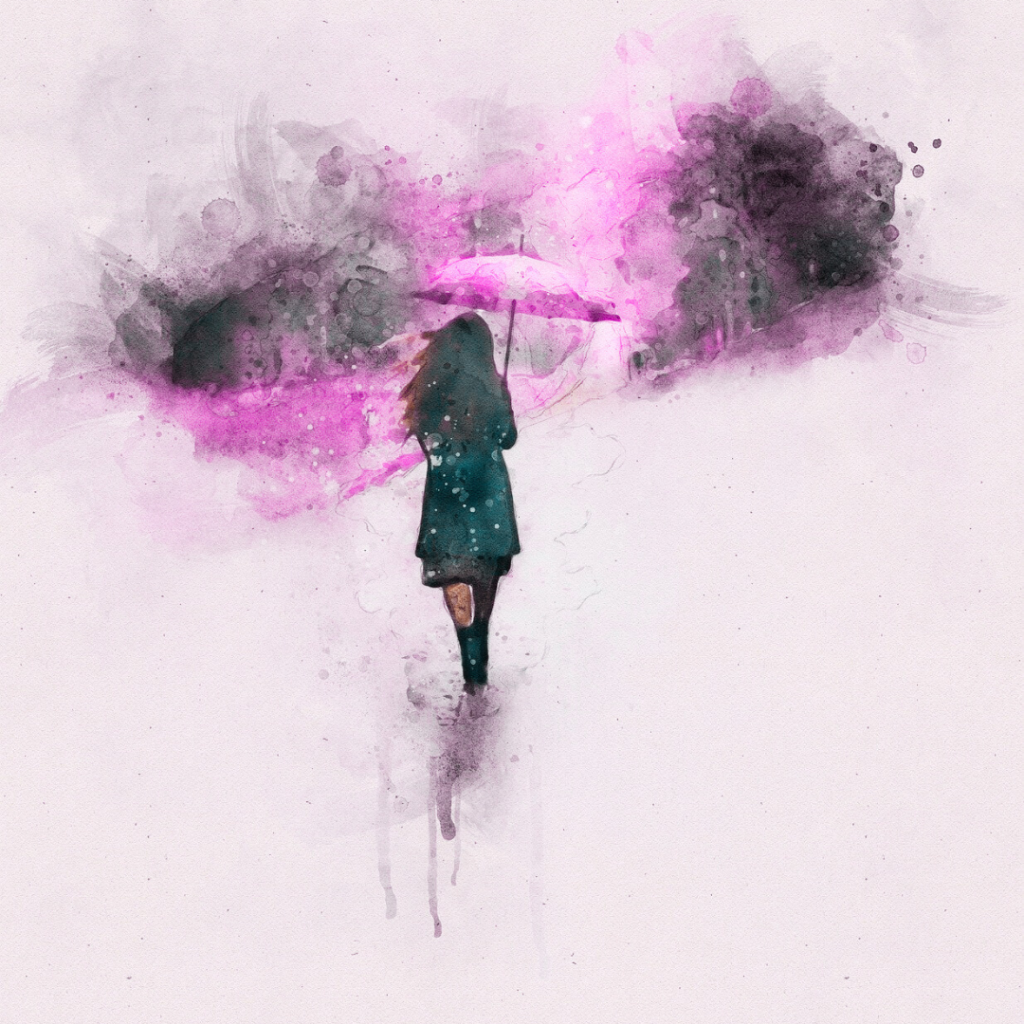
My funky umbrella that I forgot in a bus and so I had to buy a silly raincoat. [Source – Pixabay]
*
It’s a foggy day and I am walking to somewhere all alone, carrying a green umbrella pendulum-like. Rain shower won’t stop me. The blinding whiteness won’t scare me. I check my watch, it assures me time is good.
Hearing footsteps following me, I try to hasten, only then I realise it is no one, but me. These gumboots I tell you. It is all very funny, but still I cannot take a chance to laugh aloud.
Never knew the fog could trick. The fresh green plants and giant trees that till now looked painting-like, now seem spooky.
Suddenly I hear fresh footsteps running from a direction towards me. Numbly I tell myself don’t move, still I turn and find someone in a funny raincoat running towards me.
Then a voice, “Smarty pants, give me back my umbrella, don’t want this silly raincoat of yours’. It is my friend Marcia. I smile and say, “But you look good in it.”
We fight and then laughing aloud walk ahead together.
I am joy running free/
freely flying, fluttering, soaring in a valley/
Of joy am running free.
Greetings!
A storyteller, following the ancient tradition of cave chroniclers, standing in vrikshasana (the tree pose) on a hill top (it is sunny, but windy), breathing in and out stories (relishing it all, but at times overwhelmed), declares animatedly that she will continue to – tell stories, share rare story gems, and connect with the pacy universe while also keeping the website ad-free.
Big thanks to my readers. Stay tuned!
Also, a humble request to the new subscribers to check the spam folder after subscribing. Silly (but necessary) confirmation emails often land there instead of the bright inboxes. Merci!
Ya-hoy!
Chiming Stories (formerly Home Chimes)
P.S – Supporting a storyteller is good for the world’s health (and undoubtedly, for the storyteller’s health as well). Shower some love by sharing, commenting and subscribing to the Weekly Newsletter.
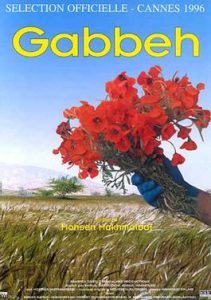
Gabbeh, the 1996 film, is a simple tale of a gipsy girl, her clan and the way their life goes on. Unfolding beautifully just like an artist painting a canvas, Gabbeh quietly touches the grand questions.
Ranked as one of the greatest British films of all time, The Lavender Hill Mob confides in the audience, letting them see, feel, laugh and think without tickling persuasively with a joke here and a punch-line there.
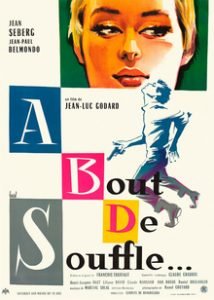
Godard… Breathless and Alive
A Tribute to Jean-Luc Godard, the Film Philologist who Reinvented Cinema.
Yes fly! For walking on the second track is dull and usual, but dreaming high, high, high requires tools. Tools like the right pair of shoes, a chirpy, gritty soul that eats butter-jam dreams, a soul that drinks milky-milky creams.
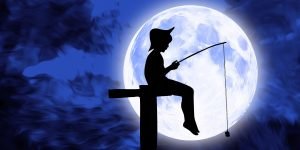
Silver cascade shimmering the night sky, music to the waves and surreal beauty to the eyes, the Moon loves the art of discipline.
It may be difficult to believe for the Moon’s splendour defies time, it stupefies the clock, it follows the path of a dreamer, but how could this be possible if the Moon knew not discipline?
In this moment, I am a little bit of this and a little bit of that, I am complete and incomplete, I am pleased and uncertain, I wish for nothing and I know I have to wait.
Because the distance covered reminds me of the hurdles I have crossed and the ones I could not, it reminds me of a throbbing past and a dreamy future and it reminds me of how much time is left.
Meredith and the Green Lake
Illimitable Splendour
A joy so complete without any rise or fall, so free without any time corners, so real without true being false, false being true.