Jane in her simple jade dress stood out in that mahogany room. The splendour surrounding her could not match the spark in her eyes, knowing this the chandelier, humbled, dimmed its light.
Jane in her efforts to live freely always broke barriers and always lived freely. The shackles, when not shown any fear of, never dared to grab the fire named Jane Eyre.
She walked towards the window and half opened it; the gushing wind reminded her of a folk tale, of the times when a princess stared at the moon through a half open window, shared a secret and smiled. Jane Eyre could not help but smile then.
*
Title page of the first Jane Eyre edition. [Source – Wikimedia Commons]
Charlotte Bronte’s Jane Eyre is a marvellous, striking Victorian novel which was originally published under a pseudonym ‘Currer Bell’. Many female writers in that era opted for a pen name, occasionally for anonymity, but mostly for their work to get a wider audience (if it is accepted for publication at all).
*
We do not know who ‘Currer Bell’ might be, but his name will stand very high in literature.
The Weekly Chronicle
While all the reviewers praised the powerful story and imagination of the author, no one expected it to be a woman.
*
Charlotte Bronte, portrait by George Richmond. [Source – Wikimedia Commons]
One great merit of the work unquestionably is its originality. The author deserves no slight credit for the ingenuity and success with which fact and fiction, reality and romance, have been intermingled and made to serve conjointly in maintaining deep and unflagging interest.
Morning Advertiser
*
Have you lived the life of Jane Eyre? If not, then you must.
Raj Kapoor, the showman of Hindi cinema, has given dozens of super hits as an actor, a director and a producer. What made it possible, other than his brilliant performing skills, is the richness of the story, good quality of screenplays and earnestly written dialogues in the majority of his films.
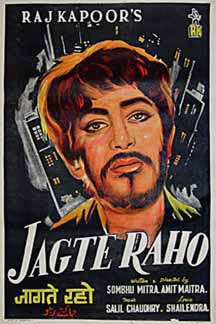
One such film is Jagte Raho (Stay Awake), written and directed by the legendry Sombhu Mitra, along with Amit Maitra and screenplay by Khwaja Ahmad Abbas.
A social satire, this 1956 film is about a poor villager – we meet Raj Kapoor in his famous Chaplinesque avatar, though in a dhoti this time – who comes to the city with the hope of making a better life. The story unveils in real-time i.e. in a single night’s time when the protagonist feeling thirsty enters an apartment block and is simply presumed to be a thief. Thus, begins the epic cat and mouse chase where not one but many thieves are caught apart from the protagonist, who is reminded by a little girl that if he is not the thief then he should not worry at all. The poor villager then leaves the building and the chaos behind and meets Nargis (guest appearance) in a temple who finally gives him water to drink.
Setting the Tone and Foreshadowing
Without wasting a second, the tone of the film is set – it is night time in the city and the watchmen are roaming the streets shouting ‘jagte raho, jagte raho!’ Who are they asking to stay awake… themselves, the residents, the thieves or the viewers? Perhaps the message is for all.
We then meet the protagonist who is searching for some water to drink. When a watchman finds him kneeling against a fire hydrant, he rebukes and pushes him down, calling him ‘Chotta kahin ka’ (petty thief) going just by his shabby look and threatens him of dire consequences if he saw him there again. This is foreshadowing i.e. what is going to happen later on in the story is subtly hinted right in the beginning – the poor villager is going to be framed as a thief.
The First Song
With roughly seven minutes into the film we are presented with the first song. A drunkard (played by Motilal), lost in his world, sings these sarcastic lines –
“Zindagi Khawab Hai, Khawab Me Jhuth Kya Aur Bhala Sach Hai Kya… Sab Sach Hai.”
Translation – Life is a dream, in a dream what is a lie and what is a truth… everything is a truth.
Songs in Hindi films are different from the Western Musicals, for it does not only elevate the emotion of the scene, but takes the story forward in every possible way – introducing new characters, hinting of what is approaching, adding to the underlying theme of the story.
Here, the drunkard returns in the story, not able to distinguish between a man and a container, between his wife and the poor villager. Thus, touching the theme of the story – the elite ‘dressed in silk’ are either busy drinking or hoarding money, while the poor ‘a tramp’ is crushed even if he asks just for some water.
Jagte Raho’s hit music is given by Salil Choudhary and the lyrics are written by Shailendra and Prem Dhawan.
The Conflict
The main conflict in Jagte Raho is between the honest and the fraudster, between the poor villager and the hypocritical lot. The protagonist stumbles upon the secret world of the civilized city men complexing the conflicting situation further.
His first few encounters occur with the young lovers, the gambler who tries to steal his own wife’s jewellery and the drunkard; these situations are comic as wells as sensitive, highlighting the predicaments of the so-called upper class.
The movie then takes a dramatic turn as the Police are called for an investigation. A journalist, disappointed on finding that the information about the dacoits is false, has to make do with a resident’s photograph who is arrested for brewing liquor illegally in his apartment. This causes a silent alarm bell to ring for many residents; a Punjabi song highlights this beautifully –
“Oye aiwe duniya dewe duhai/ jhootha pondi shor/ te apne dil to pooch ke vekho/ kaun nahi hai chor/ te ki mein jhooth bolya, koi na…”
Translation – The world appeals for no reason, the liar makes a hue and cry. Why don’t you ask your heart, who is not a thief! Hey, have I lied? No!
The poor villager finally meets the biggest thug of all, a foreign return business man who mints fake money with help of a few others; when the thug finds out that the villager knows all about him, he first tries to kill him, but with the residents knocking on his door, he quickly fills the villager’s pockets with all the fake money and pushes him out through the window.
Hanging to a pipe, the poor villager is attacked by the entire society with stones until he empties his pockets and showers the crowd with the fake money; the residents immediately forget the poor villager and fight amongst themselves to collect the notes.
Culmination
The climax holds its intensity till the last scene, though the verbose speech by the poor villager on the terrace mars the impact of the silence he maintained until then. Scenes like juxtaposing the image of Christ to the bleeding poor villager adds to the melodrama.
A little girl is rightly chosen by the writer for speaking the truth as children rarely hesitate from doing so. The poor villager realises the truth and then looking fearless, he walks out; neither the Police nor the residents notice him; the situation is frantic as all the criminals in the building are getting arrested one by one.
It is early morning now and he finds a lady singing in a temple –
Translation – Wake up dear Mohan, a new day is here to welcome you.
The film ends here as the lady gives the poor villager water to drink.
Writing Style
Jagte Raho is not a hard core mystery or a thriller yet it endeavors to keep the viewer throughout on the edge. Following the linear structure, each scene has a micro story that is disrupted by the protagonist for he unknowingly strips the ones who are masked.
Though an off-beat topic was selected by the RK Productions, it was made sure that this film is liked by the masses; hence, the script is full of slapstick comedy, songs and dramatic visuals.
Theme
The theme of Jagte Raho is jagte raho; the makers are warning all to stay awake for the real criminal lurks within every individual, who waits just for an opportunity to overpower you. In the film, the poor villager tries to steal the counterfeit money, but his consciousness jolts him and he does not take the money. His consciousness is in contrast to the collective consciousness of the public.
Conclusion
While a satire, Jagte Raho chooses only partially the realistic approach to narrate its story. In fact, the majority of the characters, including the protagonist, are clichéd and some even come across as frivolous and yet, as a whole, the film engages and entertains. And so, keeping in mind the era in which it was made, this film stays to be a good study for a screenplay writer.
The flowers are ambitious by nature. Image by Marisa04 from Pixabay
Gori knows not where the path leads to, the wet air, the dusky flora, and the mysterious tunes do not guide either.
Soaking in the newness she walks forward.
And why is it that we always choose to walk ahead, why does not the uncertainty collapse us?
If we stop to rest, if we feel defeated, if we turn back embarrassed and ashamed, we still reach, in some time, at the glorious hour of a beginning.
The tired, wounded, and sullen eyes once again look up, once again fathom the depth, once again find the path.
Taking the rope bridge, climbing the echoing mountains, crossing the glassy rainbows, Gori saw that valley where her loved one awaited her.
The gush of wind cheered her, the dew heavy leaves blessed her, the clouds played the drums for her.
And why does it seem that the whole world dances when we dance and the whole world moans when we moan?
How come we hear the call when there is a concrete silence around us, when facts dispel hope and when dejection raises a toast?
In anger the head is alone, when rejoicing the heart holds it all.
The illusion rudely reveals the reality and Gori faces the brazen cold marshland.
What happened to the beautiful valley, to the lover’s promise, to the perfect dream? Hush! The monster rises, its shadow darkens Gori’s faith.
Thundering sky strikes with lightening that Gori catches with her bare hands. Heaving, she runs towards the monster.
Why is life so epic, so grand, so ambitious? Why do the storytellers talk about ‘once upon a time’?
If the legends appear amused by the mundane, then how many of us are at folly for it is the ordinary that becomes extraordinary?
The tales have never ceased to be melodious, we live perpetually enchanted.
Gori starts walking, leaving behind the triumphant air, gravity shining on her forehead.
She resumes the journey as a narrow track becomes visible to her now, a solo night jasmine tree on the way, showers her with its flowers, Gori takes its fragrance along.
Gori knows not where the path leads to, soaking in the passionate silence she walks forward.
Are the night jasmines very ambitious to wait for and shower a victorious warrior and not anyone else? Yes, they are.
A voice narrates – “7th September 1980, a party from Calcutta, a film troupe is going to a village for shooting. The name of the village is Hatui. The name of the film is Aakaler Shandhane.”
The opening credits roll as we, along with the film troupe in cars, enter the village lane noticing the green fields, blue sky, rough road, dirt and poor villagers who are in full contrast to the vivacity of the song sung by the troupe. This is highlighted by the very first dialogue of the film by a character, a random villager standing on the roadside –
“The gentlemen are here for taking snaps of the famine… but the famine has enveloped us all.”
*
A story within a story, Aakaler Shandhane (1982), is a poignant portrayal of reality and our perception of it. The director (played by Dhritiman Chatterjee) knows and believes in his story, he is determined, his research is complete, he has photographs of the Bengal famine of 1943, of a mini famine in 1959, of 1971 – he says, “remember the Bangladesh war”; he thinks that is what one needs to make a film on Bengal famine.
But the director is absolutely ignorant about 1980, the present time, his time, and so when the Hatui village reveals the crippling similarities between the famine year and the present, the director feels at his wits’ end. He does then what is suggested to him – to leave and complete the film in a studio – for the ‘famine-stricken’ village could no longer entertain any of them.
*
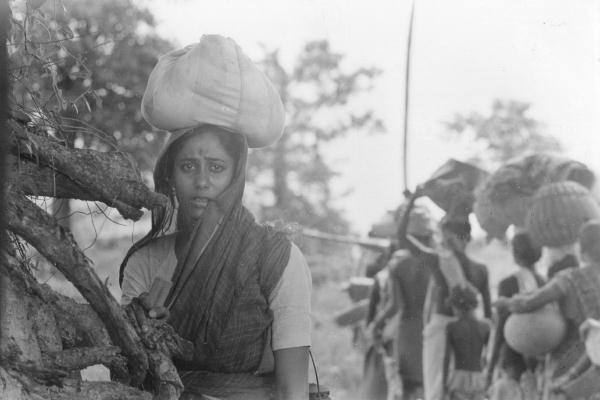
A still from the film; Smita Patil as a village woman. [Source – mrinalsen.org]
Smita Patil plays the role of a village woman, a wife married to a stubborn husband, who will die, but not bow down; this wife, for the sake of her little baby, accepts the famine, accepts exploitation, accepts filth and brings home a handful of rice and oil to prepare a meal in her dusty kitchen.
The husband goes mad with anger and picks up the little baby, ready to kill his own child for it unknowingly became the cause of bringing blasphemy to their household; Smita shouts and so does Durga. The director says “CUT”. Durga, a villager, standing in the crowd could not bear the pain, afraid for the child she shouted unaware of the camera and the art of acting. Every eye then stares at her, she hides her moist eyes and leaves.
*
Durga lives in the 80s, but finds a resemblance with Smita Patil’s character of the 40s – and why would not she, their lives resonate with gloom, caused by famine and its aftermath. Both are suffering, both have a child to feed, a husband to serve, a famine that torments and a society that reminds of it forever.
Quiet like a candle, Durga becomes a flambeau in the end; burning with rage she asks her incompetent husband what is wrong if the director offered her a role in the film, what is wrong if the role is of a prostitute. She tells him that when a lady, in those ugly famine days, can step out the confines of her house, why cannot she?
The old village schoolmaster asks the same question from all the respectable men of the village, reminding them about their ancestors who were as opportunistic as the film’s womanising contractor.
*
It becomes clear that the famine of 1943 was not just about starvation or five million deaths, it was also about what humans are and what humans can become in trying situations; and that hunger alone did not kill, corrupt minds and hollow traditions killed too… are still killing.
And the most affected were the poor, the weak… the females – they lost their children, their families, their lands and themselves. The director’s attempt to cast a villager for the role of a girl, who is forced to become a prostitute, creates chaos so profound that in no time the whole village starts detesting the entire troupe, no one comes to help, no fans, nothing. What else will a film dealing with the topic of famine bring, but cursed memories of the past? The villager who spoke the first dialogue of the film now comments –
“The gentlemen have created a famine after coming to make a film on famine.”
*
But what about the elite… they are now long extinct. The palace in which the film troupe settles is almost in ruins. There lives a couple – a lady and her bedridden husband – the relatives of the king. While the rest of the inhabitants have left the luxuries of this palace and shifted to the cities, the presence of this couple is also but a mere illusion of the past. When the bed-ridden husband dies, the lady aptly says that everything is over.
Twice there are talks about the photographs of the famine, on one occasion a game is played – one is to guess by looking at the pictures to which period it belongs. When Smita Patil shows a picture that is completely dark, a character says it is the photo of ‘load shedding… power crises’ and everyone laughs, then another gives it a poetic touch and calls it ‘darkness at noon’ and then finally Smita Patil gives it the title ‘past, present and future’; none of them thought that this darkness will eventually force them to abandon the film shoot and leave.
Into this darkness we see Durga fading away at the very end; the narrator tells us that her frail little child died after some time, her husband fled away and Durga was left all alone.
*
The story structure, which is subtly linear, seamlessly integrates the characters with the plot highlighting the contrast between the film troupe’s “idea of famine” and the actual impact of the many famines still reverberating in the village.
The First Plot Point and the Second Plot Point appear visually the same i.e. both are the scenes where the photographs of the famine are shown and talked about; the former is where the director, confident about his research, is showing his actors the photographs of 1943 famine and telling how while the World War II struck the rest of the world, in their land “people just starved and dropped dead”, in the latter scene, they play a guessing game – “to which famine does the photograph belong”. In both the scenes, the horridness of the famine photographs is seen in stark contrast to the amusement of the film troupe.
The story takes a turn, naturally so, after both these plot points, taking the troupe and the audience closer to the seriousness that the reality of famine holds. In the climax we see that the entire village opposes and loathes the film troupe, the main characters find themselves completely defeated, and neither the modern nor the rural people are able to do anything about the famine that stared at them.
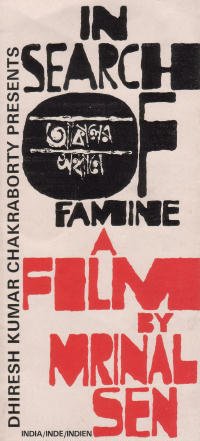
The original brochure of the film. [Source – mrinalsen.org]
This masterpiece by Mirnal Sen won National Awards for Best Feature Film, Best Direction, Best Screenplay and Best Editing; it also won Silver Bear, Special Jury Award at 31st Berlin International Film Festival.
Aakaler Shandhane(In Search of Famine), searched for an answer, an answer that is still due.
Golden, glowing and emitting exuberance, vigour and vibrancy, the dynamic, ceaseless dance of fire, the Sun has mastered the art of discipline.
It has attained absolute freedom for nothing else can explain the mystical, marvellous zeal it possesses and the pizzazz it flaunts so calmly, so brilliantly.
The Sun enthrals us wholly, it rules all life forms; in its magnificence, it conducts the solar system without a baton.
147.19 Million kilometres away from the Sun I feel its warmth, I feel home, I feel alive.
Silver cascade shimmering the night sky, music to the waves and surreal beauty to the eyes, the Moon loves the art of discipline.
It may be difficult to believe for the Moon’s splendour defies time, it stupefies the clock, it follows the path of a dreamer, but how could this be possible if the Moon knew not discipline?
Think for yourself, it never fails to heal a sad heart and rejoice with a happy soul, it never leaves one alone, it moves with the one walking, it blinks at the dreamy one, it soars with the child allowing the little hands to embrace it.
The Moon’s discipline is unique for it never minds the clouds, the rain, the darkness; it shines serenely, reigning in power and peace. Divine o divine!
What is this magic? This Universe, this miracle… it is disciplined to invite life, to hold the infinite, to make the ending light and the beginning bright.
This Universe, it sings and plays rhythms that touch every element quiet and sentient both; it is a rainbow of colours that paints with accuracy and fun alike.
The Universe runs the art of discipline, it gloriously celebrates the art of discipline, for what else are the galaxies going round and round, round and round… for why the invisible cells in a body are forming a life…
The macro and the micro worlds imbibe the Universe’s joy and freedom, which is nothing but the art of discipline.
Mother India (1957), a benchmark in Hindi film industry, glorifies our country, which had then seen just 10 years of independence; it celebrates the Indian women – a daughter, sister, lover, wife, mother, an individual and the goddess; and in the most dramatic, impactful manner it presents the magic of cinema.
This epic film is written by Wajahat Mirza (who also wrote the dialogues for Mughal-e-Azam), S. Ali Raza (who wrote films like Aan and Andaz) and Mehboob Khan (the director). It was a remake of Mehboob Khan’s film titled Aurat (1940), based on the story by Babubhai Mehta, to which he profusely added a strong sense of nationalism – like in the song ‘Dukh Bhare Din Beete Re’ we see an outline map of India literally drawn on the land using haystacks, with people inside, waving joyously and Radha, along with her two sons, standing at the centre on a pedestal, with sickles in hands.
Though 172 minutes long, with a total of 12 songs (by Naushad; lyrics by Shakeel Badayuni), Mother India has a very well written, crisp screenplay. It begins with the protagonist, Radha, an old lady, considered as the mother of the entire village, taking the audience into a flashback, as if saying, ‘come, listen to my story’.
We see now a younger, beautiful Radha who marries Shamu. At first, she comes across as a shy and subservient bride, her husband being her lord, but wait until Radha hears about the loan that Shamu’s mother took from the devious moneylender, Sukhi Lala, right then Radha confidently offers her jewellery, her gold bangles to pay off this debt.
The tussle between a family in debt and a corrupt loan shark, between Radha’s values and absolute degradation of every moral standard, only intensifies as the story moves ahead. Radha’s family grows, their needs increases, but so does Sukhi Lala’s interference and with Panchayat’s support he declares his right on Shamu’s farm and its produce.
Birju, Radha’s second son, is a rebel right from the beginning – he wants his farm and Radha’s gold bangles back at any cost. Foreshadowing this, Birju troubles Sukhi Lala as a kid, not ready to give him the harvest, calling him a thief and grows up to become Sukhi Lala’s doom.
The tight plot doesn’t give respite to the viewer for Radha has not one but many battles to win; Shamu’s arms are crushed in an accident, humiliated by Sukhi Lala for living on his wife’s mercy, he leaves Radha and their four kids forever; after passing away of her mother-in-law, Radha faces natural disasters – flood and storm hits her land and takes away her two youngest kids.
With only Ramu and Birju as her family now, defeated, she goes to Sukhi Lala and begs him for a morsel of bread. In this highly dramatic sequence, Radha, who had decided to compromise, eventually doesn’t allow Sukhi Lala to violate her; she has a dialogue with the goddess Laxmi –
“Devi, Radha k roop mein aate hue laaj na aayi… mere roop mein aayi ho to apni laaj lut-te hue bhi dekh lo… hanso nahi… hanso nahi… sansar ka bhaar utha logi Devi, mamta ka bojh na uthaya jayega… Maa bankar dekho, tumhare panv bhi dadmaga jayenge…”
(Translation – Goddess now that you have come in my avatar, witness how you are dishonoured. Don’t laugh! It is easy to nurture the whole world and truly difficult to be a mother, try being one, even you’ll falter.)
Radha looks weak at first – like the mother who is expected to sacrifice and is thusly, worshipped – but after talking to the goddess within her, she remembers her individual self; Radha stands up, crushes the evil and soars like a phoenix.
She raises her kids into fine young men; she gets Ramu, a man of principle, married, but worries for Birju, the stubborn son. Once again foreshadowing is used here – Radha warns Birju not to trouble any girl or else she won’t spare him, in fact, after the Holi sequence when Birju tries to get Radha’s bangles back from Rupa (Sukhi Lala’s only daughter) and the whole village beat up Birju for being so insolent, then Radha promises the entire village to punish Birju herself, kill him if need be.
Bloodthirsty, Birju joins some dacoits, kills Sukhi Lala and abducts Rupa. When Radha tries to stop him, with a rifle in her hands, Birju doesn’t listen, sure that his mother can’t harm him; Radha shoots him down – Birju dies in Radha’s arms after giving her the gold bangles.
Here the flashback ends; Radha opens the gate of the irrigation canal, allowing the muddy reddish water to flow in the fields, symbolizing bloodshed that she and the whole nation had witnessed for freedom.
Every scene, every dialogue, every song makes this film nothing less than an epic poem. The three love stories, in its limited space, bloom beautifully – Ramu and Champa represent ‘love’ that triumphs; Birju and Chandra, both opposite in nature, represent unfulfilled love; Radha and Shamu, unite to face separation forever, represent ‘love’ that sacrifices.
Throughout the film, the characters stick to their traits and yet, each character grows. Ramu fights Birju to protect Rupa in the end; Sukhi Lala begs Radha to save his daughter, but still doesn’t say a word about the debt; Birju leaves the village to become a dacoit, hitting his mother when she tries to stop him; and Radha, a mother becomes Radha, a woman and sacrifices her son for a girl’s honour. That is why these characters are still remembered, they repeat their traits, their flaws, just like we all do.
A 21st-century screenwriter could be reluctant to accept Mother India’s melodramatic approach, but what cannot be resisted is its great storyline, life-like characters and true representation of Hindi cinema.
I stopped then on the road, don’t know why exactly, my mind blank and my eyes fixed on the ground. I couldn’t move.
What was I hoping for? To see a rainbow? By looking down?
The wind swam past me and I heard it quickly whisper something, I didn’t get the message. Split seconds passed, then I finally looked up and straight.
Before I could realise, I had crossed the road and now was walking on an old worn out footpath. Grey surroundings didn’t overwhelm me, how could it? But a marigold did, how couldn’t it?
Marigold standing alone with yellow, orange, red coloured joys looked real. I became the part of the background and the marigold became the centre.
I was jealous, why did I take this journey?
The sun rays fell on the chosen one and the Marigold shone bright, beamed its joy. It communicated to me, but how… why?
I smiled for no reason. Marigold nodded at me and I foolishly raised my hand to say ‘hello’.
Fool I made of myself, and still I liked that feeling. In that shared moment I changed.
I am joy running free/
freely flying, fluttering, soaring in a valley/
Of joy am running free.
Greetings!
A storyteller, following the ancient tradition of cave chroniclers, standing in vrikshasana (the tree pose) on a hill top (it is sunny, but windy), breathing in and out stories (relishing it all, but at times overwhelmed), declares animatedly that she will continue to – tell stories, share rare story gems, and connect with the pacy universe while also keeping the website ad-free.
Big thanks to my readers. Stay tuned!
Also, a humble request to the new subscribers to check the spam folder after subscribing. Silly (but necessary) confirmation emails often land there instead of the bright inboxes. Merci!
Ya-hoy!
Chiming Stories (formerly Home Chimes)
P.S – Supporting a storyteller is good for the world’s health (and undoubtedly, for the storyteller’s health as well). Shower some love by sharing, commenting and subscribing to the Weekly Newsletter.
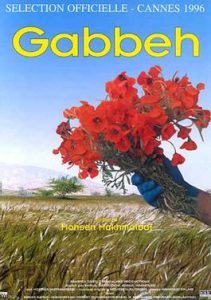
Gabbeh, the 1996 film, is a simple tale of a gipsy girl, her clan and the way their life goes on. Unfolding beautifully just like an artist painting a canvas, Gabbeh quietly touches the grand questions.
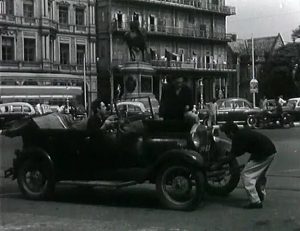
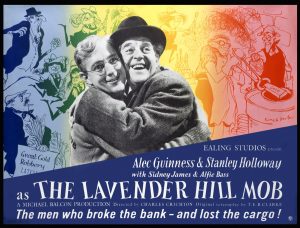
Ranked as one of the greatest British films of all time, The Lavender Hill Mob confides in the audience, letting them see, feel, laugh and think without tickling persuasively with a joke here and a punch-line there.
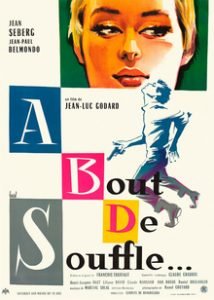
Godard… Breathless and Alive
A Tribute to Jean-Luc Godard, the Film Philologist who Reinvented Cinema.
Yes fly! For walking on the second track is dull and usual, but dreaming high, high, high requires tools. Tools like the right pair of shoes, a chirpy, gritty soul that eats butter-jam dreams, a soul that drinks milky-milky creams.
Silver cascade shimmering the night sky, music to the waves and surreal beauty to the eyes, the Moon loves the art of discipline.
It may be difficult to believe for the Moon’s splendour defies time, it stupefies the clock, it follows the path of a dreamer, but how could this be possible if the Moon knew not discipline?
In this moment, I am a little bit of this and a little bit of that, I am complete and incomplete, I am pleased and uncertain, I wish for nothing and I know I have to wait.
Because the distance covered reminds me of the hurdles I have crossed and the ones I could not, it reminds me of a throbbing past and a dreamy future and it reminds me of how much time is left.
Meredith and the Green Lake
Illimitable Splendour
A joy so complete without any rise or fall, so free without any time corners, so real without true being false, false being true.